Tremors and Shakiness from Prescription Drugs: What You Need to Know and How to Fix It
Medication Tremor Risk Calculator
Enter Your Current Medications
List the prescription drugs you're currently taking. This tool will assess your risk of drug-induced tremors.
Medication Risks
Next Steps
Continue monitoring your symptoms. If tremors worsen, consult your doctor.
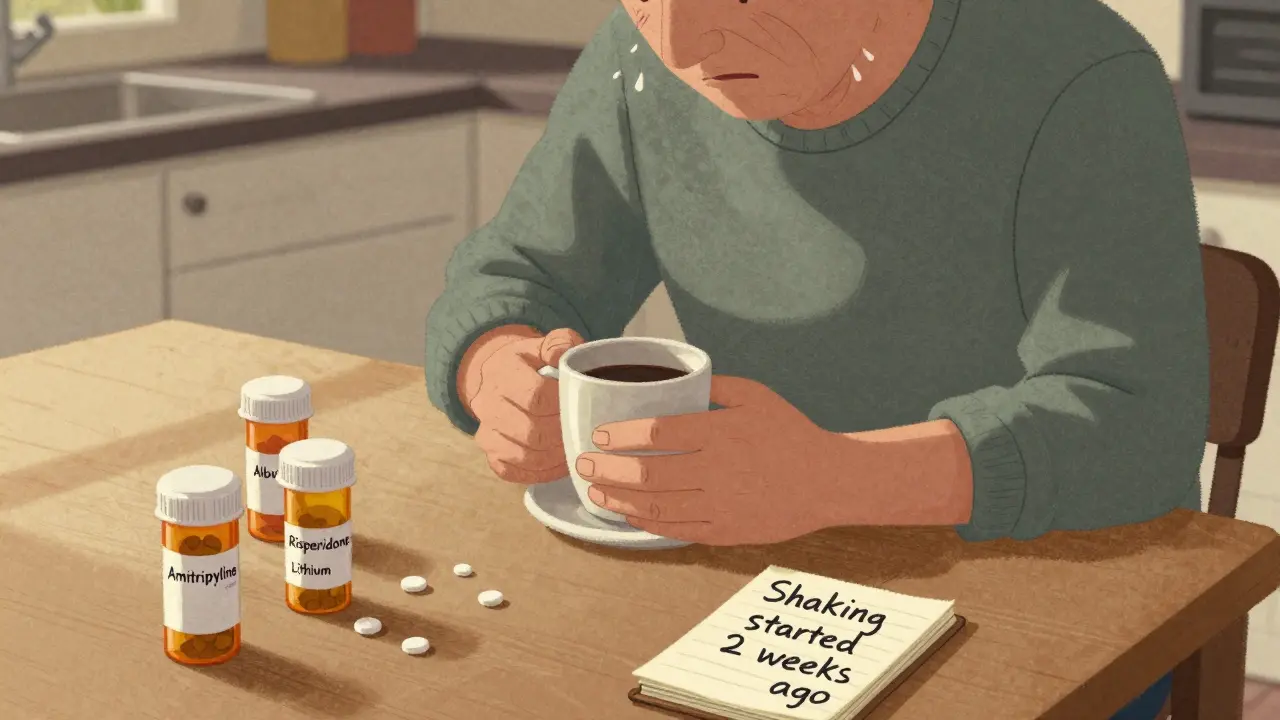
Have you started a new medication and suddenly noticed your hands shaking? Maybe your coffee cup rattles when you try to hold it still, or your voice wobbles when you speak. You’re not imagining it. This isn’t just nerves - it could be drug-induced tremors, a common and often misunderstood side effect of many prescription drugs.
Unlike the slow, resting tremors of Parkinson’s disease, drug-induced tremors happen when you’re trying to do something - holding your arm out, writing, or even just sitting still. They’re rhythmic, usually between 6 and 12 shakes per second, and they disappear when you’re asleep. The good news? In most cases, they go away completely once you stop or switch the medication causing them.
Which Medications Cause Tremors?
It’s not just one drug. Over 100 commonly prescribed medications can trigger tremors. The biggest culprits fall into a few key categories:
- Antidepressants - Especially tricyclics like amitriptyline and certain SSRIs like paroxetine (Paxil), fluvoxamine (Luvox), and clomipramine (Anafranil). These are responsible for nearly a quarter of all drug-induced tremors.
- Antipsychotics - Medications like risperidone (Risperdal) and haloperidol can cause tremors in 5-30% of users. In some cases, they trigger full Parkinsonian symptoms - stiffness, slow movement, and shakiness - which can be mistaken for Parkinson’s disease.
- Heart medications - Amiodarone, used for irregular heart rhythms, is one of the most frequent offenders, linked to 15% of reported tremor cases.
- Lithium - Used for bipolar disorder, lithium causes tremors in almost 20% of patients, especially when blood levels go above 0.8 mmol/L.
- Asthma inhalers - Albuterol and similar bronchodilators can shake your hands, even at normal doses.
- Thyroid meds - Too much levothyroxine can mimic anxiety symptoms, including tremors and rapid heartbeat.
Here’s the reality: if you’re taking five or more medications, your chance of developing tremors jumps to 34%. That’s not rare - it’s a growing problem, especially among older adults managing multiple conditions.
How to Tell If It’s the Drug - Not Parkinson’s or Essential Tremor
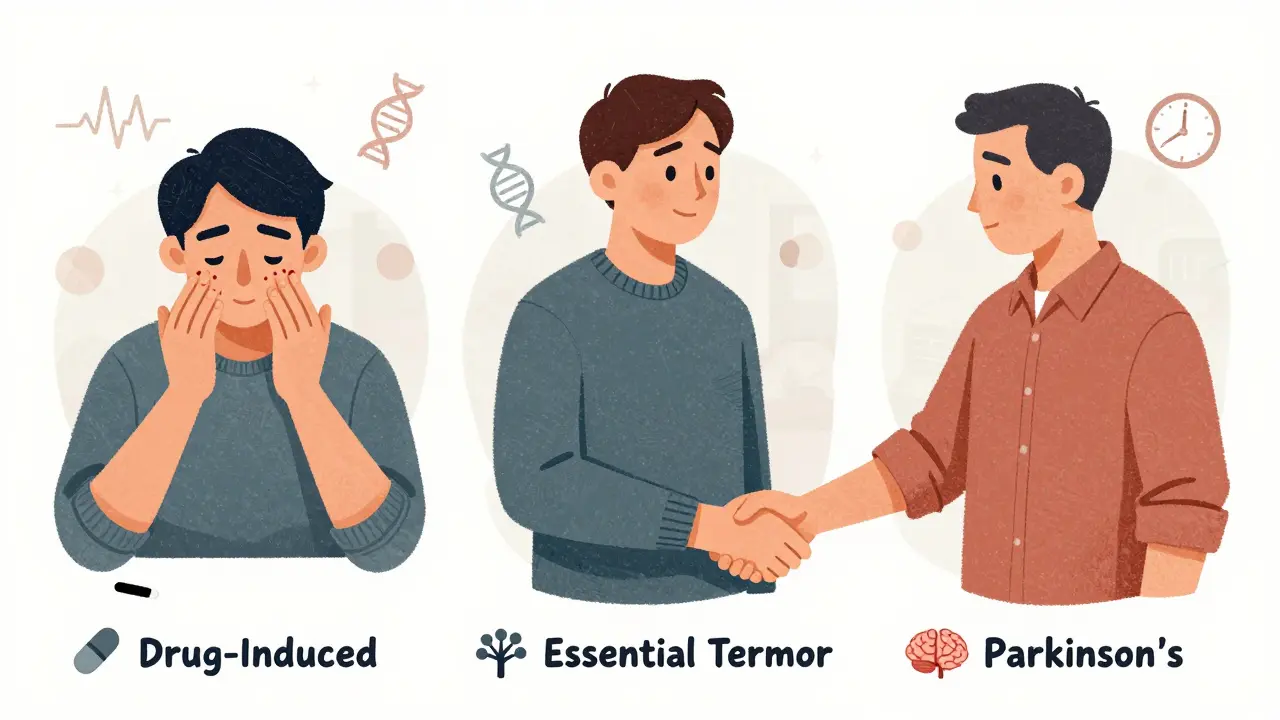
One of the biggest dangers is mistaking drug-induced tremors for something permanent. Many people panic when they see shaking hands, fearing Parkinson’s. But here’s the difference:
| Feature | Drug-Induced Tremor | Essential Tremor | Parkinson’s Disease |
|---|---|---|---|
| When it happens | During movement or holding a position | During movement (especially with tasks) | At rest, improves with movement |
| Speed | 6-12 Hz (fast) | 4-12 Hz | 4-6 Hz (slower) |
| Body parts affected | Hands, head, voice, trunk - anywhere | Hands, head, voice (usually symmetric) | Hands, chin, head, sometimes legs |
| Does it go away? | Yes - often within weeks of stopping the drug | No - it slowly gets worse | No - it progresses without treatment |
| Other symptoms | Only tremor (unless drug causes more) | Only tremor | Stiffness, slow movement, balance issues |
Key clue? If your tremor started within days or weeks of starting a new drug - and it’s worse when you’re active - it’s likely medication-related. If you’ve had tremors for years and they run in your family, it’s probably essential tremor. Parkinson’s usually comes with more than just shaking.
What to Do If You Think a Drug Is Causing Tremors
Don’t stop your medication on your own. But do talk to your doctor - and bring a full list of everything you take, including supplements and over-the-counter drugs.
Here’s what a good doctor will do:
- Check the timeline. Did the tremor start within 72 hours of starting the drug? That’s a strong signal. Some, like SSRIs, can take weeks, but the pattern still holds.
- Review your meds. Which drug is most likely? Antidepressants, antipsychotics, and heart meds top the list. Lithium and asthma inhalers are also common.
- Try the simplest fix first. If the drug isn’t essential - say, an older antihistamine for allergies - stop it. 76% of people see improvement within two weeks.
- If you can’t stop it, lower the dose. Many tremors improve when the dose is cut. For example, lithium tremors often settle down if blood levels drop below 0.8 mmol/L.
- Switch to a safer alternative. If you need an antidepressant, sertraline or escitalopram cause 40% fewer tremors than paroxetine or fluvoxamine. For asthma, levalbuterol causes 37% fewer tremors than albuterol.
- Consider a beta-blocker. Propranolol (20-80 mg daily) helps reduce tremor severity in 58% of cases - even if you can’t stop the original drug.
Some people worry that switching antidepressants means starting over with therapy. But research shows that switching to a lower-risk SSRI doesn’t reduce effectiveness - it just reduces the shaking.
Warning Signs: When to Seek Help Immediately
Most drug-induced tremors are annoying, not dangerous. But some are red flags:
- Fever + tremor + confusion - Could be neuroleptic malignant syndrome (NMS), a life-threatening reaction to antipsychotics. Call 911.
- Tremor + rapid heartbeat + sweating - Could mean too much thyroid hormone (thyroid storm), especially if you’re on levothyroxine.
- Sudden shaking after stopping an SSRI abruptly - Withdrawal from drugs like paroxetine can cause tremors in 22% of people. Always taper slowly.
These aren’t normal side effects. They’re medical emergencies. Don’t wait.
What’s Changing in 2025? New Tools and Insights
Doctors are getting better at spotting and preventing these tremors. In 2023, the FDA updated labels for 17 drugs to include clearer tremor risk warnings. The Movement Disorder Society now includes drug history as a required part of diagnosing movement disorders.
And there’s exciting new science. Researchers found that people with a specific gene variant (CYP2D6 poor metabolizer) are 2.4 times more likely to develop tremors from antidepressants. That means one day, a simple genetic test could tell you if you’re at higher risk before you even start a drug.
AI tools are also being tested. A 2023 Mayo Clinic pilot program used electronic health records to predict who would develop tremors before they happened - with 82% accuracy. This isn’t science fiction anymore. It’s the next step in personalized medicine.

Final Thoughts: You’re Not Alone, and It’s Not Your Fault
Shaking hands can make you feel embarrassed, anxious, or even afraid you’re getting sick. But drug-induced tremors are not a sign of weakness or poor health. They’re a predictable side effect of powerful medicines - ones that often save lives.
The key is awareness. If you’ve noticed new shaking, don’t ignore it. Don’t assume it’s just stress or aging. Talk to your doctor. Bring your pill bottles. Ask: “Could any of these be causing my tremors?”
More than 70% of these tremors disappear completely once the medication is adjusted. That’s not a slim chance - that’s your best path forward. You don’t have to live with shaking hands if you don’t have to.
Can prescription drugs cause tremors even if I’ve been taking them for years?
Yes. While tremors often start soon after starting a new drug, some can appear after months or even years. This is common with lithium, amiodarone, and certain antidepressants. Your body’s response can change over time - especially as you age or add other medications. If you notice new shaking, even after years on a drug, it’s worth discussing with your doctor.
Will my tremors go away if I stop the medication?
In most cases, yes. Studies show 70-90% of drug-induced tremors resolve within weeks to months after stopping or reducing the medication. The timeline varies: some people feel better in days, others take up to three months. The longer you’ve been on the drug, the longer it may take for your nervous system to reset. But unlike Parkinson’s or essential tremor, this is reversible.
Can anxiety make tremors worse?
Absolutely. Stress, caffeine, fatigue, and anxiety all make drug-induced tremors more noticeable. That’s why you might shake more during a presentation or when you’re rushed. But anxiety doesn’t cause the tremor - the drug does. Managing stress won’t fix the root cause, but it can help reduce how bad it feels.
Are there any natural remedies that help with medication tremors?
No proven natural remedies can eliminate drug-induced tremors. Magnesium, B vitamins, or herbal supplements won’t reverse the effect of a medication that’s triggering your tremors. In fact, some supplements - like St. John’s Wort - can interact with antidepressants and make tremors worse. The only proven solutions are adjusting the drug, lowering the dose, switching to a safer alternative, or using propranolol under medical supervision.
Should I avoid all medications that list tremors as a side effect?
No. Tremors are listed as a possible side effect because they happen - not because they’re guaranteed. For many people, the benefit of the drug (like controlling depression, heart rhythm, or asthma) far outweighs the risk. The goal isn’t to avoid all these drugs - it’s to choose the safest option for you, monitor for symptoms, and act early if tremors appear. Many people take these medications for years without issues.
Is it safe to take propranolol long-term to control tremors?
Yes, for many people. Propranolol is a well-studied beta-blocker used safely for decades to treat high blood pressure, heart conditions, and tremors. It’s often prescribed at low doses (20-40 mg daily) for tremor control. Side effects can include fatigue, dizziness, or low heart rate - especially in older adults. But if your doctor monitors you, it’s a safe, effective option when you can’t stop the original medication.
Why do some doctors miss drug-induced tremors?
Because tremors are often assumed to be neurological - especially in older patients. Many doctors don’t take a full medication history or link the timing of symptoms to new prescriptions. A 2017 study found that 10% of patients diagnosed with Parkinson’s were actually suffering from drug-induced parkinsonism. It’s not always the doctor’s fault - it’s a system-wide blind spot. That’s why it’s important to bring up your concerns yourself and keep a symptom diary.
Next Steps: What You Can Do Today
- Write down every medication you take - including doses and when you started.
- Note when your tremors started and what makes them better or worse.
- Call your doctor and say: “I’ve noticed new shaking since I started [drug name]. Could this be related?”
- Ask: “Is there a safer alternative with lower tremor risk?”
- If you’re on lithium, ask for a blood level check.
- Don’t stop anything without talking to your provider - especially antidepressants or antipsychotics.
Tremors from medication are common, treatable, and often reversible. You don’t have to live with shaking hands. With the right information and a proactive conversation with your doctor, you can get back to feeling like yourself again.
So you’re telling me my shaky coffee isn’t just caffeine… it’s my antidepressant? 😅
Been on sertraline for 3 years and never had a shake. But my cat knocks over my mug every morning so… yeah. 😄
I’ve been sitting here thinking about how much we trust chemicals to fix our minds… and then get mad when they shake our hands. It’s like blaming the mirror for showing your wrinkles. We don’t want to admit that healing isn’t clean-it’s messy, slow, and sometimes it trembles. I’ve seen people on lithium for decades, terrified their hands will betray them. But the real tragedy? Not the tremor. It’s the silence around it. Nobody talks about how scary it is to hold your own body and wonder if it’s you… or the pill. Maybe we need to stop seeing side effects as flaws in the system, and start seeing them as signals. Your body’s whispering, ‘Hey, maybe we should slow down.’ And we’re too busy Googling ‘is this Parkinson’s?’ to listen.
Anyway. I switched from paroxetine to escitalopram. Tremors faded in 11 days. No drama. Just… peace. I still take it. I still need it. But now I hold my coffee without thinking about it. That’s worth a conversation with your doctor, right?
Ugh. Of course it’s the meds. Everyone’s on too many pills these days. My cousin’s on 14 different things and she can’t even hold a phone. She’s 42. What even is this? Pharma’s running a science experiment on us and we’re just nodding and swallowing.
Also, propranolol? That’s a beta-blocker. Used to be for heart patients. Now it’s just… anxiety’s Band-Aid. What’s next? Pills for pills?
Let me guess-this whole thing was written by a Big Pharma shill. Did you know the FDA gets millions from drug companies? Of course they’re ‘updating labels’-it’s PR, not science. And ‘AI predicting tremors’? Ha. That’s just a fancy way of saying they’re tracking your data to upsell you more meds. They don’t want you to get better-they want you to be dependent. Propranolol? That’s a communist drug. I heard it’s banned in 17 countries. And lithium? That’s what they put in the water to keep people docile. You think your tremors are from a pill? Maybe it’s the fluoride. Or the 5G. Or both.
Stop taking the pills. Go raw. Eat kale. Drink lemon water. Your body will thank you. Or it won’t. Either way, you’ll be free.
Also, I’m filing a class-action lawsuit. Join me. #FreeFromPharma
I’ve been on amiodarone for 5 years and my hands shake like I’m holding a jackhammer but I thought it was just aging… wait so you’re saying it’s the drug? I didn’t even know that was a thing. I’m gonna call my cardiologist tomorrow. I don’t even know what to ask but I’m gonna ask. Thanks for writing this. I feel less alone now.
Also I take fish oil and magnesium every day and I swear it helps but I don’t know if it’s placebo or what. I’m not gonna stop the amio though. My heart’s too messed up to risk it.
Thank you for this comprehensive and clinically grounded overview. It is both a public service and a vital educational resource for patients navigating the complexities of polypharmacy. The distinction between drug-induced tremors and neurodegenerative etiologies is not merely academic-it is existential. I encourage all individuals experiencing new-onset motor instability to engage in a structured medication review with their primary care provider or clinical pharmacist. The integration of pharmacogenomic screening, as referenced, represents a paradigm shift toward precision therapeutics. Propranolol remains a first-line adjunctive agent in appropriate candidates, with a well-established safety profile when monitored appropriately. Your call to action-documenting medication timelines and initiating dialogue-is not merely prudent; it is imperative. You are not alone, and your agency in this process is both valid and powerful.
Sincerely,
A physician who has seen too many tremors misdiagnosed.
i had no idea lithium could do that. i’ve been on it for 8 years and my hands shake when i’m tired but i thought it was just stress. i’m gonna ask my dr for a blood test. also ty for writing this i’ve been too scared to say anything bc i thought i was just being dramatic lol
Oh so now it’s the meds? Funny how the same people who scream ‘pharma is evil’ when the side effects are bad, turn right around and demand the exact same pills when they’re depressed or anxious. You want the benefits without the consequences? That’s not medicine-that’s entitlement. And don’t even get me started on ‘switching to escitalopram.’ Like that’s some magical safe drug. It’s still a psychoactive chemical that rewires your brain. And propranolol? That’s just another chemical to mask the problem. The real solution? Get off the pills entirely. Go live in the woods. Meditate. Eat organic. Stop being a slave to the system. Your body doesn’t need 14 drugs to function. It needs freedom. And maybe a little less screen time.
Also, the FDA is corrupt. I know people who got Parkinson’s from antidepressants and got zero compensation. This is a cover-up. You think your tremor is from a pill? Maybe it’s the government’s mind control program. They put it in the water. In the air. In the Wi-Fi. Wake up.
And no, I’m not on any meds. I’m perfectly calm. And I don’t need a pill to hold my coffee.