Seized Counterfeit Medications: Real Cases and What We’ve Learned
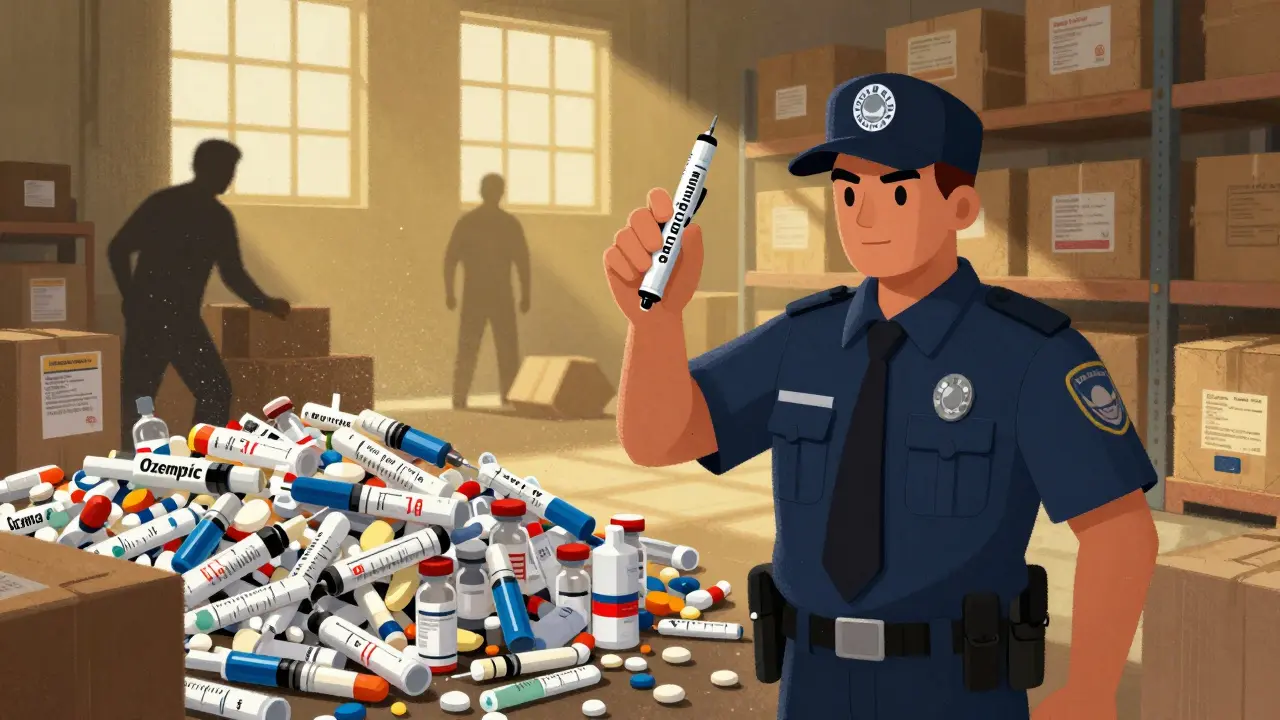
Every year, millions of fake pills, injectables, and vials enter the global drug supply-packaged to look real, labeled to fool even trained pharmacists, and sold to people who believe they’re getting life-saving medicine. In 2025, law enforcement agencies seized over 50 million doses of counterfeit medications in a single global operation. These aren’t just fake cosmetics or knockoff sneakers. These are dangerous, unregulated drugs that can kill.
What’s Being Seized-and Where
The most common counterfeit drugs being intercepted today aren’t old-school antibiotics or painkillers. They’re high-demand, high-profit medications: weight-loss injectables like Ozempic, Semaglutide, and Tirzepatide; erectile dysfunction pills; Botox; dermal fillers; and even HIV treatments. In August 2025, U.S. Customs and Border Protection stopped a single shipment of 16,740 counterfeit pre-filled pens containing these substances. Most came from Hong Kong, China, Colombia, and South Korea. These weren’t random packages-they were bulk shipments headed to 40 U.S. states. In South Africa, police seized counterfeit medicines worth over $118,000 in Gqeberha. In Nigeria, authorities shut down an illegal herbal medicine lab in Kaduna that was producing unapproved treatments. Meanwhile, in Cincinnati, CBP seized $3.5 million in fake pharmaceuticals. In Iowa, a pharmacy was fined $25,000 for selling counterfeit Ozempic. These aren’t isolated incidents. They’re part of a pattern.How Counterfeiters Are Getting Better
Ten years ago, fake pills were easy to spot: misspelled names, blurry logos, wrong colors. Today, the packaging is nearly perfect. Some counterfeiters even replicate the holograms, batch numbers, and QR codes found on real boxes. One patient in Canada reported buying what looked like genuine Semaglutide from an online pharmacy-only to find the liquid inside had visible particles and caused severe swelling. Criminals are now using a tactic called “localization.” Instead of shipping fully assembled drugs, they send unassembled parts-empty vials, fake labels, inactive powder-to small warehouses near the target country. There, they assemble the product on-site, avoiding detection at major ports. This makes it harder for customs to trace the origin and easier to slip through inspections. Even more alarming: counterfeiters are targeting biologics-complex, expensive drugs made from living cells. These include cancer treatments and autoimmune therapies. The Pharmaceutical Security Institute recorded a 12% jump in biologic counterfeiting in 2024. Unlike simple pills, biologics can’t be easily replicated. But criminals don’t need to get the formula right-they just need to make something that looks real and sells for a fraction of the price.Where You’re Most Likely to Buy Fake Drugs
You won’t find most counterfeit medications in street corners or shady alleyways anymore. They’re sold on websites that look like legitimate pharmacies, Instagram ads, Etsy listings, and Telegram channels. The National Association of Boards of Pharmacy found that 47% of counterfeit GLP-1 medications are sold through online marketplaces like Etsy. Another 31% come from direct orders with unlicensed manufacturers overseas. Only 22% are bought from foreign pharmacies, which many people mistakenly think are safe. A Reddit user who works as a pharmacist shared a case from August 2025: a patient developed severe cellulitis after injecting counterfeit dermal fillers bought from an Etsy seller. The packaging matched the real brand perfectly. The only clue? The needle was too short, and the liquid had tiny metallic flakes. Lab tests later showed traces of industrial solvents and heavy metals. The FDA’s MedWatch system saw a 43% increase in adverse event reports linked to suspected counterfeit drugs in the first half of 2025. Most involved weight-loss injectables and cosmetic fillers. People aren’t just getting sick-they’re being hospitalized, and some are dying.
The Regulatory Gap
Here’s something most people don’t realize: U.S. customs can’t seize every fake drug they find. They can only intercept products that are clearly counterfeit-meaning they’re falsely labeled, misbranded, or imitate a registered trademark. If a drug is simply imported without FDA approval but contains the right active ingredient, it’s not illegal to bring in. That’s a huge loophole. Dr. Carmen Catizone of the NABP put it bluntly: “CBP cannot seize medications that violate only the Federal Food, Drug, and Cosmetic Act-they must be counterfeit to be seized.” That means thousands of unsafe, unapproved drugs slip through every day. A vial of fake Botox with real botulinum toxin might be seized. But a bottle of “Semaglutide” with no active ingredient at all? That’s not always enough to trigger a seizure. This gap lets criminals operate with relative safety. They know the rules. They exploit them.Real Consequences
Counterfeit medications don’t just waste money. They destroy lives. In one documented case, a patient with type 2 diabetes took counterfeit Semaglutide for three months. His blood sugar spiked dangerously high. He ended up in the hospital with diabetic ketoacidosis. Lab tests showed his “medication” contained no active ingredient-just sugar, cornstarch, and traces of lead. Another patient bought fake HIV medication from a website claiming to be based in Canada. The pills looked authentic. The website had a secure checkout, customer reviews, and even a live chat agent. But the pills had no antiretroviral drugs. Within six months, his viral load skyrocketed. He developed drug-resistant HIV. The U.S. Department of Justice prosecuted a network of 70+ people who defrauded Medicaid of $17 million by selling $9.5 million in counterfeit drugs-including $3 million in fake HIV treatments. These weren’t street hustlers. They were organized criminals running businesses.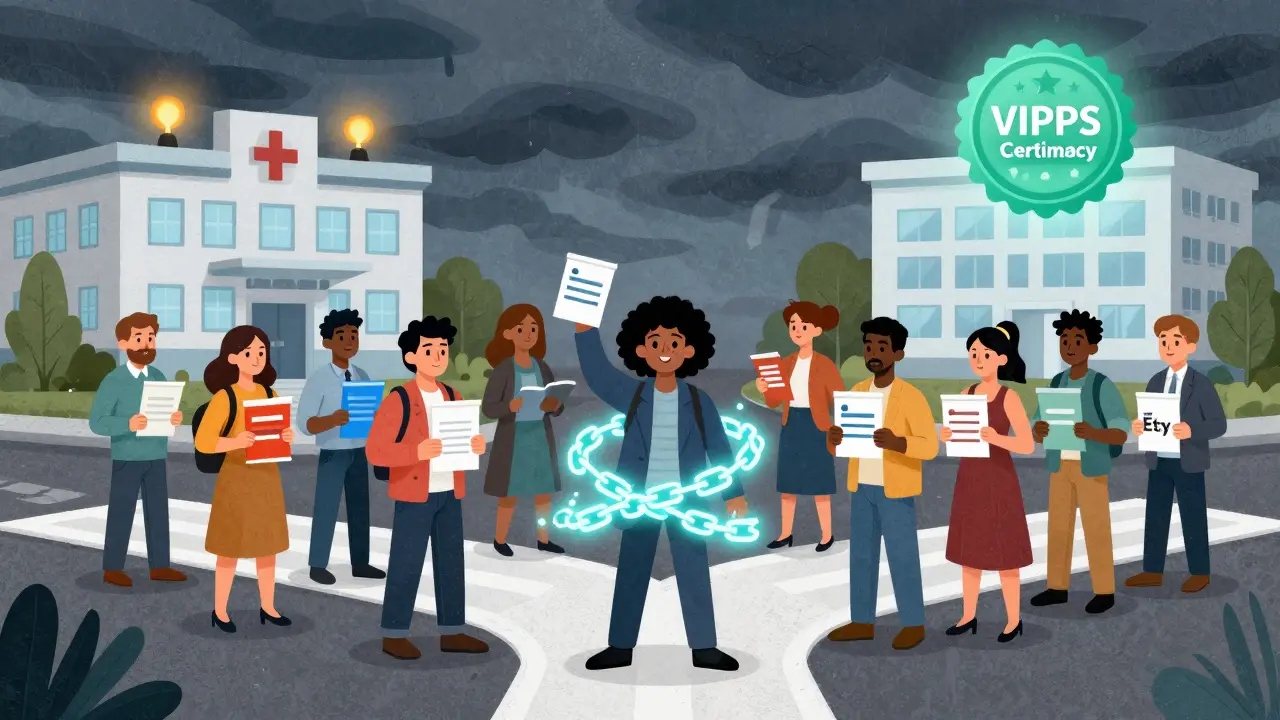
What’s Working: Lessons from Enforcement
There’s good news: global cooperation is improving. Interpol’s Pangea XVI operation in 2025 involved 90 countries. They shut down 13,000 illegal websites, arrested 769 people, and dismantled 123 criminal groups. They seized 50.4 million doses. That’s a win. Pharmaceutical companies like Pfizer have trained law enforcement in 183 countries on how to spot fakes. They teach agents to check for:- Subtle differences in font size or spacing on labels
- Incorrect batch numbers or expiration dates
- Unusual packaging materials-too thin, too glossy, or wrong color
- Missing or mismatched security features
- Products sold outside authorized channels
What You Can Do
If you’re buying medication online:- Only use websites verified by the National Association of Boards of Pharmacy (NABP). Look for the VIPPS seal.
- Never buy from social media sellers, Etsy, or Instagram ads-even if they look professional.
- Ask your pharmacist to verify the packaging. They’re trained to spot fakes.
- Check the lot number with the manufacturer. Most have online tools for this.
- If the price seems too good to be true, it is.
The Future Is Riskier
The threat isn’t shrinking. It’s evolving. By 2026, experts predict 78% of counterfeit GLP-1 drugs will be sold through social media and disguised e-commerce sites. Criminals are using AI to generate fake websites, deepfake videos of doctors endorsing products, and chatbots that mimic customer service. Without stronger international laws, better tech, and more public awareness, the number of counterfeit drug incidents could rise 15-20% each year. And as more people turn to online pharmacies for convenience, the risk grows. The truth is simple: fake medicine isn’t a victimless crime. It’s a public health emergency. Every seizure, every arrest, every warning saves someone. But until we all stop buying from untrusted sources, the problem won’t end.How can I tell if my medication is counterfeit?
Look for inconsistencies in packaging: mismatched fonts, blurry logos, odd colors, or incorrect batch numbers. Check if the pills look different from previous refills-size, shape, or color changes can be red flags. Compare the packaging with images on the manufacturer’s official website. If you’re unsure, take it to a licensed pharmacist. They can verify authenticity using manufacturer databases.
Are online pharmacies safe?
Only if they’re verified by the National Association of Boards of Pharmacy (NABP). Look for the VIPPS seal. Most fake drug sales happen through websites that look real but aren’t licensed. Avoid pharmacies that don’t require a prescription, offer “discounts” on controlled substances, or ship from overseas. If you can’t find their physical address or phone number, walk away.
Why are weight-loss drugs like Ozempic so commonly counterfeited?
They’re expensive, in high demand, and easy to sell online. A single pen of real Ozempic can cost over $1,000. Counterfeit versions sell for $50-$150. Criminals make huge profits with low risk. Plus, many people are desperate for results and don’t question where the drug comes from. This creates a perfect market for fraud.
What happens if I take a counterfeit drug?
It depends on what’s inside. Some contain no active ingredient, so your condition worsens. Others contain dangerous contaminants-like heavy metals, industrial solvents, or even fentanyl. People have suffered strokes, organ failure, infections, and death after taking fake medications. Even if you feel fine at first, long-term damage can occur without symptoms.
Can I report a fake drug anonymously?
Yes. In the U.S., you can report suspected counterfeit medications through the FDA’s MedWatch program without giving your name. In Canada, contact Health Canada’s Adverse Reaction Reporting system. In the EU, use EudraVigilance. Your report helps authorities track patterns and shut down dangerous operations.
so uhm… fake ozempic? lol. next they’ll sell counterfeit oxygen. people are dumb.
you ever notice how the same people who’d never buy a knockoff handbag will order a $60 ‘Ozempic’ pen from an Instagram ad like it’s a coupon for enlightenment? 🤡 The packaging’s flawless, sure-but the liquid inside? Looks like someone boiled glitter and regret. I’ve seen patients show up with arms swollen like balloons, convinced they’re ‘just detoxing.’
It’s not just greed. It’s a cultural sickness. We’ve turned medicine into a status symbol, a quick fix for existential dread. You don’t want to be fat? Fine. But don’t poison yourself because a TikTok influencer said ‘glow up’ means injecting industrial solvent.
And don’t even get me started on the ‘herbal weight loss’ labs in Nigeria or the Etsy sellers calling themselves ‘medical aestheticians.’ Someone’s grandma is injecting glitter into her cheeks because she saw a 5-star review. This isn’t crime. It’s performance art with lethal consequences.
Meanwhile, the FDA can’t seize a vial unless it’s *technically* counterfeit? That’s like arresting someone for selling a fake smile if the teeth aren’t the right shade of white. We need to treat unapproved drugs like weapons. Not paperwork.
And yes-I’ve called out a pharmacy myself. They had the right logo. Wrong batch number. Tiny. Almost invisible. But I saw it. My patient’s insulin was just sucrose and sadness. She didn’t know. Neither did her doctor. That’s the real horror.
Let’s stop pretending this is about ‘online scams.’ This is a public health war. And we’re losing because we keep blaming the victims instead of the architects.
Also: if your ‘Botox’ comes with a QR code that links to a .xyz domain? Run. Not walk. Run like your face depends on it. Because it does.
One must question the epistemological foundations of pharmaceutical trust in an era where blockchain verification is marketed as a panacea while regulatory bodies remain structurally impotent. The commodification of biological integrity has reached a point of grotesque absurdity-where the placebo effect is now weaponized by criminal cartels with corporate efficiency.
It is not merely a matter of counterfeit vials; it is the collapse of semiotic authority in medical signifiers. When a QR code can be forged, when holograms are replicated with 3D printing, when the very language of safety is co-opted by fraudsters-what remains of the sacred contract between patient and healer?
The FDA’s legal myopia is not bureaucratic inefficiency. It is moral failure.
I just want to say thank you for writing this. I work in a clinic and we had a patient last month who came in with a rash from fake filler. She was so scared. We got her help, but she didn’t know how to report it. I hope more people read this and feel less alone.
This is one of the most comprehensive and sobering overviews I’ve read on the counterfeit drug crisis. The systemic loopholes you’ve outlined-particularly the distinction between ‘unapproved’ and ‘counterfeit’-are criminally under-discussed. The fact that a vial containing no active ingredient may not be legally actionable is a chilling testament to regulatory stagnation.
Pharmaceutical companies must be held accountable not just for innovation, but for proactive detection and public education. The blockchain pilot programs are promising, but they’re not scalable without public-private collaboration and legislative reform.
Thank you for the actionable steps. I’ve shared this with my entire professional network.
Wait-so you’re telling me someone bought ‘Botox’ from Etsy… and then went to a spa to get it injected? Like, at a place that also sells handmade candles? Did they ask for a license? Did the person holding the syringe have a degree? Or did they just Google ‘how to inject Botox’ and say ‘eh, close enough’?
I’m not even mad. I’m just… impressed. In the worst way possible.
Also, I just checked my last Ozempic pen. The font on the label? Slightly off. I thought it was a printing error. Now I’m terrified.
Oh wow. Another ‘big pharma is innocent’ fairy tale. Let me guess-the FDA’s just lazy? The real problem? The government won’t let Americans buy cheaper meds from Canada. That’s why people turn to shady websites. Blame the regulators, not the desperate. This article is pure propaganda.
Also, ‘counterfeit’ is just a buzzword. Most of these drugs are just unregulated. Big difference. You’re fearmongering to sell ads.
I’ve worked in public health across five countries, and this is the most accurate summary I’ve seen. The localization tactic-sending empty vials and labels to be assembled locally-is genius, in the most horrifying way. It turns every small town into a potential manufacturing hub.
In rural Kenya, we saw the same pattern with HIV meds. The counterfeiters didn’t need to replicate the drug-just the box. People trusted the packaging. That’s the real tragedy: we’ve trained patients to trust logos, not science.
Also, the AI-generated doctor videos? I saw one last month. It was flawless. Even the cough. I almost believed it.
Look, I get it. Fake meds are bad. But let’s be real-most of these people are just trying to afford treatment. Ozempic costs $1,000. I’m a single dad. I work two jobs. If I could buy a $70 version that ‘looks real,’ wouldn’t you? The system failed them first.
Also, why is everyone blaming the buyers? Where’s the outrage against the pharmacies that sell real Ozempic without insurance coverage? This isn’t a criminal problem-it’s an economic one.
And yes, I’ve bought meds online. I’m not proud. But I’m alive. And I didn’t die.
Hey everyone-just wanted to say you’re not alone. I’ve been there. Took fake GLP-1 for two months. Felt fine at first. Then I got dizzy, nauseous, and had this weird metallic taste. Didn’t know why. Took it to my pharmacist. She spotted the batch number mismatch in 10 seconds.
She called the manufacturer. Turns out it was a fake batch from a warehouse in Florida. They traced it to a shipping label from a UPS store. I reported it. Two weeks later, the whole network got shut down.
You think you’re just saving money. But you’re risking your life. And your family’s peace of mind.
Don’t be ashamed to ask. Don’t be afraid to report. We’ve got your back. 💪❤️
bro i just bought some ‘semaglutide’ off a guy on discord. he said it was ‘from the same place as the real stuff.’ i think he meant the same guy who sells robux for free. i’m gonna take it tomorrow. wish me luck 😎
The commodification of biological necessity is not merely a criminal enterprise-it is the logical endpoint of a healthcare system that treats life as a transaction. The counterfeiters are not aberrations; they are the mirror held up to a society that values profit over personhood.
When a diabetic must choose between insulin and rent, and a cosmetic consumer must choose between a pen and a vacation, the market doesn’t fail-it fulfills its design.
Let us not mistake the symptoms for the disease. The disease is indifference.
Why is everyone so obsessed with ‘fake’ meds? Real meds are just as dangerous. Ever heard of opioid overdoses? Or people dying from real Botox? This is just fear porn. The government wants you scared so you’ll pay more for ‘approved’ drugs.
Also, China? Really? You’re blaming China again? Wake up. The U.S. makes more dangerous drugs than any country. This is just anti-Asian panic dressed up as public health.
Thank you for this. I’m a retired pharmacist. I’ve seen 30 years of this. The packaging gets better every year. We used to catch fakes by the smell. Now? They smell like the real thing. The only thing left? The batch number. The expiration date. The tiny font on the cap.
I taught my granddaughter how to check. She’s 17. She works at a grocery pharmacy. She caught a fake insulin pen last week. She didn’t say anything. Just called me. We reported it. The company didn’t even know it was missing.
Don’t underestimate the power of a trained eye. And don’t be afraid to ask. Even if you think you’re being paranoid.
You’re not. You’re just smart.
And here’s the kicker: the same people who buy fake Ozempic are the ones who’ll post about their ‘miracle weight loss’ on Instagram. Then they get hospitalized. Then their family sues the ‘pharmacy’… which doesn’t exist. And the real brand? They get blamed. Again.
It’s a perfect storm of desperation, deception, and digital delusion.
And we’re all just scrolling past it.