Respiratory Combination Inhalers: What You Need to Know Before Switching to Generic Versions

When you’re managing asthma or COPD, your inhaler isn’t just a device-it’s your lifeline. For years, branded combination inhalers like Symbicort and Advair were the gold standard. But now, generic versions are everywhere. Pharmacies are switching them automatically. You might not even notice-until your symptoms get worse.
Why Generic Inhalers Aren’t Like Generic Pills
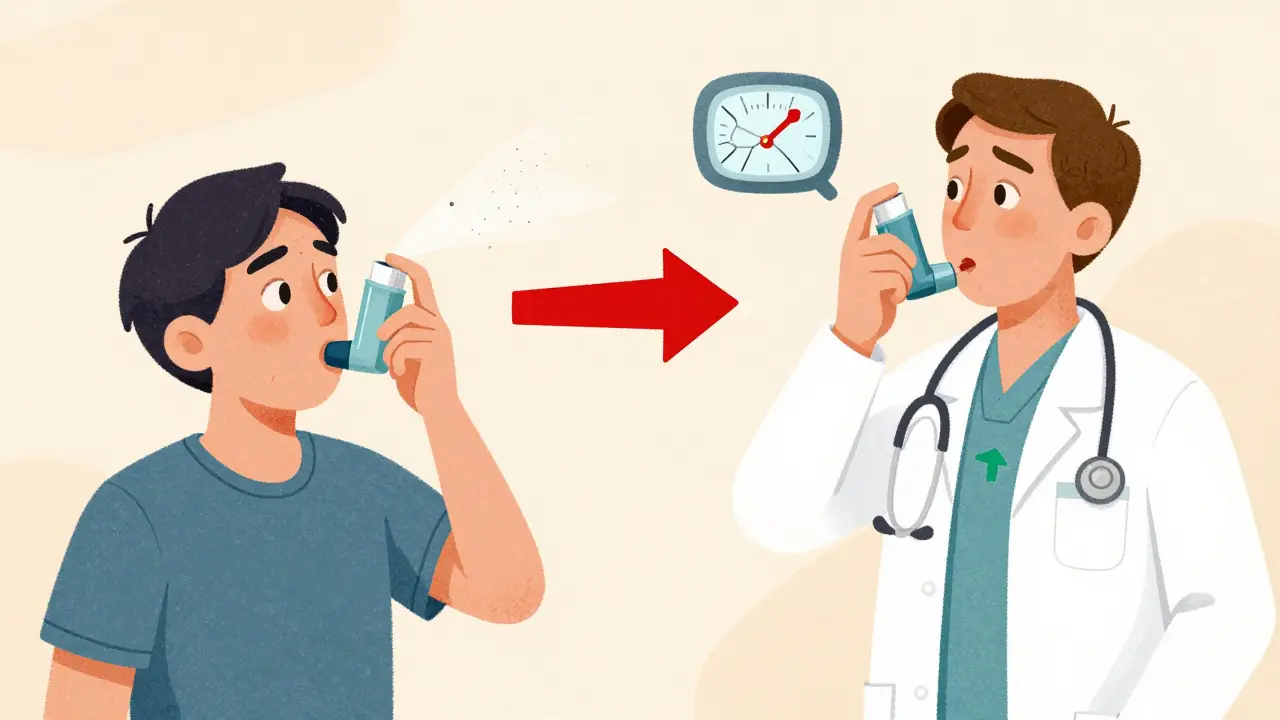
If you’ve switched from brand-name ibuprofen to a generic version, you probably didn’t think twice. The pills look different, sure, but they work the same. That’s not true for inhalers. A generic inhaler isn’t just a cheaper version of the same medicine-it’s often a completely different device. And that matters more than you think.Combination inhalers deliver two drugs at once: a corticosteroid to reduce swelling and a long-acting beta agonist to open your airways. But the device you use-whether it’s a Turbuhaler, Spiromax, or pMDI-controls how much medicine actually reaches your lungs. If the device changes, your technique has to change too. And most people don’t know how to use their new inhaler correctly.
A 2020 study found that 76% of patients switched from a Turbuhaler to a Spiromax without training used it wrong. That’s not a small mistake. It means they got barely half the dose they needed. No wonder so many end up in the ER.
The Device Difference: How Inhalers Work
There are three main types of inhalers: pressurized metered-dose inhalers (pMDIs), dry powder inhalers (DPIs), and nebulizers. Each requires a different breathing pattern.With a pMDI, you press the canister and breathe in slowly at the same time. Miss the timing by even a second, and most of the medicine hits your throat instead of your lungs.
DPIs like the Turbuhaler and Spiromax don’t need a puff button. You breathe in hard and fast to pull the powder out. But here’s the catch: Turbuhaler needs a twist to load the dose. Spiromax uses a sliding mechanism. They look similar, but the motions are totally different. If you’re used to twisting and suddenly have to slide, you might not load the dose at all.
One patient in the UK told her pharmacist: “I didn’t know I had to breathe harder. I thought the inhaler was broken.” She ended up in the hospital with a severe asthma attack.
What the Experts Are Saying
The American Thoracic Society reviewed 12 studies and found that automatic substitution of inhalers without training increases the risk of treatment failure by 37%. That’s not a minor bump-it’s a serious safety issue.The European Medicines Agency (EMA) requires manufacturers to prove their generic inhaler delivers the same amount of medicine to the lungs as the brand. That’s hard to do. Lung deposition can vary by 25-40% between devices, even if the active ingredients are identical.
In the U.S., the FDA says generic inhalers should be interchangeable without extra training. But real-world data contradicts that. A 2021 study showed patients switched from Symbicort Turbohaler to generic Spiromax without instruction had a 22% increase in asthma attacks within six months.
Dr. Amirala Pasha, a physician and legal expert, put it bluntly: “Generic substitution laws work for pills. They don’t work for inhalers because the device is part of the drug.”
What Patients Are Experiencing
On Reddit’s asthma forum, 83% of people who were switched to a generic inhaler without warning reported worse symptoms. One user wrote: “I thought the pharmacy gave me the wrong medicine. I didn’t realize it was the same drug-just a different device.”A 2022 survey by Asthma UK found that 57% of patients felt confused after switching. One in three had an emergency visit within three months. On Drugs.com, Symbicort Turbohaler has a 6.2/10 rating. The generic Spiromax? 4.8/10. The top complaints? “Harder to use,” “doesn’t feel as effective,” and “I didn’t know how to use it.”
But here’s the good news: when patients get proper training, success rates jump. One study found that 89% of people using a generic inhaler correctly had been shown how to use it by a healthcare provider.
What Should You Do?
If your pharmacy switches your inhaler without asking:- Stop and ask-Is this the same device? If not, what’s different?
- Ask for a demonstration-Don’t just watch. Do it yourself. Say, “Show me how to use this, then let me try.”
- Use the teach-back method-After they show you, explain it back in your own words. If you can’t, you haven’t learned it yet.
- Check your symptoms-If you’re coughing more, waking up at night, or needing your rescue inhaler more often, it might be the device, not your condition.
- Ask your doctor to prescribe by brand name-In many places, you can request “dispense as written” or “no substitution.”
Some countries are catching on. Germany requires pharmacists to give 15 minutes of in-person training for first-time inhaler users. Norway has a 62% generic substitution rate-but they also have strong education programs. France, where brand-name prescribing is standard, has a 22% substitution rate-and fewer hospitalizations related to inhaler errors.

Why This Is a System Problem
The cost savings look good on paper. Generic inhalers can be 30-50% cheaper. But when patients get sick because they can’t use them, the real cost skyrockets. A 2023 report estimated that inappropriate substitution costs healthcare systems $1.2 billion a year in emergency visits and hospital stays.Most pharmacies don’t have the time or training to teach inhaler technique. A 2022 survey found only 28% of U.S. community pharmacies consistently provide device-specific training. The main reason? “We’re too busy.”
Meanwhile, the FDA is starting to take notice. In May 2023, they issued new draft guidance requiring more clinical studies to prove generic inhalers work the same way-not just in theory, but in real patients. The EMA and Global Initiative for Asthma (GINA) have already updated their guidelines to say: “Device familiarity and correct technique should be prioritized over cost.”
What’s Next?
By 2027, nearly half of all combination inhalers will face generic competition. That means more switches. More confusion. More risk.But there’s hope. Smart inhalers-like those with sensors that track your breathing and send feedback to your phone-are becoming more common. A 2022 study in JAMA Internal Medicine found that patients using smart inhalers with real-time feedback had 33% fewer asthma attacks. These tools can catch technique errors before they lead to emergencies.
The message is clear: generic doesn’t mean interchangeable when it comes to inhalers. The device is part of the medicine. If you’re switched without warning, it’s not just a change in packaging-it’s a change in your treatment. And you have the right to know, to ask, and to say no.
Can I switch my inhaler without talking to my doctor?
You might be switched without your doctor’s knowledge, especially in places where pharmacy substitution laws allow it. But you shouldn’t. Combination inhalers aren’t like pills. The device affects how well the medicine works. Always talk to your doctor before switching-and ask them to write "dispense as written" on your prescription if you’re happy with your current inhaler.
Why do generic inhalers cost less if they’re the same medicine?
They’re not the same. The active ingredients may be identical, but the device-the plastic body, the powder mechanism, the way you load it-is different. Manufacturing a new inhaler device is cheaper than licensing the original branded one. But that doesn’t mean it’s better or safer. The cost savings come from avoiding patent fees, not from better medicine.
How do I know if my new inhaler is working?
Track your symptoms. Are you using your rescue inhaler more than twice a week? Are you waking up at night because of coughing or wheezing? Are you limiting your activities because you’re short of breath? If the answer is yes, your inhaler might not be working right. Don’t assume it’s your asthma getting worse-ask your provider to check your technique.
Is there a way to avoid being switched without notice?
Yes. Ask your doctor to write "dispense as written" or "no substitution" on your prescription. In some states and countries, this legally prevents the pharmacy from switching your inhaler. Even if it’s not required by law, many pharmacists will honor it if you explain why it matters for your health.
What should I do if I’ve been switched and feel worse?
Don’t wait. Contact your doctor or respiratory nurse immediately. Bring your new inhaler with you. Ask them to watch you use it. If your technique is off, they can show you how to fix it. If your symptoms don’t improve after learning the correct technique, ask to switch back to your original inhaler. Your health is more important than cost savings.
It’s wild how we treat inhalers like they’re just another pill bottle. I had no idea the device mattered this much until I switched and started coughing all night. Turns out I was breathing wrong-like, completely wrong. No one warned me. No one asked. Just a new box on the shelf and a shrug. My lungs didn’t care about the cost savings.
generic inhalers r sooo overrated tbh. i got the new one and it felt like my lungs were fulla sand. no training nothin. why do they think we can just magically know how to use these weird plastic toys??
so let me get this straight… the FDA says it’s fine but real people are ending up in the ER?? classic. someone’s getting a bonus for cutting costs while the rest of us gasp for air. why don’t they just slap a warning label on it like ‘this might kill you if you’re dumb’
Guys I get it. I was switched last year and I thought I was just getting worse. Turns out I wasn’t inhaling right at all. I went to the pharmacy and asked for a demo and the pharmacist looked at me like I was asking for a PhD. But when they showed me? Holy crap. I was twisting instead of sliding. That’s it. That’s the whole problem. You need to ask. You need to demand it. Don’t be shy-your lungs are worth it.
I’m from the Midwest and I’ve been on these inhalers for 15 years. I’ve seen the shift from brand to generic. Most people don’t know the difference until they’re wheezing at 3 a.m. But here’s the thing-it’s not just about the device. It’s about how disconnected our system is from real people. We treat health like a spreadsheet. But lungs don’t care about budgets. They care about breathing. Maybe we need to start treating them like that.
There’s a dangerous myth that ‘generic = equivalent’ in medicine, and inhalers are the perfect example of why that’s a lie. The active ingredients may be identical, but delivery is everything. A 25-40% variation in lung deposition isn’t a rounding error-it’s a clinical disaster waiting to happen. This isn’t about brand loyalty. It’s about pharmacokinetics, patient safety, and the ethical obligation of healthcare systems to prioritize function over cost. If you’re being switched without training, you’re being failed.
STOP LETTING PHARMACIES DO THIS TO YOU. I was switched and I almost ended up in the hospital. I called my doctor the second I felt off. They didn’t even blink-they wrote ‘dispense as written’ on my next script. If you’re not happy, SAY SOMETHING. You have rights. Your breath is not a commodity. Fight for it.
...and yet, the EMA, GINA, and now the FDA are all starting to acknowledge this... it’s about time... we’ve known for years... why did it take so many ER visits... to get here?... I’m glad someone’s finally listening... but it’s still not enough...
It is imperative to note that the regulatory framework governing pharmaceutical substitution was designed for oral solid dosage forms, which exhibit bioequivalence through systemic absorption. Inhalers, however, rely on pulmonary deposition-a localized, device-dependent mechanism that cannot be adequately modeled by pharmacokinetic bioequivalence studies. Consequently, the current FDA paradigm for generic substitution is methodologically unsound for this class of therapeutics.
I’ve worked in respiratory therapy for 22 years. I’ve seen patients who thought their asthma was worsening-when really, they just didn’t know how to use the new inhaler. One woman cried because she thought she’d failed herself. She hadn’t. The system failed her. Training isn’t a luxury. It’s a lifeline. And if your pharmacy won’t give you 10 minutes? Find one that will.
Okay, but… like… why don’t we just make all inhalers the same? Like, why can’t there be one universal design? I mean, if we can have one type of phone charger, why not one type of inhaler? Is it because corporations want to lock us in?… I just feel like we’re being played…
Everything you say is true. But let me tell you the real truth: Big Pharma designed this. They know people won't notice until they're sick. They pushed generics because they own the patents on the devices now. The ‘brand’ inhalers? They’re just the old models. The new ones? All controlled by the same conglomerates. This isn’t about savings-it’s about control. And they’re letting you pay with your breath.
Canada doesn’t do this. We don’t just swap inhalers like candy. Pharmacists here have to train you. Period. And if they don’t? You complain to the college. We don’t treat health like a Walmart clearance aisle. Maybe America should stop pretending cost-cutting is patriotism.
Let me be brutally honest: This is the inevitable consequence of commodifying healthcare. The pharmaceutical-industrial complex has weaponized efficiency. They’ve turned a medical device into a profit center. You think this is about cost? No. It’s about shareholder value. And the collateral damage? Your airway. Your sleep. Your life. The system is not broken-it’s operating exactly as designed. And it’s designed to make you suffer quietly.