Refrigerated Medications While Traveling: Best Cooling Options for 2025
Carrying refrigerated medications while traveling isn’t just about packing a cooler-it’s about keeping your treatment alive. If you’re using insulin, Mounjaro, vaccines, or other temperature-sensitive drugs, even a few hours outside the 36°F to 46°F (2°C to 8°C) range can cut their effectiveness by up to 15% per hour. That’s not a risk you can afford to take, especially when you’re miles from home and your next dose is due.
Why Temperature Control Matters More Than You Think
Most people assume that if a medication doesn’t look spoiled, it’s still good. That’s a dangerous myth. Insulin, for example, starts breaking down visibly after just 24 hours at 77°F (25°C). By day three, you could be losing 10% of its potency per day. Biologics like tirzepatide (Mounjaro) are more forgiving-up to 21 days at room temperature-but that’s an exception, not the rule. Most vaccines, hormone therapies, and antibiotics degrade fast when exposed to heat or freezing.
Repeated warming and cooling cycles are even worse. Dr. Robert Tomaka, a clinical pharmacist at Memorial Sloan Kettering, says temperature swings can reduce efficacy by up to 40% over a week-even if the meds never go above 46°F. That’s because proteins in these drugs unfold and clump together when they’re cycled in and out of cold. Once that happens, no amount of re-cooling fixes it.
What Counts as a Real Medical Cooler?
Not all coolers are created equal. A lunchbox with a frozen gel pack? That’s not enough. Standard coolers don’t maintain consistent temperatures, and direct contact between ice and medication can freeze and ruin your dose. Medical-grade coolers are built differently.
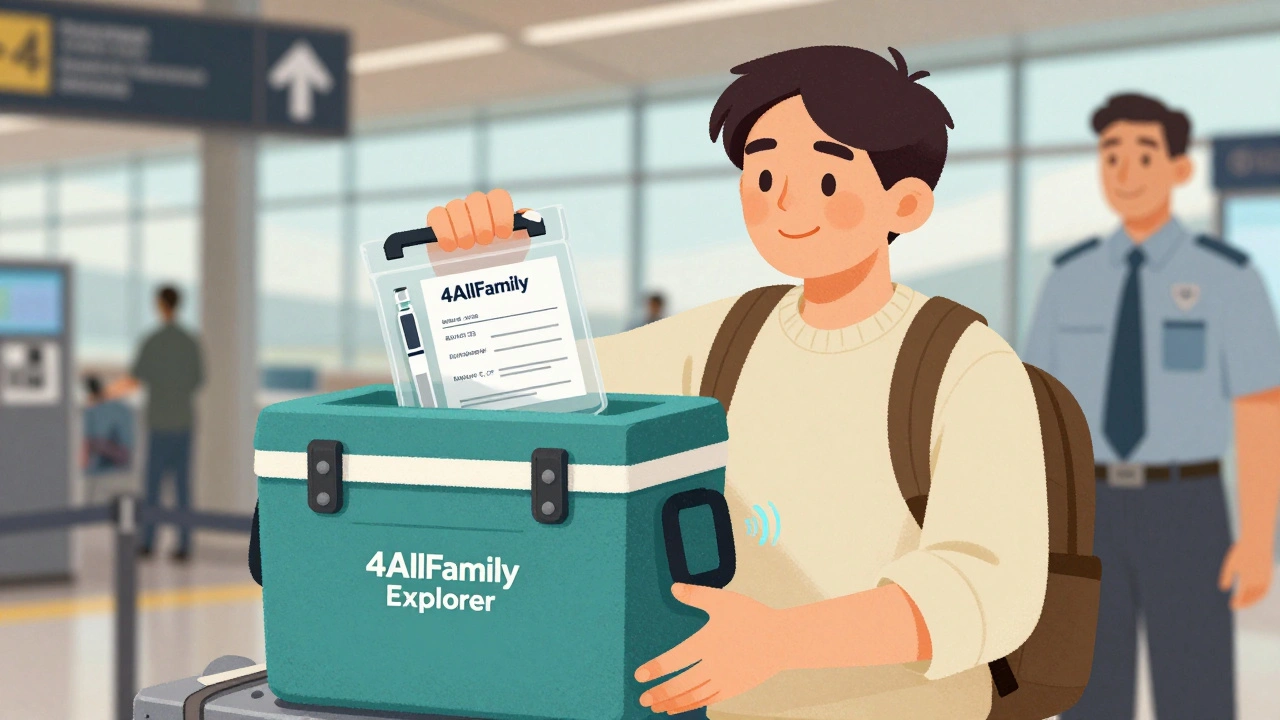
The 4AllFamily Explorer is one of the most tested devices on the market. Lab-tested by Intertek in January 2023, it keeps meds between 36°F and 45°F for up to 50 hours in 104°F heat. It uses a Biogel Freeze Pack that’s designed to stay just cold enough-not freezing-and the lid has a USB port to recharge the cooling system. Empty, it weighs just 1.2 pounds and fits seven insulin pens. No bulky ice. No condensation on your vials.
Compare that to the SUNMON Insulin Cooler Bag, priced at $34.99. It’s TSA-approved and lightweight, but 87% of Amazon reviewers say it only lasts 8-12 hours before warming up. You’d need to refill it with ice every few hours on a long trip. That’s not practical for a flight from Halifax to Miami, let alone an international journey.
Portable Fridges vs. Gel Packs: What’s Better?
You’ve got two main paths: passive cooling (gel packs) or active cooling (battery-powered fridges).
- Gel packs (like those from Novo Nordisk or Lilly) are cheap and TSA-friendly. But they need 12-24 hours in the freezer before use. In hot climates, they last only 12-24 hours. If the ambient temp hits 90°F, their cooling power drops by 30%.
- Active fridges like the Armoa Portable Medical Fridge ($299.99) run continuously. They plug into a car outlet or USB and maintain exact temps. But they weigh 6.2 pounds, need 65W of power, and aren’t ideal for backpacking or flights without a power source.
The 4AllFamily Explorer hits a sweet spot: it works with or without electricity. Use the Biogel pack alone for 72 hours. Plug it in for 96. That’s why it’s the top pick for travelers who need reliability without the bulk.
TSA Rules You Can’t Afford to Ignore
Security checkpoints aren’t the enemy-they’re your ally if you know how to play the game. TSA requires you to declare refrigerated medications and cooling devices at the checkpoint. Put them in a separate bin. Bring the original prescription label or a doctor’s note. You’re not asking for special treatment; you’re exercising your rights under the Americans with Disabilities Act.
Pro tip: Don’t wrap your meds in foil or put them in a metal box. TSA agents need to see the contents clearly on X-ray. A clear plastic bag with labeled vials and a visible cooler model is the fastest way through security. According to TSA data, travelers with documentation cut screening delays by 75%.
What to Do When You Reach Your Destination
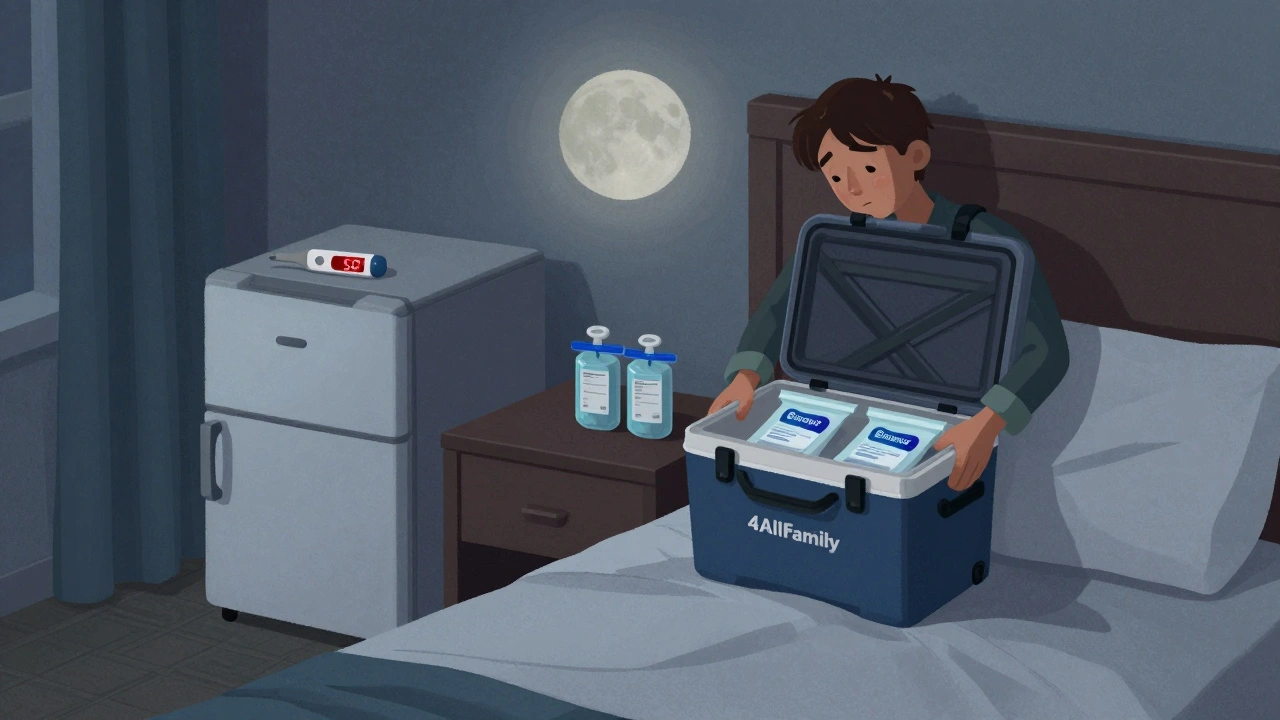
Hotels lie about their mini-fridges. Most run at 50°F-too warm for insulin. Always test the temperature with a digital thermometer before storing meds. If it’s above 46°F, ask for a different room or use a portable cooler as backup.
Most major hotel chains (Marriott, Hilton, Hyatt) will provide a mini-fridge if you request one at booking. Call ahead. Mention you’re carrying refrigerated medication. They’ve done this hundreds of times.
Need to refresh your gel packs? Use the hotel ice machine. PWSA USA found that travelers who refreshed their cooling packs every 12 hours maintained safe temps for up to 10 days on international trips. Just make sure to seal your meds in waterproof bags-condensation from melting ice can ruin labels and packaging.
Don’t Use Dry Ice. Seriously.
Some people think dry ice is the ultimate solution. It’s not. Dry ice hits -109°F. That’s cold enough to freeze insulin solid in minutes. Once frozen, the protein structure breaks. The medication becomes useless. And TSA bans dry ice on most flights unless you’re a certified medical courier.
The American Diabetes Association explicitly warns against it. Even if you’re not flying, using dry ice in a car or hotel room risks frostbite and asphyxiation in enclosed spaces. Stick to medical-grade gel packs or battery-powered coolers. They’re safer and just as effective.
Monitoring: The Hidden Game-Changer
Visual checks don’t cut it anymore. If you’re carrying life-saving meds, you need to know what’s happening inside your cooler at all times.
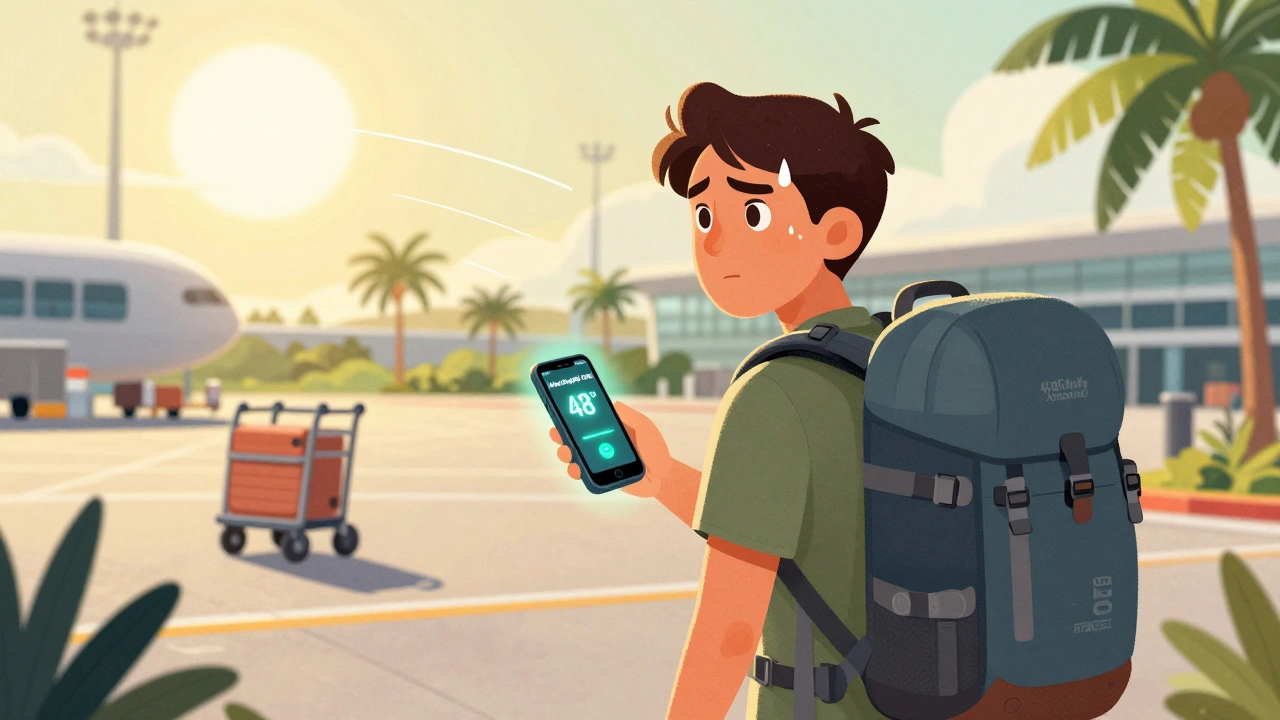
The MedAngel ONE is a tiny Bluetooth sensor that clips inside your cooler. It tracks temperature every 5 minutes and sends alerts to your phone if it goes above 48°F or below 34°F. Accuracy? ±0.2°F. That’s more precise than most hospital refrigerators.
Even better, the new 4AllFamily Explorer 2.0, released in October 2023, has this built in. It doesn’t just cool-it logs and alerts. If you’re flying to a hot country or have a long layover, this feature alone can prevent a medical emergency.
What to Pack: The Travel Checklist
- Medications in original packaging with labels
- Doctor’s note or pharmacy letter (83% of pharmacists provide this for free)
- Medical-grade cooler (4AllFamily Explorer recommended)
- Two pre-frozen Biogel packs (freeze for 24 hours before departure)
- Waterproof bags for each vial or pen
- Small digital thermometer with memory function
- USB power bank (at least 10,000mAh)
- Backup cooling pack (in case one fails)
Pro tip: Store your cooler in your carry-on. Checked luggage can sit in hot cargo holds for hours. Temperatures there can hit 120°F. That’s not a cooler-it’s an oven.
Market Trends and What’s Coming Next
The market for travel-friendly medication coolers is growing fast. In 2022, 34.2 million Americans used refrigerated meds. That number is rising as more biologics get approved-42% of new FDA drugs in 2022 were temperature-sensitive. Companies are responding.
MedTech Dive reported that MedAngel’s new CORE system, launching in early 2024, promises 120 hours of cooling using advanced phase-change materials. But early tests show it struggles in tropical climates. The industry is still catching up to extreme heat.
Pharmaceutical companies are also starting to ship travel kits with every prescription. 41% of major healthcare systems now provide them-up from 12% in 2019. If you’re on a new treatment, ask your pharmacy: ‘Do you offer a travel cooling kit?’
Final Reality Check
There’s no magic solution. No cooler lasts forever. But with the right gear and preparation, you can travel safely with refrigerated meds. The key is not just buying a cooler-it’s understanding how to use it, monitor it, and backup your system.
Test your setup before you leave. Do a trial run: pack your meds, freeze the pack, leave it in a hot car for 12 hours. Check the temp. If it’s above 46°F, your gear isn’t good enough.
You’re not being paranoid. You’re being responsible. Your medication is your lifeline. Treat it like one.
omg this is life saving info!! i just got mounjaro and was gonna use a regular cooler lol
Why are we even talking about this? In America, if you can't afford to keep your meds cold, maybe you shouldn't be traveling. Just sayin'.
Also, why is everyone so obsessed with this 4AllFamily thing? It's just another overpriced gadget.
Stacy's comment about dry ice is spot on. I used to think it was the ultimate solution until I saw a friend freeze their insulin solid on a road trip. The protein denaturation is irreversible. I now carry two MedAngel sensors-one in the cooler, one in my pocket just in case. Also, always test your hotel fridge. I once found one at a Hilton in Phoenix reading 52°F. They gave me a new one immediately after I showed them the thermometer.
Pro tip: If your pharmacy doesn't offer a travel kit, ask for a printed dosing schedule with your name and prescription number. TSA loves that more than any note.
Let me ask you something real: if your life depends on a vial of insulin that’s been sitting in a cargo hold at 120°F, do you really think the system cares? We’re told to be responsible, to pack right, to test, to monitor-but the system doesn’t adjust. Airlines don’t have climate-controlled cargo for meds. Hotels don’t guarantee fridge temps. Pharmacies charge $200 for a ‘travel kit’ that’s just a ziplock and a sticky note.
So we’re left to DIY survival with $300 gadgets and Bluetooth sensors because the infrastructure failed us. And now we’re supposed to be grateful someone made a cooler that doesn’t freeze our meds? This isn’t innovation. This is damage control. We’re not optimizing our lives-we’re just trying not to die while moving between cities.
And don’t even get me started on the fact that people still think ‘if it looks fine, it’s fine.’ That’s not a myth. That’s a death sentence wrapped in denial.
I’ve watched my sister go blind from degraded insulin because she trusted a gel pack that ‘felt cold.’ No one told her about protein unfolding. No one told her that temperature swings are silent killers. So yes-I’ll rant. Because if I don’t, someone else will wake up with a dead vial and no answers.
The 4AllFamily Explorer is the only device that meets international medical transport standards for temperature stability under extreme ambient conditions. Its Biogel system has been validated under ISO 13485 and ASTM D3103 protocols. Do not substitute with consumer grade products. Your life is not a compromise.
Just got back from Bali with my Mounjaro and let me tell you-this post saved me. I used the 4AllFamily with two pre-frozen packs, plugged it into my power bank on the plane, and kept it in my carry-on. When the flight attendant asked if it was a cooler, I said, ‘It’s my lifeline.’ She nodded, gave me a bottle of water, and didn’t ask another question.
And yes-I did the hotel fridge test. 51°F. I asked for a new one. They said, ‘We have one in storage.’ No drama. No attitude. Just kindness.
Also, I brought a tiny notebook and wrote down every time I refreshed the pack. I felt like a scientist. But honestly? I felt alive.
Thank you for writing this. I’m not just traveling-I’m surviving with dignity.
Interesting. But let’s not romanticize the 4AllFamily. It’s a niche product for a niche market. The real issue is pharmaceutical monopolies pricing life-saving drugs so high that patients must choose between medication and travel. A $300 cooler is a Band-Aid on a hemorrhage.
Also, dry ice? Of course it’s dangerous. But so is the entire system that makes you carry your medicine like contraband. 🤷♂️
And yes, I’ve seen TSA agents confiscate insulin pens because they didn’t like the ‘look’ of the cooler. Documentation doesn’t always save you. It just makes you feel better while they take your dignity.
Still… the MedAngel ONE is brilliant. 0.2°F accuracy? That’s next-level. I’m buying one.
I’m not gonna lie-I cried reading this. I’ve been on insulin since I was 12. I’ve flown with melted pens. I’ve slept in airports with my cooler under my head. I’ve had hotel staff tell me, ‘We don’t have fridges for that.’
But the part about testing your hotel fridge? That’s the one I wish someone had told me 15 years ago.
I just bought the 4AllFamily. It’s not perfect. But it’s the first thing that made me feel like my life matters.