Pediatric Vision Screening: How Early Detection Prevents Lifelong Vision Problems
Did you know that one in every 20 children has a vision problem that could lead to permanent vision loss if not caught early? Most parents assume their child sees fine-until they’re told at school or during a checkup that their 4-year-old can’t see the board. By then, it might be too late to fully fix it. The truth is, pediatric vision screening isn’t optional. It’s a simple, fast, and life-changing step every child needs before age 5.
Why Screening Before Age 5 Matters More Than You Think
The human eye doesn’t fully develop until around age 7. Before that, the brain is still learning how to interpret what the eyes see. If one eye is blurry, crossed, or misaligned, the brain starts ignoring signals from that eye. That’s called amblyopia-commonly known as lazy eye. Once the brain shuts down that connection, it’s extremely hard to reopen it. Studies show that when amblyopia is caught before age 5, 80 to 95% of kids can regain normal vision with treatment. After age 8? That number drops to just 10 to 50%. Strabismus, or crossed eyes, is another silent threat. It affects nearly 3 in 100 children. Left untreated, it doesn’t just look unusual-it can destroy depth perception and lead to permanent vision loss in one eye. These aren’t rare conditions. They’re common. And they’re almost always preventable with early screening.What Happens During a Pediatric Vision Screen?
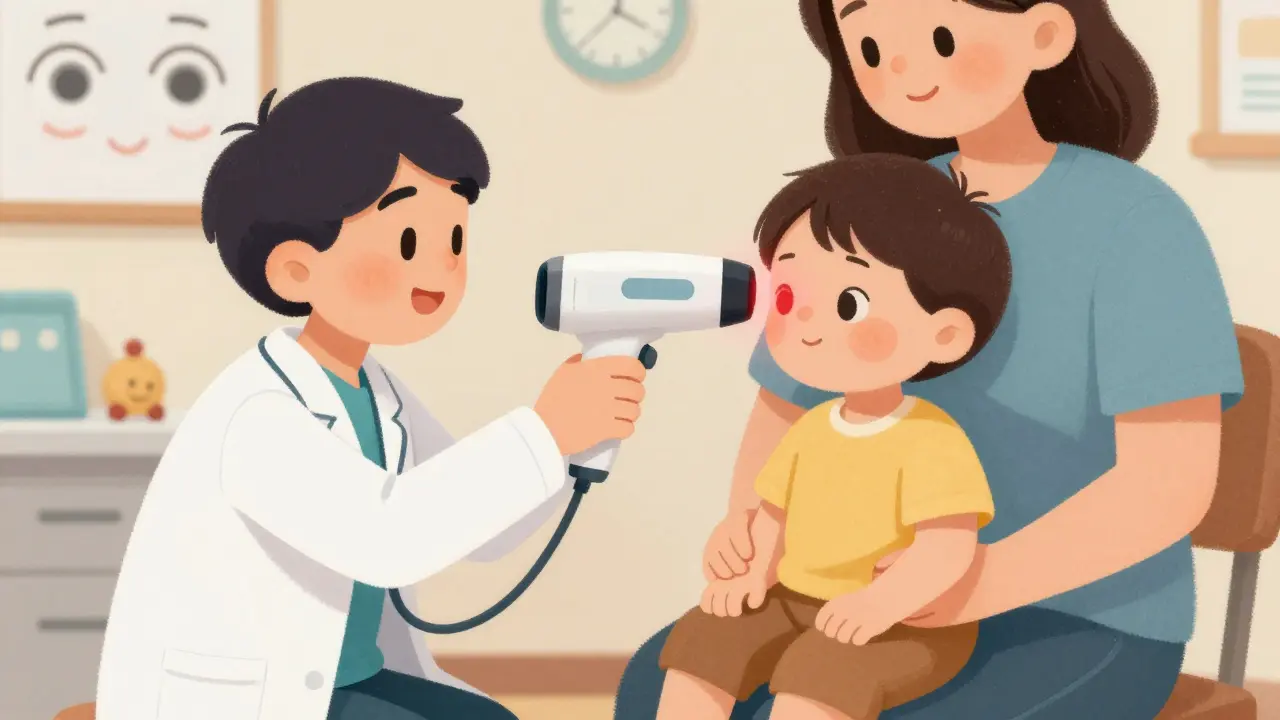
Screening isn’t a full eye exam. It’s a quick check to find kids who need further testing. The method changes as the child grows. For babies under 6 months, doctors use the red reflex test. A small light shines into each eye. If the reflection looks white, gray, or uneven instead of red, it could mean a cataract, retinal tumor, or other serious issue. It takes 10 seconds. No crying required. From 6 months to 3 years, providers check for eye alignment, pupil response, and whether the child follows moving objects. They also watch for signs like tilting the head, squinting, or one eye drifting. Starting at age 3, visual acuity tests begin. This is where charts come in. But not the big Snellen charts you remember from the doctor’s office. For young kids, it’s symbols: apples, circles, or letters like H, O, T, V. The child points to a matching card or says what they see. At age 3, they need to read the 20/50 line. At 4, it’s 20/40. By 5, it’s 20/32. If they miss more than a few, they’re referred.Two Ways to Screen: Charts vs. Machines
There are two main ways to screen: optotype-based (charts and symbols) and instrument-based (machines). Optotype screening is the traditional method. It’s low-cost and widely used. But it needs a cooperative child. About 1 in 4 three-year-olds won’t sit still, won’t understand the task, or just won’t try. That’s why many clinics now use devices like the SureSight, Retinomax, or the newer blinq™ scanner. These handheld machines flash a light into each eye and measure how light focuses on the retina. They detect nearsightedness, farsightedness, astigmatism, and eye misalignment-all in under two minutes. No response needed. The child just looks at a light while the device does the work. Studies show these tools are more accurate for kids aged 3 to 4 than traditional charts, with a 68% positive predictive value compared to 52% for visual acuity tests. The blinq™ scanner, cleared by the FDA in 2018, is especially promising. It uses AI to analyze images and has shown 100% sensitivity for detecting vision problems that need referral. It’s becoming the new standard in pediatric clinics across the U.S. But here’s the catch: machines can flag kids who don’t actually need treatment. A small refractive error might show up, but if it’s not affecting vision, no intervention is needed. That’s why a positive screen doesn’t mean a diagnosis-it means a referral to an eye doctor.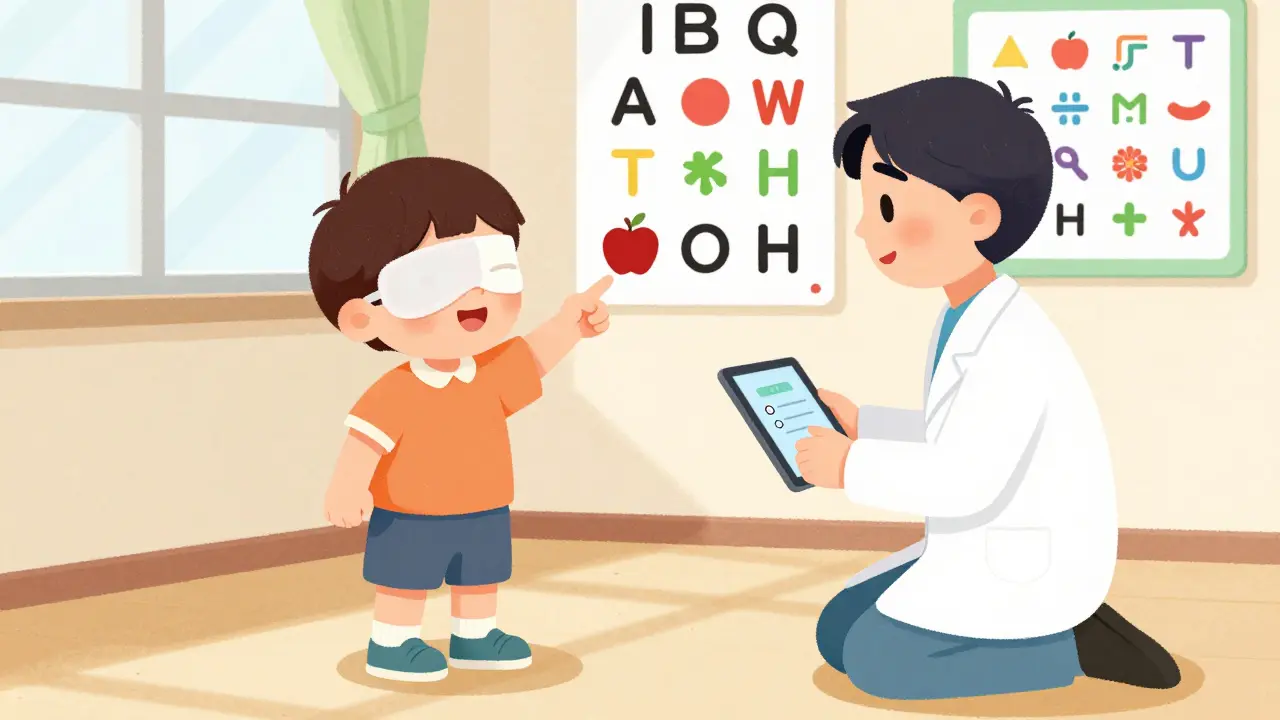
Who Should Be Screened and When?
Guidelines are clear. The U.S. Preventive Services Task Force recommends at least one vision screening between ages 3 and 5. The American Academy of Pediatrics says screening should happen at 8, 10, 12, and 15 years too. But the most critical window is 3 to 5. Screening should be part of every well-child visit starting at age 1. Many pediatricians now use instrument-based screening even before age 3. Research published in JAMA Pediatrics in 2022 showed it’s possible-and accurate-as early as 9 months. That’s a game-changer. If your child has a family history of eye problems, premature birth, developmental delays, or neurological conditions, they need screening even earlier and more often. These kids are at higher risk.Common Mistakes That Ruin Screening Results
Even with good tools, screenings fail when protocols aren’t followed. One of the biggest errors? Getting the distance wrong. For accurate results, the chart must be exactly 10 feet away. Too close? The child passes falsely. Too far? They fail even if they see fine. A 2018 study found 25% of screenings had improper lighting, and 20% had incorrect distance measurements. Another issue? Testing both eyes at once. Each eye must be screened separately. Covering one eye with a patch or paddle is essential. If you don’t, you’ll miss amblyopia. Providers also skip training. Screening isn’t intuitive. It takes 2 to 4 hours of hands-on practice to get it right. Over 15,000 healthcare workers in the U.S. have completed free online training from the National Center for Children’s Vision and Eye Health. If your pediatrician hasn’t, ask if they’ve been trained.What Happens After a Positive Screen?
A positive screen doesn’t mean your child needs glasses or surgery. It means they need a full eye exam by a pediatric ophthalmologist or optometrist trained in children’s vision. Treatment depends on the issue. For amblyopia, patching the stronger eye for a few hours a day can force the brain to use the weaker one. Glasses fix refractive errors. In some cases, eye drops or surgery correct strabismus. The earlier treatment starts, the better. Most kids respond within weeks. By age 6, 90% of those treated have normal or near-normal vision.
Why This Isn’t Just About Sight
Vision problems don’t just affect how well a child sees the board. They affect learning, social development, and self-confidence. A child with undiagnosed amblyopia might struggle in school, be labeled as inattentive, or avoid sports because they can’t judge distance. Economically, the return on investment is huge. The U.S. Preventive Services Task Force found that for every dollar spent on pediatric vision screening, $3.70 is saved in lifetime costs-from reduced special education needs, fewer accidents, and better long-term employment outcomes. Untreated amblyopia costs the U.S. an estimated $1.2 billion a year.What’s Changing in 2025?
New tools are coming. AI-powered screening is becoming more common. Research funded by the National Eye Institute is focused on improving accuracy in Black and Hispanic children, who are 20 to 30% less likely to get screened. That gap is narrowing, but it’s still there. The American Academy of Pediatrics is expected to update its guidelines by 2025 to recommend instrument-based screening for all children starting at age 1. That’s a big shift-and it’s backed by solid data.What Parents Can Do Right Now
Don’t wait for school screenings. They’re too late. By then, the window for full recovery may be closing. Ask your pediatrician: "Has my child had a vision screening this year?" If they say no, ask why. If they say yes, ask what method they used. If they used a chart and your child is under 4, ask if they’ve considered an instrument-based screen. If your child fails a screen, don’t delay. Get a full eye exam within 6 weeks. Every month counts. Vision isn’t something you can guess. You can’t assume your child sees fine because they recognize you or follow a toy. The only way to know is to screen.At what age should my child have their first vision screening?
The first vision screening should happen during a well-child visit between 9 and 12 months of age. At this stage, it’s usually a red reflex test and observation of eye movement. Formal visual acuity screening begins at age 3, but instrument-based screening can be done as early as 1 year old if the provider has the equipment.
Can my child pass a school vision screening and still have a problem?
Yes. School screenings are often basic and done by untrained staff. They typically only test distance vision with a chart and may miss near vision problems, astigmatism, or amblyopia in one eye. A child can pass a school screening but still need glasses or treatment. A full eye exam by a pediatric eye specialist is the only way to be sure.
Is vision screening covered by insurance?
Yes. Under the Affordable Care Act, pediatric vision screening is a required benefit in all health plans. Most insurance plans, including Medicaid, cover screening at well-child visits. Some states also require coverage for follow-up exams after a positive screen. Always check with your provider, but you shouldn’t pay out-of-pocket for a screening.
What if my child won’t cooperate during screening?
That’s common, especially with 3-year-olds. If your child refuses to use a chart, ask if the clinic uses an instrument-based screener like SureSight or blinq™. These devices work even if the child won’t sit still or respond. They take just a few seconds and require no participation. If no machine is available, try scheduling the screening when your child is well-rested and not hungry.
How often should my child be screened after age 5?
After age 5, children should be screened at least once every year or two until age 18. The American Academy of Pediatrics recommends screenings at ages 8, 10, 12, and 15. If your child wears glasses or has a known vision condition, they may need more frequent checks. Always follow your eye doctor’s advice.
If you’ve ever wondered why your child squints in bright light or sits too close to the TV, now you know: it might not be a habit. It could be a sign their eyes are struggling. Don’t wait for them to say something. Don’t assume they see fine. A five-minute screening could change their vision-for life.
It's wild how something so simple can have such a massive ripple effect. I never thought about how vision development ties into brain wiring until I read this. My niece failed a school screening at 4 and turned out to have severe amblyopia. We caught it just in time thanks to her pediatrician pushing for a specialist. She’s 8 now and reads without squinting. That’s not luck-that’s science.
Stop waiting for school screenings. They’re a joke. I work in a pediatric clinic and we’ve switched entirely to blinq™ scanners for kids over 1. It takes 90 seconds, no cooperation needed, and catches things charts miss 40% of the time. If your doc is still using Snellen charts on a 3-year-old, ask them why they’re using 1980s tech.
One cannot help but observe the profound epistemological rupture in contemporary pediatric practice: the uncritical adoption of algorithmic diagnostics as a surrogate for clinical discernment. While the blinq™ scanner may offer statistical efficacy, it obfuscates the phenomenological encounter between caregiver and child-a sacred space reduced to binary outputs and machine-generated referrals. One must ask: Are we healing eyes-or automating anxiety?
This hit home. In India, we often think vision problems are just ‘weak eyes’ and wait till school. But my cousin’s daughter was diagnosed with strabismus at 2 because her aunt insisted on a screening. She got glasses and surgery before 3. Now she plays cricket like a pro. Early screening isn’t medical-it’s love in action. We need this everywhere.
I had no idea instrument-based screening existed until last year. My son refused to look at the chart at his 3-year checkup. The nurse pulled out a handheld device, pointed it at his eyes, and in 15 seconds said he needed a referral. We were shocked-but grateful. No tears, no stress, just results. This should be standard everywhere.
Let’s be real-most parents don’t care until their kid fails a test. I’ve seen it a hundred times. Mom says, ‘He sees the TV fine!’ Then the kid can’t read the board and gets labeled ‘lazy.’ No, sweetheart. He can’t see. And you waited until it was almost too late. This isn’t about convenience. It’s about responsibility.
My daughter failed the screening at 3.5. We thought it was just stubbornness. Turns out she had astigmatism in one eye and was suppressing vision. We got glasses and patching started right away. Now she’s 5 and loves drawing. I didn’t know vision could be fixed like this. It’s not magic. It’s just early action. Do it. Don’t wait.
My kid hated the chart. Loved the machine. No crying. No yelling. Just a little beep and done. I’m telling everyone. If your doc doesn’t have one, ask for it. It’s not extra. It’s essential.
In my village in rural Tennessee, we didn’t even know vision screening was a thing until the mobile clinic came through. One little device, one afternoon, and suddenly three kids had glasses. No one paid a dime. This isn’t just healthcare. It’s justice.
Let’s not pretend this is about children’s health. This is a corporate-driven agenda disguised as preventive medicine. Instrument-based screening generates referrals, which generate revenue for optometrists and manufacturers. The real cost? Parental anxiety and overdiagnosis. The data is manipulated to sell gadgets, not to save eyes.
I’m from Nigeria. We don’t have access to these machines. But we do have community health workers trained to do red reflex tests. It’s low-tech, but it works. We’ve reduced undiagnosed cataracts in infants by 60% in three years. You don’t need AI to save sight. You need commitment.
Screen at 9 months. Use the machine. Refer if flagged. No excuses. Done.
My daughter’s screening was done by a nurse who’d never been trained. She held the chart too close. My kid passed. We didn’t find the real issue until she was 5 and struggling in kindergarten. Don’t assume the person doing the screening knows what they’re doing. Ask questions.
Thank you for this. 🙏 In India, we often delay because of cost or stigma. But I’ve started sharing this with my family and neighbors. One screening. One chance. No child should lose vision because we didn’t act. Let’s make this normal.
While the article presents a compelling narrative, it fails to adequately address the confounding variable of selection bias in the cited JAMA Pediatrics study. The cohort was disproportionately urban and insured, skewing the 9-month screening efficacy rate. Furthermore, the 100% sensitivity claim for the blinq™ device is misleading-it refers to detection of *refractive anomalies*, not *clinically significant amblyopia*. Misinterpretation of sensitivity as specificity is a common statistical fallacy in public health messaging.