Patient Information vs Healthcare Provider Information: How Label Differences Affect Care
Why Your Doctor’s Notes Don’t Match How You Feel
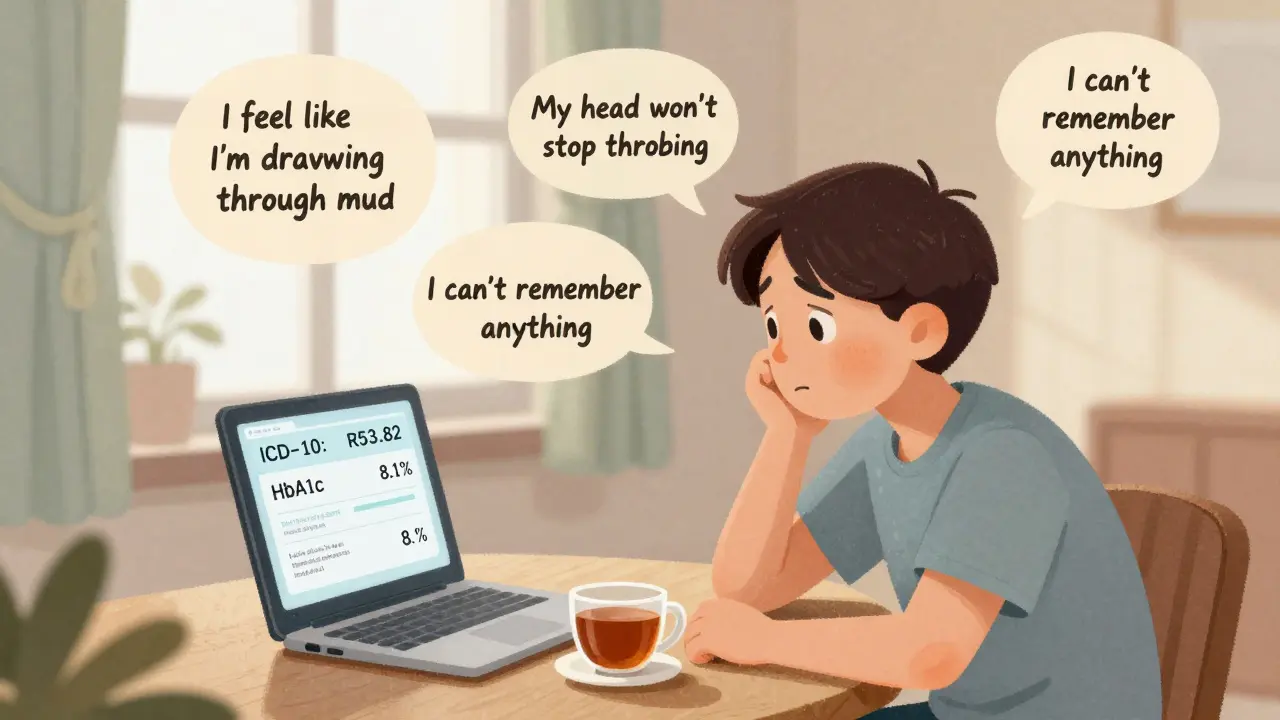
You go to the doctor with a pounding headache, fatigue, and trouble sleeping. You describe it all in plain words: "I feel like I’m dragging through mud every day," "My head won’t stop throbbing," "I can’t remember anything." Later, you check your patient portal and see this: "Chronic fatigue syndrome, ICD-10: R53.82, with associated headache and cognitive dysfunction." It’s accurate. But it doesn’t feel like you.
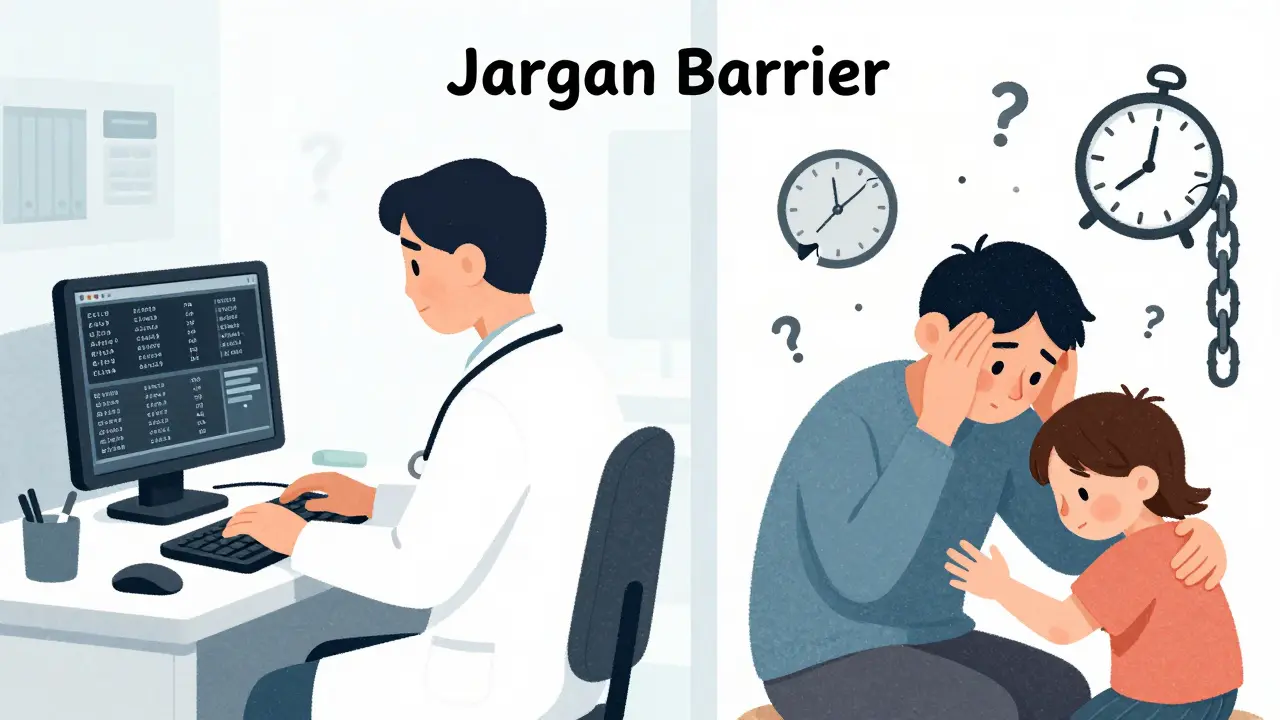
This isn’t a mistake. It’s a gap - a real, measurable divide between how patients describe their health and how providers record it. And it’s causing confusion, missed meds, and even avoided care. The labels used by doctors aren’t meant to confuse. They’re built for efficiency, billing, and research. But when those labels land in front of patients without translation, they can feel like a foreign language - and sometimes, like a judgment.
What Providers See: Codes, Not Stories
Healthcare providers don’t write notes to tell stories. They write to bill, to track, and to communicate with other clinicians. That’s why their language is packed with codes: ICD-10 for diagnoses, CPT for procedures. There are over 70,000 ICD-10 codes. Each one stands for a specific condition - like E11.9 for "Type 2 Diabetes Mellitus without complications." It’s precise. It’s standardized. And it’s useless to most patients.
Electronic Health Records (EHRs) like Epic and Cerner were designed around these codes. They help hospitals get paid. They help insurers process claims. They help researchers spot disease trends. But they weren’t built to help you understand your own body. A provider might type: "Metformin 500mg BID, HbA1c 8.1%" - all clear to a pharmacist or endocrinologist. To you? It’s just jargon. You don’t know what HbA1c means. You don’t know what 8.1% says about your health. All you know is you’re still tired, and you’re taking pills you don’t fully understand.
What Patients Experience: Feelings, Not Diagnoses
Patients don’t think in codes. They think in sensations. "My knees ache when I walk up the stairs." "I get dizzy after lunch." "I cry for no reason." These aren’t symptoms to be filed under a code - they’re the lived reality of illness. A 2019 study in the Journal of General Internal Medicine found that 68% of patients misunderstood common medical terms. Forty-two percent didn’t know "hypertension" meant high blood pressure. Sixty-one percent didn’t recognize "colitis" as inflammation of the colon.
And it’s not just vocabulary. It’s meaning. A 2017 study in the Journal of Patient Experience showed patients felt their illness carried deeper personal weight than providers realized. One woman with rheumatoid arthritis told researchers: "It’s not just my joints. It’s my ability to hold my grandkids." Her provider documented M06.9 - "Rheumatoid arthritis, unspecified." The code didn’t capture the loss of hugs, the guilt of not being able to play.
The Consequences of Misaligned Labels
This gap isn’t theoretical. It has real costs.
Dr. Thomas Bodenheimer from UCSF says the language barrier contributes to 30-40% of medication errors. Think about that. Someone takes the wrong dose because they thought "BID" meant "twice a day until I feel better," not "twice daily, every day, no matter what."
Patients avoid care because they’re afraid they’ll be judged. On PatientsLikeMe, one user wrote: "My doctor wrote ‘poorly controlled DM’ in my chart. I thought it meant I was a bad diabetic. Like I failed." DM = diabetes mellitus. But to her, it felt like a moral failure.
A 2022 survey by the American Medical Association found 57% of patients felt confused by medical terms in their records. And 32% said they skipped follow-up appointments because of it. Meanwhile, doctors are spending 15-30 minutes per visit just explaining terms they assume everyone knows. That’s time lost for actual care.
How Some Hospitals Are Fixing This
It’s not all broken. Some places are fixing it - and it’s working.
Kaiser Permanente started Open Notes in 2010. They let patients read their doctors’ notes - word for word. At first, staff worried patients would panic. Instead, confusion dropped 27%. Medication adherence rose 19%. Why? Because patients could see the context. They could ask questions before their next visit.
Mayo Clinic went further. They built plain-language templates into their EHR system. When a doctor types "myocardial infarction," the system automatically suggests: "heart attack" for the patient-facing version. In their pilot, patient confusion dropped 38%.
The teach-back method is another simple fix. Instead of saying, "Take this pill twice a day," a provider asks: "Can you tell me how you’ll take this at home?" A 2018 JAMA study showed this cuts miscommunication by 45%.
What’s Changing Now - And What’s Coming
The rules are shifting. The 21st Century Cures Act (2016) forced providers to give patients full access to their notes by April 2021. No more hiding. No more "we’ll explain it later." Now, patients see everything - even if it’s confusing.
That pushed hospitals to adapt. In 2010, only 15% of U.S. hospitals let patients see their notes. By 2024, it’s 89%. And it’s not just access - it’s translation.
The World Health Organization’s ICD-11, rolled out in 2022, added patient-friendly descriptions next to every code. For the first time, "E11.9" doesn’t just mean "Type 2 Diabetes" - it also says: "High blood sugar over time, often linked to weight and lifestyle."
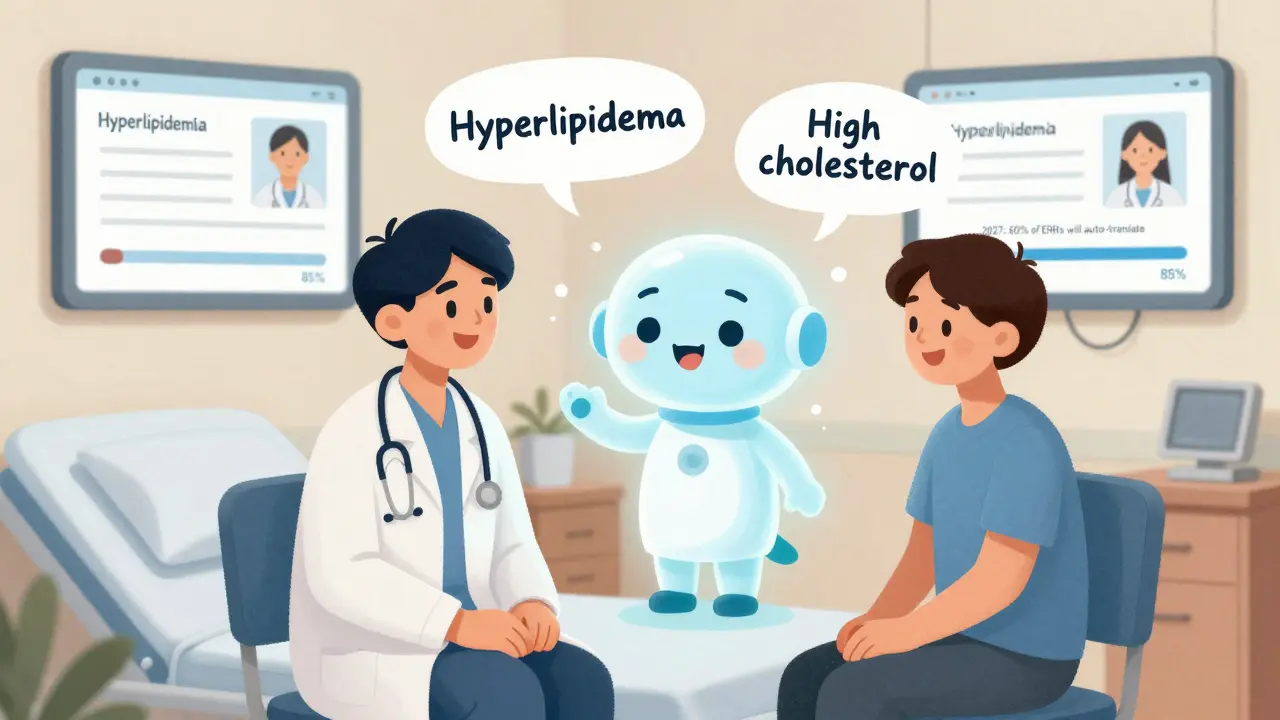
Technology is catching up too. HL7 FHIR, used by 78% of major U.S. health systems, lets EHRs show two versions of a note: one for providers, one for patients. Google’s Med-PaLM 2 AI can now convert clinical notes into plain language with 72.3% accuracy. It’s not perfect yet - but it’s getting close.
By 2027, the American Medical Informatics Association predicts 60% of EHRs will have real-time translation built in. That means when your doctor writes "hyperlipidemia," you’ll see "high cholesterol" - right there on your phone.
What You Can Do Today
You don’t have to wait for technology to fix this. You can take control now.
- Ask for plain language. When you hear a term you don’t know, say: "Can you explain that in simpler words?" No shame. Providers expect this.
- Use the teach-back method yourself. After your doctor gives instructions, say: "Just to make sure I got it - you’re saying I should take this pill with food, twice a day, even if I feel fine?" This catches misunderstandings before they become problems.
- Read your notes. If your portal lets you see them, open them. Don’t wait for your next visit. If something feels off, write it down. Bring it up.
- Ask for a summary. At the end of your visit, say: "Can you give me the top two things I need to remember?" That forces clarity.
Healthcare isn’t just about fixing bodies. It’s about connecting people. The labels matter - but only if they help you understand your own life.
What’s Next for Patient-Centered Care
The future of healthcare isn’t just better apps or faster EHRs. It’s a shift in power. It’s recognizing that the person who lives with the illness - not the person who diagnoses it - is the expert on their own experience.
When labels are translated, when notes are shared, when patients are asked to repeat back what they heard - that’s when care becomes truly patient-centered. Not because it’s trendy. But because it works.
And if you’ve ever felt lost in your own medical record - you’re not alone. And you’re not wrong. The system is still catching up. But now, you know how to speak up.
Why do doctors use medical jargon instead of plain language?
Doctors use medical jargon because it’s standardized for billing, research, and communication between providers. Systems like ICD-10 and CPT codes are required for insurance claims and legal documentation. While these terms are precise, they’re not meant for patient understanding. The real issue is when that language isn’t translated for patients - which is now being addressed through plain-language templates and patient portals.
Can I ask my doctor to rewrite my medical notes in simpler terms?
Yes, absolutely. You can ask for clarification during your visit or request a plain-language summary afterward. Many clinics now offer this as part of standard care. If your provider doesn’t offer it, ask if they can explain terms in your next visit or provide written materials. Your understanding is part of your care - you have the right to it.
What should I do if I find something wrong in my medical record?
If you see a mistake - like a wrong diagnosis, incorrect medication, or misunderstood symptom - contact your provider’s medical records department. You have a legal right under HIPAA to request corrections. Write down exactly what’s wrong and why. Most clinics have a form for this. Don’t wait. Inaccurate records can affect future care, prescriptions, or insurance claims.
Are patient portals making this problem better or worse?
They’re making it better - but only if used right. Before 2021, most patients couldn’t see their notes. Now, 89% can. That transparency is powerful. But if the notes are full of jargon, it can increase confusion. The solution isn’t hiding notes - it’s adding plain-language versions. Many hospitals now offer dual-view notes: one for providers, one for patients. If yours doesn’t, ask if they plan to.
How does this affect my insurance or billing?
The medical codes in your record - like ICD-10 or CPT - are what insurers use to decide if they’ll pay for your care. So accuracy matters for billing. But your personal description of symptoms doesn’t affect payment. That’s why providers write two versions: one for billing (with codes), one for you (in plain language). You don’t need to understand the codes - but you should understand what your condition means for your health.
Is this problem getting better over time?
Yes, and faster than most people realize. Since 2021, federal rules have forced providers to share notes with patients. ICD-11 now includes plain-language descriptions. AI tools are emerging to auto-translate clinical notes. Hospitals like Mayo Clinic and Kaiser Permanente have already reduced patient confusion by over 30%. By 2027, most EHRs will likely include real-time translation. The gap isn’t gone - but it’s closing.
Honestly? This whole thing is just bureaucracy wearing a white coat. Doctors don't care if you understand. They care if the code gets billed. Plain language? That's a marketing buzzword. The system ain't broken-it's designed this way to protect the institution.
I read this in Lagos and felt seen. My aunt went to the hospital with chest pain and came out with a sheet full of Latin words. She thought she had "something that kills rich people". No one told her it was just high blood pressure. We need translators-not just in language, but in humanity.
This is what happens when Western medicine colonizes the body. They take your pain, turn it into a code, and sell it to insurance giants. Your suffering becomes a line item. India doesn't need this. We have Ayurveda, yoga, ancestral wisdom. Why are we letting American EHRs dictate how we feel?
I work in a clinic and I swear half the time doctors just copy-paste notes. Last week I saw "chronic fatigue syndrome" for someone who just stayed up with a newborn. The system is lazy. And the patients? They just nod and pay the bill. #MedEdFail
It’s not just about language-it’s about power. The medical record is a sacred text, but only priests can read it. What if we flipped it? What if the patient’s description was the primary note, and the code was the footnote? Maybe then we’d stop treating bodies like data points.
This is why I always ask patients to repeat it back to me. 🙌 I don’t care if you know what "HbA1c" means-I care if you know you need to take your pill before breakfast. Small changes, big impact. And yes, I use plain language templates now. My patients actually show up for follow-ups. Who knew?
You think this is bad? Wait till AI starts writing your notes. Soon, your doctor won't even be in the room. Just a chatbot reading you a script generated by an algorithm trained on 10 million insurance denials. Welcome to the future. It's cold. It's efficient. And it doesn't care if you cry.
The use of standardized terminology ensures continuity of care across providers. While patient comprehension is important, clinical accuracy must remain paramount. Translation tools are helpful, but they cannot replace professional medical judgment.
The medical lexicon is a cathedral of abstraction-built by centuries of empiricism, yet inaccessible to the faithful who seek sanctuary within it. To translate is not to dilute, but to democratize. The soul of healing lies not in the precision of the label, but in the resonance between the one who suffers and the one who tends.
I just checked my portal. My doctor wrote 'anxiety disorder' but I told him I was stressed because my mom's sick and I'm working two jobs. He didn't write that. That's not just jargon-that's erasure.
I was in the ER last month with a migraine so bad I vomited. The note said: 'Headache, N/V, possible migraine'. I Googled it. Turned out 'N/V' meant nausea and vomiting. I cried. Not from pain. From being so alone in a room full of people who speak a language I don't know. We need to stop pretending this is normal.
This is why America is falling apart. We're giving patients too much control. Doctors are trained professionals. Let them do their job. If you can't understand a medical term, go back to school. Or stay home. This obsession with 'patient experience' is weakening the entire system.
I used to be a nurse. I saw people cry because they thought 'DM' meant 'defective human'. We need to teach providers this isn't just about efficiency-it's about dignity. A simple phrase like 'your blood sugar is too high' doesn't cost extra. But it changes lives.
My grandma didn’t know what 'hypertension' meant. She thought it was a new brand of tea. So I printed out a sticky note that said 'high blood pressure = take pill'. She stuck it on her fridge next to the milk. That’s patient-centered care. No AI needed.