Over-the-Counter Medication Safety: Hidden Ingredients and Interactions
Medication Safety Checker
This tool helps identify potential dangerous interactions between your OTC medications and prescription drugs based on known safety issues discussed in the article.
Enter the medications you're currently taking, including prescription drugs and OTC products. The tool will check for dangerous combinations and hidden ingredients based on FDA reports.
How This Tool Works
This tool identifies dangerous interactions based on known ingredients mentioned in the article. It checks for combinations that could cause severe health issues like high blood pressure, heart attacks, or kidney damage.
WARNING: Potential Danger Detected
Based on your inputs, you may have dangerous medication combinations. Stop taking these products immediately and consult your doctor or pharmacist.
SAFE: No Dangerous Combinations Detected
Your medication combinations don't appear to have dangerous interactions based on known issues. However, always check for third-party verification on your supplements.
Common Hidden Ingredients to Watch For
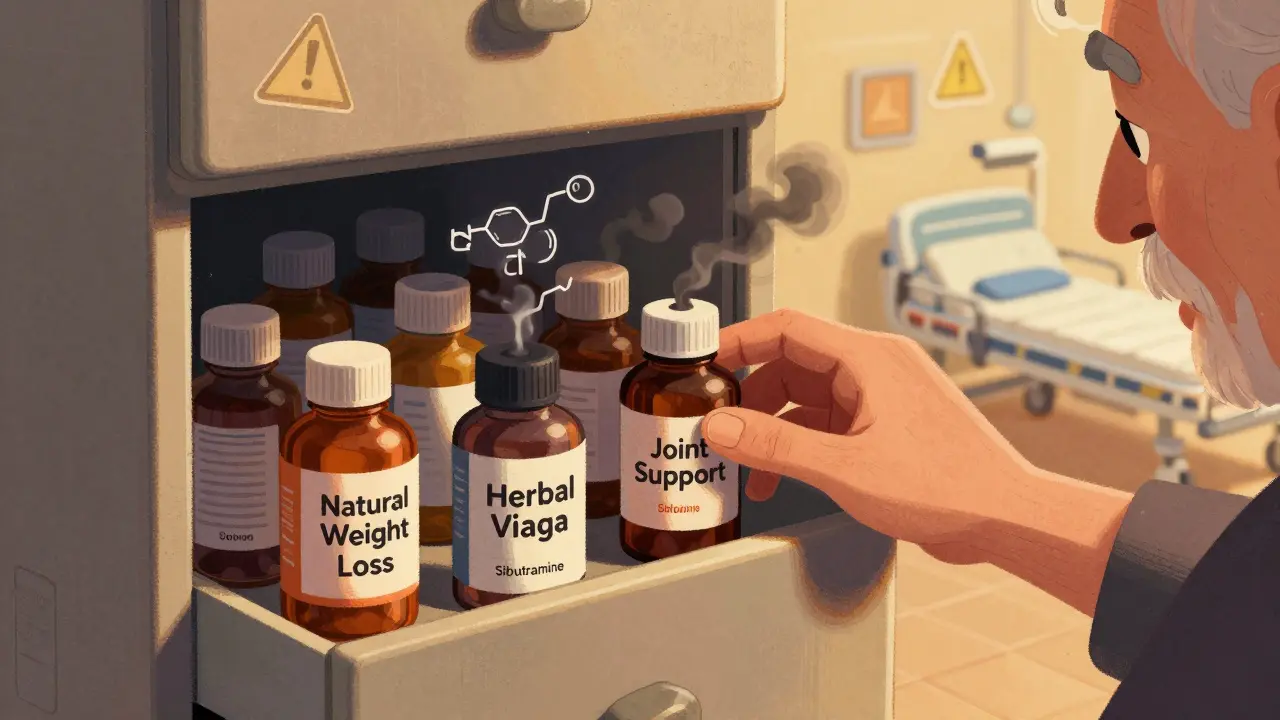
- Sibutramine: Increases risk of heart attack and stroke. Banned since 2010 but still found in weight loss products.
- Sildenafil: Same ingredient as Viagra. Causes dangerous drops in blood pressure when mixed with certain medications.
- Phenolphthalein: Potential carcinogen. Previously used in laxatives but now illegal in OTC products.
- Hidden NSAIDs: Can cause kidney damage when combined with certain medications.
Every year, millions of people reach for over-the-counter (OTC) meds without a second thought. A pain reliever for a headache. A sleep aid after a long day. A weight loss pill promising quick results. But what if the bottle you’re holding doesn’t tell you everything inside? What if it contains a prescription drug you didn’t ask for - one that could send you to the ER?
What’s Really in Your OTC Pills?
You might think OTC means safe. But the truth is, many supplements and OTC products are packed with hidden ingredients that aren’t listed on the label. Between 2007 and 2021, the FDA identified over 1,000 dietary supplements containing active pharmaceutical ingredients - drugs that are either banned or require a prescription. These aren’t mistakes. They’re deliberate additions by manufacturers trying to make their products work faster - and make more money. The most common culprits? Sibutramine in weight loss pills, sildenafil (the same ingredient in Viagra) in sexual enhancement products, and phenolphthalein in laxatives. Sibutramine was pulled from the market in 2010 because it raised the risk of heart attack and stroke by 16%. Yet it’s still showing up in products sold online as “all-natural fat burners.” Phenolphthalein, once a common laxative, was flagged by the National Toxicology Program as a potential carcinogen. And sildenafil? It’s in nearly 300 products marketed as “herbal Viagra.” None of these are listed on the label. None of them come with warnings.Why This Is a Silent Health Crisis
The real danger isn’t just the hidden drugs - it’s what happens when they mix with what you’re already taking. Imagine you’re on blood pressure medication. You take a “natural” weight loss pill containing sibutramine. Your blood pressure spikes to dangerous levels - 180/110, like one Reddit user reported. You don’t know why. Your doctor doesn’t know why. You end up in the hospital. Or maybe you’re diabetic and take a joint pain supplement. It contains hidden NSAIDs - nonsteroidal anti-inflammatory drugs - that can spike your blood sugar and damage your kidneys. The American College of Gastroenterology says NSAIDs cause 100,000 hospitalizations and 16,500 deaths every year in the U.S. Add in hidden ingredients, and those numbers could be much higher. Even common OTC meds like ibuprofen or naproxen carry serious risks: stomach ulcers, kidney failure, heart attacks. When you layer on unlisted drugs, the risks multiply. A 2019 NIH study found that 20.2% of contaminated supplements contained multiple hidden drugs. One product had six. Six different prescription-strength chemicals, all hidden, all untested for interactions with your existing meds.Who’s at Risk - And Why
This isn’t just about people buying shady supplements online. It’s about grandparents taking “joint support” pills while on blood thinners. It’s about teens trying the “Benadryl challenge” on TikTok, overdosing on diphenhydramine until they have seizures or heart arrhythmias. It’s about people with chronic conditions who assume “natural” means safe. Elderly adults take an average of 4.9 prescription medications plus supplements. That’s a recipe for disaster when hidden ingredients aren’t tracked. Adolescents are increasingly targeted by social media trends promoting OTC misuse. And the elderly? They’re often the most trusting - and the most vulnerable. The FDA has documented cases of priapism - painful, prolonged erections lasting more than four hours - caused by sexual enhancement supplements. These aren’t rare. They’re emergencies. One case required surgery to prevent permanent tissue damage. Another involved severe gastrointestinal bleeding, liver failure, and hospitalization.
How to Protect Yourself
You don’t have to give up OTC meds. But you do need to be smarter about them. Here’s how:- Check the FDA’s Health Fraud Product Database. Type in the product name or brand. If it’s listed, don’t buy it. If it’s not listed? That doesn’t mean it’s safe - just that it hasn’t been caught yet.
- Look for third-party seals. USP, NSF International, or ConsumerLab.com test products for what’s actually inside. These aren’t perfect, but they’re the best option available.
- Use the 5-5-5 rule. Before buying any OTC product: spend 5 minutes Googling it, 5 minutes checking the FDA database, and 5 minutes asking your pharmacist. Pharmacists see these cases every day.
- Never trust “all-natural” or “miracle” claims. If a weight loss pill promises 20 pounds in two weeks, it’s hiding something. If a sexual enhancer says “works like Viagra but without a prescription,” it probably contains sildenafil. Eighty-seven percent of these products do.
- Keep a full medication list. Write down every pill, powder, drop, or gummy you take - even the ones you think are “just vitamins.” Bring it to every doctor’s visit. A 2021 JAMA study found 63% of adverse events involving supplements happened because patients didn’t tell their doctors they were taking them.
The Bigger Problem: A Broken System
The supplement industry is a $44 billion business in the U.S. alone. But here’s the catch: the FDA doesn’t approve supplements before they hit the shelves. Under the 1994 DSHEA law, manufacturers are responsible for safety - not the government. That means a company can sell a product with sibutramine, and the FDA won’t know until someone gets sick and reports it. And reports are rare. Only 0.3% of adverse events are ever reported to the FDA. That means for every one case you hear about, there are hundreds going unnoticed. The average time between a dangerous product being identified and being pulled from shelves? Fourteen months. Even worse, the same products keep popping up. In one study, 3.8% of contaminated products were caught multiple times - each time with new hidden ingredients. It’s like playing whack-a-mole with poison. Congress has tried to fix this. The 2023 OTC Medication Safety Act proposed mandatory reporting and stronger FDA powers. But until laws change, you’re the last line of defense.
What to Do Right Now
If you’re taking any OTC supplement, stop and ask yourself: Do I really know what’s in this? - If you’re unsure, throw it out. Better safe than sorry. - If you’ve had unexplained side effects - rapid heartbeat, dizziness, nausea, chest pain - talk to your doctor. Bring the bottle. Ask: Could this contain something hidden? - If you’re helping an older relative manage their meds, check their medicine cabinet. Many of these products are bought online and kept in drawers, out of sight. - Talk to your pharmacist. They’re not just there to fill prescriptions. They’re trained to spot dangerous combinations. The truth is, OTC doesn’t mean harmless. It means unregulated. And in a system where the fox guards the henhouse, you have to be your own watchdog.Frequently Asked Questions
Can I trust OTC supplements labeled as ‘natural’ or ‘herbal’?
No. Products labeled ‘natural’ or ‘herbal’ are among the most likely to contain hidden pharmaceutical ingredients. A 2018 study found that 87% of sexual enhancement supplements marketed as ‘natural’ contained sildenafil or tadalafil - prescription drugs that are never listed on the label. ‘Natural’ doesn’t mean safe. It often means untested and unregulated.
What should I do if I think a supplement made me sick?
Stop taking it immediately. Save the bottle and packaging. Contact your doctor and report the reaction to the FDA through their MedWatch program. Even if you’re not sure the supplement caused the issue, report it. The FDA needs these reports to identify dangerous products. Only 0.3% of adverse events are reported - your report could help prevent someone else’s hospitalization.
Are there safe OTC supplements I can use?
Yes - but only if they carry a third-party verification seal from USP, NSF International, or ConsumerLab.com. These organizations test for label accuracy, contaminants, and hidden drugs. Look for their logo on the bottle. If it’s not there, assume the worst. Even then, talk to your pharmacist before starting any new supplement, especially if you’re on prescription meds.
Why don’t more people know about this?
Because the industry spends billions on marketing that makes supplements sound harmless and natural. Meanwhile, the FDA lacks the staff and authority to police the market effectively. Only 17 full-time employees are assigned to oversee all dietary supplements in the U.S. Most consumers assume if it’s on the shelf, it’s safe. That’s a dangerous assumption.
Can hidden ingredients in OTC meds interact with my prescription drugs?
Absolutely - and dangerously. Sibutramine can raise blood pressure and interfere with antidepressants. Sildenafil can cause severe drops in blood pressure when mixed with nitroglycerin or other heart meds. NSAIDs can damage kidneys when taken with diuretics or blood pressure drugs. These aren’t theoretical risks. They’re documented emergencies. Always tell your doctor and pharmacist everything you’re taking - even the supplements you think are harmless.
So let me get this right: the FDA has 17 people watching over $44 billion in supplements?? And we wonder why people are dropping like flies?? This isn't negligence-it's corporate capture with a side of apathy. I took a 'natural' energy booster last year. Woke up with my heart trying to escape my chest. Turned out to have hidden caffeine analogs. No label. No warning. Just a pretty bottle with a mountain on it. I'm lucky I didn't die. Now I only buy USP-certified stuff-or nothing at all. And yes, I'm still mad.
It is imperative to underscore the critical importance of regulatory oversight in the realm of dietary supplements, particularly given the absence of pre-market approval mandated by the Dietary Supplement Health and Education Act of 1994. The documented presence of unlisted pharmaceutical agents within consumer products constitutes a significant public health concern, necessitating heightened vigilance on the part of both consumers and healthcare professionals. It is strongly advised that individuals consult with licensed pharmacists prior to ingestion of any non-prescription product, and that all adverse events be formally reported to the FDA’s MedWatch program to facilitate systemic improvement.
I used to buy those 'fat burner' gummies for my mom. She’s 72, on blood pressure meds. I thought they were just vitamins. Then she started having dizzy spells. We threw them out, got the bottle to the pharmacist, and he said, 'Oh yeah, that one’s been flagged.' I didn’t know. No one told me. I feel awful. Now I check every bottle with her doctor before she even opens it.
Look I get it people are scared but don’t let fear make you paranoid. I take a joint supplement every day and I’ve never had an issue. The key is knowing your body and talking to your doctor. Most of these horror stories are outliers. The real problem is that people don’t read labels or ask questions. Just because something’s online doesn’t mean it’s poison. Do your homework and you’ll be fine
They’re putting this stuff in because they know you’re dumb enough to buy it. The FDA doesn’t care. The pharmaceutical companies own Congress. The whole system is rigged. You think they want you healthy? No. They want you dependent. On their pills. On their doctors. On their profits. They let these supplements fly under the radar so you’ll keep buying them-and then when you end up in the ER, they’ll charge you $20k to fix what they made. Wake up. This isn’t an accident. It’s a business model.
Man I’m from India and we’ve got the same problem here-people buy weight loss powders from Instagram influencers who say it’s 'ancient Ayurvedic wisdom' but it’s got sibutramine mixed in with turmeric and sugar. My cousin’s uncle had a stroke after three weeks of taking one of those. The labels are in Hindi, English, and sometimes Sanskrit to look legit. No one checks the FDA because they don’t even know it exists. We need education campaigns in local languages-not just for Americans. This isn’t a US-only crisis. It’s global. And it’s getting worse because social media algorithms push these products to the most vulnerable-elderly, low-income, people with chronic pain. We need to stop treating this like a personal responsibility issue and start treating it like a public health emergency.
You’re not being paranoid if the system is designed to fail you. The fact that you have to be a detective just to buy a pain reliever is a sign that something is deeply wrong. Stop blaming yourself for not knowing. Start blaming the companies that hide poison in pretty bottles. And if you’re reading this and you’re a pharmacist, a nurse, a doctor-speak up. We need more professionals calling this out publicly. This isn’t just about labels. It’s about trust. And trust has been broken.
This is what happens when you let foreigners and corporations run your country. The FDA doesn’t act because they’re too busy bowing to globalist agendas. Real Americans used to make real medicine. Now we’re eating Chinese-laced weight loss pills because we’re too lazy to eat right. This isn’t science. It’s surrender. And the people who buy this stuff are just enabling the collapse. Take responsibility. Stop being a victim. The solution isn’t more regulation-it’s more discipline.
They put this stuff in because they know you’re stupid. You think the government cares? They get paid to look the other way. I saw a guy on YouTube who said his wife died from a 'natural' sleep aid. Turns out it had benzos and antidepressants. No warning. No label. Just a pretty bottle. And now the company is still selling it. Why? Because no one reports it. And the FDA is too busy doing nothing. This is why I don’t trust anything made after 2000. Everything’s poisoned. Everything’s a scam. You think your vitamins are safe? They’re not. They’re just waiting for you to die so they can sell another one.
I used to think supplements were harmless until my dad ended up in the hospital after taking a 'joint support' pill. Turns out it had naproxen and a hidden diuretic. He didn’t know. His doctor didn’t know. The label said 'organic herbs.' We found out by accident because the pharmacist recognized the ingredients from a previous case. Now I check every bottle with him. I don’t care how 'natural' it looks. If it’s not USP or NSF, it’s not in this house. You’re not being dramatic if your life’s on the line.
I’ve been a pharmacy tech for 12 years. I’ve seen this happen too many times. Elderly patients come in with 12 bottles, half of them bought online. I ask what’s in them. They say 'I don’t know, it’s just for my back.' I check the label. Sometimes it’s nothing. Sometimes it’s a hidden NSAID. Sometimes it’s two. One time, a woman had five hidden drugs in one capsule. She was on warfarin. She didn’t know. I told her to stop. She cried. Said she couldn’t afford her real meds. That’s the real tragedy-not the hidden chemicals, but the fact that people are choosing between pain and safety because the system failed them. We need better access to affordable care, not just better labels.
My mom bought a 'natural' testosterone booster on Amazon. Said it made her feel 'more energized.' Three weeks later she had a panic attack and her BP was sky high. We threw it out. Turned out it had clenbuterol. I didn’t even know that was a thing. Now I check every supplement with her pharmacist before she touches it. If it doesn’t have USP or NSF? Gone. I don’t care if it’s 'all natural' or 'made in the USA.' If the label’s too vague, I don’t trust it. Simple as that.
The 1994 DSHEA law is a catastrophe. It created a legal loophole that allows manufacturers to sell untested, unregulated, and often toxic substances under the guise of 'dietary supplements.' The FDA’s inability to act preemptively is not incompetence-it is statutory surrender. The agency lacks the authority to require pre-market safety data, meaning that every product on the shelf is, by default, a potential hazard. Until Congress amends DSHEA to require FDA pre-approval, this crisis will persist. The burden of proof should lie with the manufacturer-not the consumer. This is not a matter of personal responsibility. It is a matter of regulatory failure on a national scale.
I used to be the person who bought every 'miracle' supplement I saw on TikTok. Weight loss. Energy. Libido. All of it. I thought if it was on the internet, it was legit. Then I started having weird heart palpitations after taking a 'natural' sleep aid. I didn’t think much of it-until I Googled the ingredients and found out it had melatonin AND phenolphthalein. I threw everything out. Now I only buy things with USP seals. I still take supplements, but I’m way more careful. I wish I’d known sooner. I don’t want anyone else to learn the hard way like I did.