Insomnia Treatment: CBT-I vs. Sleep Medications - What Actually Works Long-Term?

Waking up at 3 a.m., staring at the ceiling, and dreading the day ahead is a feeling many of us know too well. If you’ve tried counting sheep or drinking warm milk without success, you’re not alone. For millions of people struggling with chronic insomnia, a persistent difficulty falling or staying asleep despite adequate opportunity to do so, the question isn’t just how to get some rest tonight-it’s how to fix the underlying problem for good.
The medical community has largely settled on two main paths forward: Cognitive Behavioral Therapy for Insomnia (CBT-I), a structured psychological treatment targeting thoughts and behaviors that perpetuate sleeplessness and traditional sleep medications, pharmacological aids such as zolpidem or melatonin receptor agonists used to induce sleep. While pills offer immediate relief, they often come with trade-offs. Therapy takes work but offers lasting change. So, which route should you take? Let’s break down the evidence, the process, and what it actually feels like to treat insomnia properly.
Why CBT-I Is the Gold Standard
If there’s one thing sleep specialists agree on, it’s this: CBT-I, the first-line recommended treatment for chronic insomnia by major medical organizations including the American College of Physicians is the most effective long-term solution available. Developed in the 1980s, this therapy doesn’t just mask symptoms; it rewires the habits and thought patterns that keep you awake.
Think about it this way. You might have lost sleep initially due to stress-a big project at work or a family issue. That stressor is gone now, but you’re still lying awake. Why? Because over time, your brain has learned to associate your bed with anxiety rather than rest. You start worrying about not sleeping, which makes it harder to sleep. It’s a vicious cycle. CBT-I breaks that cycle by addressing these maladaptive behaviors directly.
According to the American Academy of Sleep Medicine (AASM), the professional organization representing sleep medicine physicians and scientists, CBT-I is the preferred initial treatment for chronic insomnia. A massive 2023 Cochrane Review analyzed 102 randomized controlled trials and confirmed its efficacy. Unlike medications, which stop working once you stop taking them, CBT-I teaches you skills that last a lifetime. In fact, studies show that 68% of patients maintain their improvement one year after completing CBT-I, compared to only 32% of those who relied solely on medication.
How CBT-I Actually Works
CBT-I isn’t just “talk therapy.” It’s a highly structured program, usually consisting of 6 to 8 weekly sessions, each lasting 45 to 60 minutes. It combines several powerful techniques designed to reset your sleep drive and calm your mind.
- Sleep Restriction Therapy (SRT): This sounds counterintuitive, but it’s the engine behind CBT-I’s success. Your therapist limits your time in bed to match your actual sleep time (usually no less than 5 hours). If you only sleep 6 hours but spend 9 hours in bed, you’ll be restricted to 6 hours initially. This builds “sleep pressure,” making it easier to fall asleep and stay asleep. As your efficiency improves, you gradually add more time back.
- Stimulus Control Therapy (SCT): This reassociates your bed with sleep. The rules are strict: use the bed only for sleep and sex. If you can’t sleep within 20 minutes, get out of bed and go to another room until you’re tired. No phones, no TV, no reading in bed. This trains your brain that bed equals sleep.
- Cognitive Restructuring: We all have negative thoughts about sleep (“If I don’t get 8 hours, I’ll fail my presentation”). This technique helps you identify and challenge these catastrophic beliefs. You learn to replace “I’m doomed” with “I can function even if I’m tired.”
- Sleep Hygiene Education: This covers the basics-limiting caffeine, keeping the bedroom cool and dark, and maintaining a consistent wake time, even on weekends.
- Relaxation Techniques: Progressive muscle relaxation or diaphragmatic breathing helps lower physiological arousal, preparing your body for rest.
A 2024 study in *Nature Digital Medicine* found that patients who completed at least 80% of the cognitive restructuring modules saw a 62% greater reduction in insomnia severity than those who did less. Consistency matters.
The Truth About Sleep Medications
Let’s be honest: when you’re exhausted, a pill seems like the easiest answer. Zolpidem (Ambien), a sedative-hypnotic medication commonly prescribed for short-term treatment of insomnia is the most widely prescribed sleep aid in the United States, accounting for nearly half of all insomnia prescriptions. It works fast. You take it, and you sleep.
But there’s a catch. Medications treat the symptom, not the cause. According to a 2021 FDA drug safety communication, tolerance develops in 42% of patients within just 8 weeks. This means you need higher doses to get the same effect, increasing the risk of side effects like morning grogginess, memory issues, and even complex sleep behaviors like sleepwalking.
Furthermore, reliance on medication can perpetuate the fear of being unable to sleep without help. When the drug wears off, the original anxiety returns, often stronger than before. A 2022 meta-analysis in *Sleep Medicine Reviews* showed that while meds and CBT-I are equally effective in the short term (4-8 weeks), CBT-I pulls ahead significantly in the long run. At 12 months, only 32% of medication users maintained clinical improvement, whereas 68% of CBT-I patients did.
That said, medication isn’t always wrong. For some, a short course of medication combined with CBT-I can provide the stability needed to engage fully in therapy. A 2023 JAMA Network Open study found that combination therapy yielded the best durability, with 74% of patients maintaining significant improvement at 6 months. However, the goal should always be to taper off the medication as the therapy takes hold.
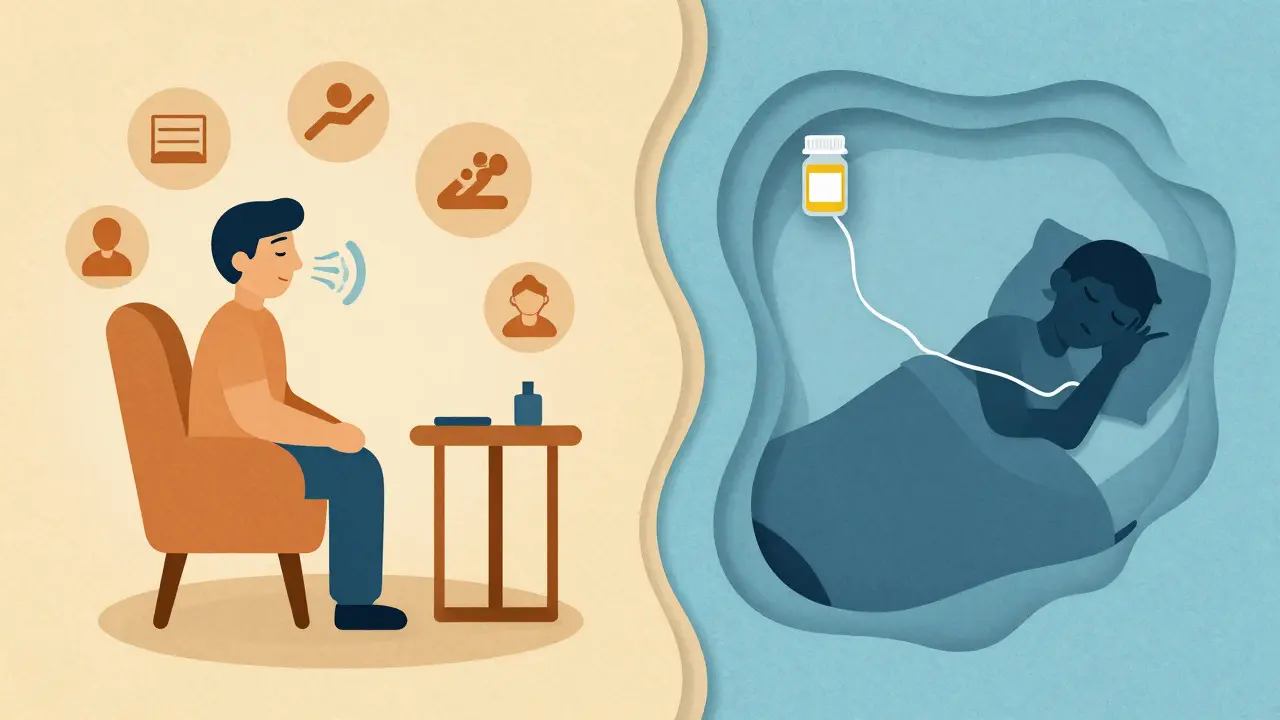
Comparing the Two Approaches
To help you decide, let’s look at how these treatments stack up against each other across key metrics.
| Feature | CBT-I | Sleep Medications (e.g., Zolpidem) |
|---|---|---|
| Onset of Action | Gradual (1-4 weeks for noticeable improvement) | Rapid (within 30-60 minutes of ingestion) |
| Long-Term Efficacy | High (68% maintain response at 1 year) | Low (32% maintain response at 1 year) |
| Side Effects | Minimal (temporary fatigue during sleep restriction) | Moderate to High (grogginess, dependency, tolerance) |
| Mechanism | Addresses root causes (behavior/thoughts) | Treats symptoms (sedation) |
| Cost & Access | Higher upfront cost/time; covered by Medicare/many insurers | Lower upfront cost ($15 copay); requires prescription |
| Risk of Dependency | None | Significant (tolerance develops in ~42% of users) |
Is CBT-I Hard to Do?
You might be wondering if you have the discipline for CBT-I. The honest answer is yes, it requires effort. The hardest part is usually the first few weeks of sleep restriction. Deliberately limiting your time in bed can make you feel tired during the day. In fact, 41% of users report significant initial difficulty, particularly during weeks 2 and 3.
However, this temporary discomfort is part of the healing process. By building sleep pressure, you’re essentially starving the insomnia. Most people find that by week 4 or 5, they are falling asleep faster and staying asleep longer. The data supports this: patients who stick with the protocol see their sleep efficiency jump from an average of 68% to over 90%.
Access has also improved dramatically. You don’t necessarily need to find a local specialist. Digital CBT-I platforms like Somryst, an FDA-cleared prescription digital therapeutic for insomnia and Sleepio, a leading digital CBT-I platform with clinical validation offer guided programs that mimic in-person therapy. These apps have seen high completion rates (65-70%) and are increasingly covered by insurance. Medicare, for instance, began covering digital CBT-I in 2022, processing over 140,000 claims in 2023 alone.

Who Should Try What?
Your choice depends on your specific situation. Here’s a quick guide:
- Choose CBT-I if: You have chronic insomnia (lasting more than 3 months), you want a permanent solution, you are wary of medication side effects, or you’ve tried pills and they stopped working.
- Consider Medication if: You are facing an acute, short-term crisis (like a bereavement or sudden job loss) and need immediate relief to function. Use it as a bridge, not a destination.
- Combine Both if: Your insomnia is severe enough that you cannot engage in therapy without some initial support. Work with your doctor to create a tapering plan for the medication as your CBT-I skills improve.
It’s also worth noting that systemic barriers exist. Only 15% of primary care physicians feel confident delivering CBT-I, and insurance reimbursement can be tricky. But with the rise of digital therapeutics and increased coverage from major insurers like UnitedHealthcare, access is becoming easier every year.
Final Thoughts on Treating Insomnia
Insomnia is not just a nuisance; it’s a health condition that affects your mood, productivity, and physical well-being. While sleep medications offer a quick fix, they often leave you dependent and vulnerable to rebound insomnia. CBT-I, though demanding, offers a path to true recovery. It teaches you to trust your ability to sleep again.
If you’re ready to tackle insomnia head-on, consider starting with a sleep diary to track your patterns. Then, seek out a certified CBT-I provider or explore FDA-cleared digital options. The investment of time and effort pays off in nights of deep, restorative rest-and days where you finally feel like yourself again.
How long does CBT-I take to work?
Most patients begin to notice improvements within 1 to 4 weeks of starting the program. Significant changes in sleep onset latency and total sleep time are typically observed by the end of the standard 6-8 week course. Full benefits, however, may continue to develop as you refine your skills over several months.
Can I use CBT-I and sleep medications together?
Yes, combination therapy is often effective, especially for severe insomnia. Studies show that combining CBT-I with medication yields the highest durability of results (74% maintenance at 6 months). The key is to use medication as a temporary aid while learning CBT-I skills, with a clear plan to taper off the drugs under medical supervision.
Is CBT-I covered by insurance?
Coverage varies by provider and plan. Medicare began covering digital CBT-I (dCBT-I) in 2022. Many private insurers, including UnitedHealthcare, have expanded coverage to millions of members. In-person CBT-I may require a referral from a primary care physician or sleep specialist to ensure reimbursement. Always check with your insurer beforehand.
What are the side effects of CBT-I?
CBT-I has minimal side effects compared to medication. The most common complaint is temporary daytime fatigue or irritability during the initial sleep restriction phase (weeks 2-3). This is intentional and subsides as sleep efficiency improves. There are no risks of dependency, tolerance, or morning grogginess associated with the therapy itself.
How do I find a CBT-I provider?
You can search for certified providers through the American Board of Sleep Medicine or the Academy of Cognitive and Behavioral Health. Alternatively, you can ask your primary care doctor for a referral. If in-person therapy is not accessible, FDA-cleared digital platforms like Somryst or Sleepio are excellent alternatives that offer guided, evidence-based programs.