Idiosyncratic Drug Reactions: Understanding Rare, Unpredictable Side Effects

Idiosyncratic Drug Reaction Risk Assessor
Patient Profile & Symptoms
Assessment Result
Enter patient details and symptoms to analyze the likelihood of an Idiosyncratic Drug Reaction.
Imagine taking a medication that millions of people use safely every day. For most, it works perfectly. But for you, it triggers a sudden, severe reaction that has nothing to do with the dose or the drug’s intended effect. This isn’t an allergy in the traditional sense, nor is it a predictable side effect like drowsiness from antihistamines. It is an idiosyncratic drug reaction, also known as type B adverse drug reaction. These rare, unpredictable events affect approximately 1 in 10,000 to 1 in 100,000 patients, yet they account for 30-40% of all drug withdrawals from the market. Understanding these reactions is critical because they often evade standard preclinical testing and can lead to life-threatening conditions if not recognized early.
What Are Idiosyncratic Drug Reactions?
To grasp what makes idiosyncratic reactions so dangerous, we first need to distinguish them from the more common type A adverse drug reactions. Type A reactions are predictable, dose-dependent extensions of a drug’s pharmacological effects. If you take too much blood pressure medication, your pressure drops too low. That is type A. It accounts for 80-85% of all adverse drug reactions and is generally manageable by adjusting the dose.
In contrast, idiosyncratic drug reactions (IDRs) are unrelated to dosage and occur only in susceptible individuals due to complex interactions between drug properties and patient-specific factors. First categorized in the 1977 Rawlins and Thompson classification system, IDRs represent the "unpredictable" category. They typically manifest after a latency period of 1 to 8 weeks following drug exposure. The severity ranges from mild, self-limiting symptoms to life-threatening organ failure. According to the U.S. Food and Drug Administration (FDA), 38 drugs were withdrawn from the U.S. market between 1950 and 2023 primarily due to idiosyncratic toxicity, including notable cases like troglitazone and bromfenac.
Common Types and Clinical Presentations
While IDRs can affect any organ system, two categories dominate clinical reports: liver injury and severe skin reactions. Recognizing the specific presentation helps clinicians differentiate IDRs from other conditions.
- Idiosyncratic Drug-Induced Liver Injury (IDILI): This accounts for 45-50% of all severe drug-induced liver injury cases. It manifests primarily as hepatocellular injury (60-65% of cases) or cholestatic injury (30-35%). The severity can be high, with mortality rates of 5-10% for severe cases.
- Severe Cutaneous Adverse Reactions (SCARs): These include Stevens-Johnson syndrome (SJS), toxic epidermal necrolysis (TEN), and drug reaction with eosinophilia and systemic symptoms (DRESS). Collectively, they represent about 30% of severe IDRs. TEN carries a particularly high mortality rate of 25-35%.
The diagnostic challenge lies in the timing. Unlike immediate allergic reactions, IDRs often appear weeks after starting the medication. This delay frequently leads to misdiagnosis. A 2021 survey by the DRESS Syndrome Foundation found that 89% of patients experienced diagnostic delays averaging 17.3 days, with 63% initially misdiagnosed with a viral infection. This lag time allows the condition to worsen before treatment begins.
Why Do They Happen? Mechanisms and Risk Factors
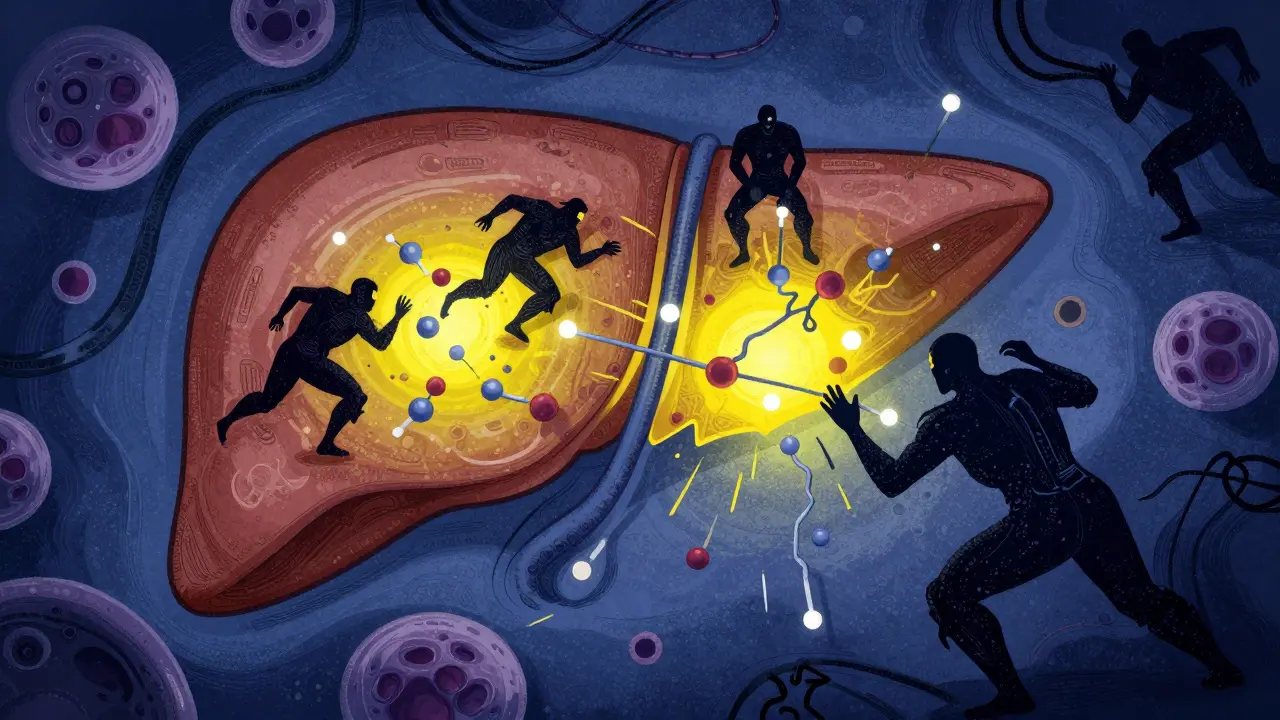
The exact cause of an IDR remains elusive for many drugs, but leading theories focus on immune system interactions. Dr. Jack Uetrecht, a prominent pharmacologist at the University of Toronto, supports the hapten hypothesis. In this model, reactive drug metabolites bind covalently to proteins in the body, creating "neoantigens." The immune system recognizes these new structures as foreign invaders and launches an attack, damaging healthy tissue.
Another framework is the "danger hypothesis," where cellular stress signals amplify immune responses to drug antigens. While we don't fully understand every mechanism, we know that genetic predisposition plays a massive role. This is where pharmacogenomics comes into play. Certain human leukocyte antigen (HLA) alleles are strongly linked to specific IDRs.
| Drug | Reaction | Genetic Marker | Predictive Value |
|---|---|---|---|
| Abacavir | Hypersensitivity | HLA-B*57:01 | Negative predictive value 100% |
| Carbamazepine | SJS/TEN (Southeast Asian pop.) | HLA-B*15:02 | Negative predictive value 99.9% |
| Phenytoin | SJS/TEN | HLA-A*31:01 | Odds ratio 25.9 |
Despite these successes, predictive biomarkers exist for only a handful of drugs. The FDA reported in 2019 that 92% of serious IDRs occur without prior warning signs during standard clinical use. This lack of predictability is why IDRs remain such a significant challenge in drug safety.
Diagnosis and Clinical Management
Diagnosing an IDR is largely a process of exclusion. Clinicians must rule out underlying diseases, infections, and other causes before attributing symptoms to the drug. Two validated scales help guide this assessment:
- Roussel Uclaf Causality Assessment Method (RUCAM): Used specifically for liver injury. A score greater than 8 indicates 'highly probable' causality.
- ALDEN Algorithm: Used for cutaneous reactions like SJS/TEN to assess drug causality.
The cornerstone of management is immediate discontinuation of the suspected drug. Studies show that dechallenge (symptom resolution after stopping the drug) is a key diagnostic indicator. Rechallenge (restarting the drug) is rarely performed due to ethical concerns and the risk of fatal recurrence, occurring in only 5-10% of cases.
Specialized testing, such as lymphocyte transformation tests, can support diagnosis but have limited sensitivity (60-70%). Because IDRs often require hospitalization-70-80% of cases result in admission compared to 20-30% for type A reactions-early recognition by primary care providers is vital. Delays in diagnosis significantly increase morbidity and costs, with the average financial burden of a severe IDR event reaching $47,500.

Impact on Drug Development and Industry
For pharmaceutical companies, IDRs are a major financial and regulatory hurdle. The global cost of IDR-related drug failures and withdrawals is estimated at $12.4 billion annually. This represents 15-20% of total late-stage drug development costs. Consequently, the industry has shifted toward more rigorous preclinical screening.
A key strategy is reactive metabolite screening. By identifying drug metabolites that are chemically reactive and likely to form haptens, companies can flag potential risks early. Pfizer, for example, implements a threshold of less than 50 pmol/mg protein for reactive metabolites in preclinical testing. Regulatory bodies like the FDA now require comprehensive metabolite profiling for drugs with systemic exposure exceeding 10% of the parent drug.
Despite these advances, IDRs remain the leading cause of post-marketing withdrawals. Between 2000 and 2020, the FDA recorded 18 drug withdrawals primarily due to idiosyncratic toxicity, compared to only 3 for predictable toxicity issues. This highlights the limitations of clinical trials, which involve small, homogeneous populations and cannot capture the rare genetic variations present in the general public.
Future Directions: Biomarkers and AI
The future of IDR management lies in better prediction. Recent developments offer hope. In 2023, the FDA approved the first IDR prediction test for pazopanib hepatotoxicity, showing 82% sensitivity in clinical trials. Genome-wide association studies have identified 17 new HLA-drug associations, expanding the scope of pharmacogenomic screening.
Artificial intelligence is also being deployed to analyze vast datasets. Companies like ArisGlobal and Oracle Health Sciences are developing AI-driven tools to detect IDR signals in real-world data. While current models have not yet achieved >70% predictive accuracy in real-world validation, the integration of multi-omics data-including genomics, proteomics, and immunology-promises to improve risk stratification. The European Commission’s IMI2 project 'ADRomics' aims to deliver multi-omics prediction models by 2027.
As Dr. Ulrich Warnke noted in a 2019 analysis, despite decades of research, we still lack predictive models for most IDRs. However, the convergence of pharmacogenomics and AI creates a realistic pathway to reduce severe IDR incidence by 60-70% within the next decade. Until then, vigilance, early reporting, and awareness of the classic triad-unexpected timing, disproportionate severity, and lack of alternative explanation-remain our best defenses.
How long does it take for an idiosyncratic drug reaction to appear?
Idiosyncratic drug reactions typically manifest after a latency period of 1 to 8 weeks following initial drug exposure. This delayed onset often leads to misdiagnosis, as symptoms may be attributed to unrelated illnesses like viral infections.
Can genetic testing prevent all idiosyncratic reactions?
No, genetic testing can only predict reactions for a small number of drugs. Currently, markers like HLA-B*57:01 for abacavir and HLA-B*15:02 for carbamazepine are clinically implemented. For the vast majority of medications, no validated predictive biomarkers exist, meaning 92% of serious IDRs occur without prior genetic warning.
What is the difference between Type A and Type B adverse drug reactions?
Type A reactions are predictable, dose-dependent, and related to the drug's pharmacological effect (e.g., bleeding from anticoagulants). Type B (idiosyncratic) reactions are unpredictable, not dose-dependent, and occur only in susceptible individuals due to unique immune or metabolic interactions.
What should I do if I suspect an idiosyncratic reaction?
If you experience unexpected, severe symptoms like rash, fever, or jaundice 1-8 weeks after starting a new medication, contact your healthcare provider immediately. Do not restart the drug. Early discontinuation is the most critical step in preventing severe organ damage or life-threatening complications.
Are idiosyncratic drug reactions common?
They are rare, affecting approximately 1 in 10,000 to 1 in 100,000 patients. However, because they are severe and unpredictable, they account for a disproportionate number of drug withdrawals and hospitalizations compared to more common side effects.