How to Translate Medication Names and Doses for Foreign Pharmacies: A Traveler’s Safety Guide
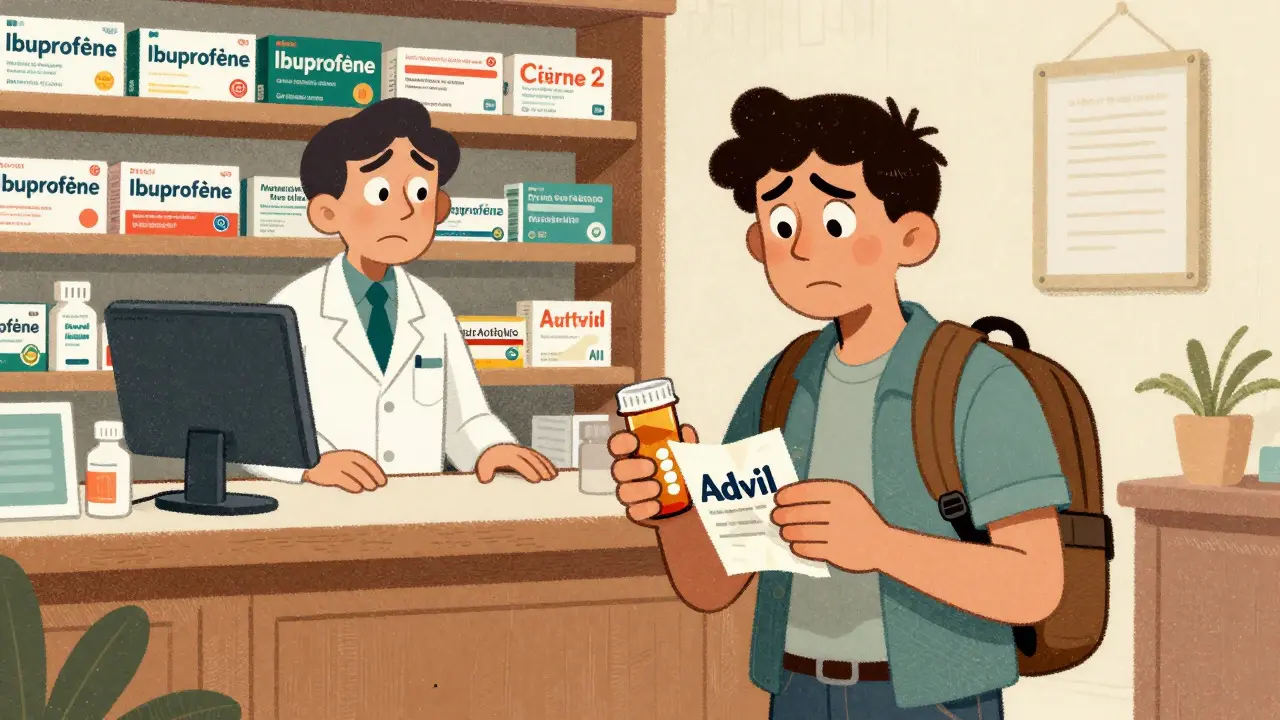
Imagine standing in a pharmacy in Paris or Tokyo, clutching an empty bottle of your daily heart medication. The pharmacist looks at you kindly, but the language barrier is thick. You hand over a crumpled piece of paper with "Advil" written on it, expecting pain relief. Instead, they hand you something that sounds similar but works completely differently-or worse, nothing at all because the brand name doesn't exist there. This isn't just a minor inconvenience; it's a potential health crisis.
Traveling with medication requires more than just packing your pills. It demands understanding how drugs are named, dosed, and regulated across borders. Brand names change, dosage formats differ, and active ingredients often go by entirely different aliases. If you rely on guesswork or basic translation apps, you risk serious errors. Here is exactly how to translate medication names and doses so you stay safe while abroad.
The Trap of Brand Names vs. Generic Ingredients
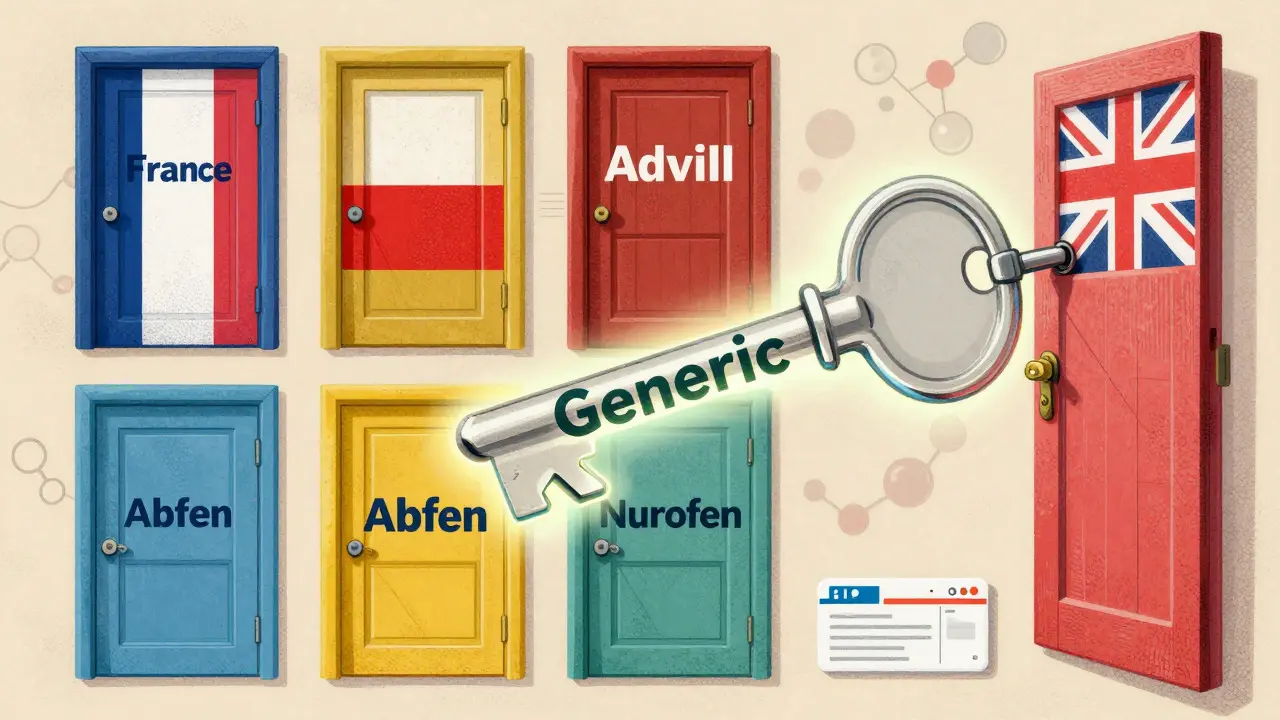
The biggest hurdle travelers face is the difference between brand names and generic names. Pharmaceutical companies sell the same chemical compound under different brand names in different countries. For instance, if you take Advil in the United States, you won't find that exact box in France. There, the equivalent product is often labeled as Ibuprofène. In Poland, you might see Abfen.
If you ask a French pharmacist for "Advil," they might not understand, or they might assume you want a specific brand formulation that isn't available. To avoid this, you must identify the active ingredient-the actual chemical that treats your condition. On your pill bottle, look for the name in lowercase letters or smaller print. That is your generic name. Ibuprofen is the generic name; Advil, Motrin, and Nurofen are brands. When traveling, always carry the generic name. It is the universal key that unlocks access to the right medication anywhere in the world.
Consider the dangerous similarity between Ambien, a common sleep aid in the U.S., and Ambyen, a medication used for irregular heartbeat in Great Britain. One letter changes everything. Confusing these two could lead to severe cardiac issues or extreme drowsiness when you need alertness. This is why relying on phonetic translations or memory is risky. Always verify the spelling of the generic ingredient against international standards.
Understanding Dosage Formats and Units
Even if you get the right drug name, the dosage format can trip you up. Different regions use different conventions for measuring strength. In the U.S., we often see milligrams (mg) clearly stated, like "500 mg." However, some European prescriptions might list concentrations per tablet or capsule differently.
A critical distinction involves grams (g) versus milligrams (mg). A prescription written as "1g" means 1,000 milligrams. If a traveler misreads this or if a translator converts it incorrectly, they might take a dose ten times higher or lower than intended. For example, a user on a pharmacy forum shared a story where a Spanish prescription listed "1g" tablets. The patient thought this was a standard low dose, but it was actually a high-strength antibiotic. Misinterpreting decimal points is another major pitfall. In many European countries, a comma separates decimals (e.g., 2,5 mg), whereas the U.S. uses a period (2.5 mg). A quick glance might make 2,5 look like 25 to someone unfamiliar with the convention.
To navigate this:
- Know your base unit: Understand if your medication is measured in mg, g, mcg (micrograms), or IU (International Units).
- Check the frequency: "Once daily" might be translated as "every 24 hours" or "morning only." Clarify this with your doctor before you leave.
- Carry the original label: The pharmacy label from your home country is your reference point. It shows the exact strength and schedule prescribed by your doctor.
Using International Nonproprietary Names (INN)
The World Health Organization (WHO) established the International Nonproprietary Name (INN) system to standardize generic drug names globally. These names are designed to be recognized worldwide, reducing confusion. When preparing for travel, cross-reference your medication with the WHO INN database. This ensures you have the scientifically accepted name that pharmacists in most countries will recognize.
For example, instead of searching for "Tylenol," search for "Paracetamol" (or Acetaminophen, depending on the region). Paracetamol is the INN widely used in Europe, Asia, and Australia. Tylenol is primarily a North American brand. By using the INN, you align yourself with global pharmaceutical standards rather than local marketing terms.
Digital Tools and Verification Resources
Technology can help, but it must be used correctly. General translation apps like Google Translate are useful for everyday phrases but lack the precision needed for medical terminology. They might translate "pill" correctly but miss nuances in dosage instructions like "take with food" or "avoid grapefruit juice."
Instead, use specialized resources:
- Drugs.com International: This tool allows you to enter a drug name and see its equivalents in other countries. It helps you find what to ask for in Paris, Berlin, or Sydney.
- Local Pharmacy Apps: Many countries have national pharmacy databases. For instance, in Canada, you can check Health Canada’s website for approved drug names.
- Professional Translation Services: For complex chronic conditions, consider having your prescription translated by a certified medical translator. Services like RxTran or Stepes offer ISO-certified translations that ensure accuracy in warning labels and patient instructions.
Remember, AI tools are improving, but they still require human verification. Dr. Michael Chen, a pharmaceutical policy analyst, warns that over-reliance on automated systems without pharmacist verification creates new risks. Always double-check digital translations with a healthcare professional.
Practical Steps Before You Fly
Preparation is your best defense. Start these steps at least two weeks before your departure:
| Action Item | Why It Matters | How to Do It |
|---|---|---|
| Get a Doctor’s Letter | Proves medical necessity | Ask your physician for a signed letter listing your diagnoses, medication names (brand and generic), dosages, and their medical license number. |
| Keep Original Packaging | Shows authenticity and details | Do not transfer pills to unmarked containers. Keep them in the bottles they were dispensed in, with the pharmacy label intact. |
| Research Local Equivalents | Saves time at the pharmacy | Use Drugs.com International to find the local brand names for your generics in your destination country. |
| Carry Extra Supply | Covers delays or lost luggage | Bring enough medication for the entire trip plus 3-5 extra days. Split supplies between carry-on and checked bags. |
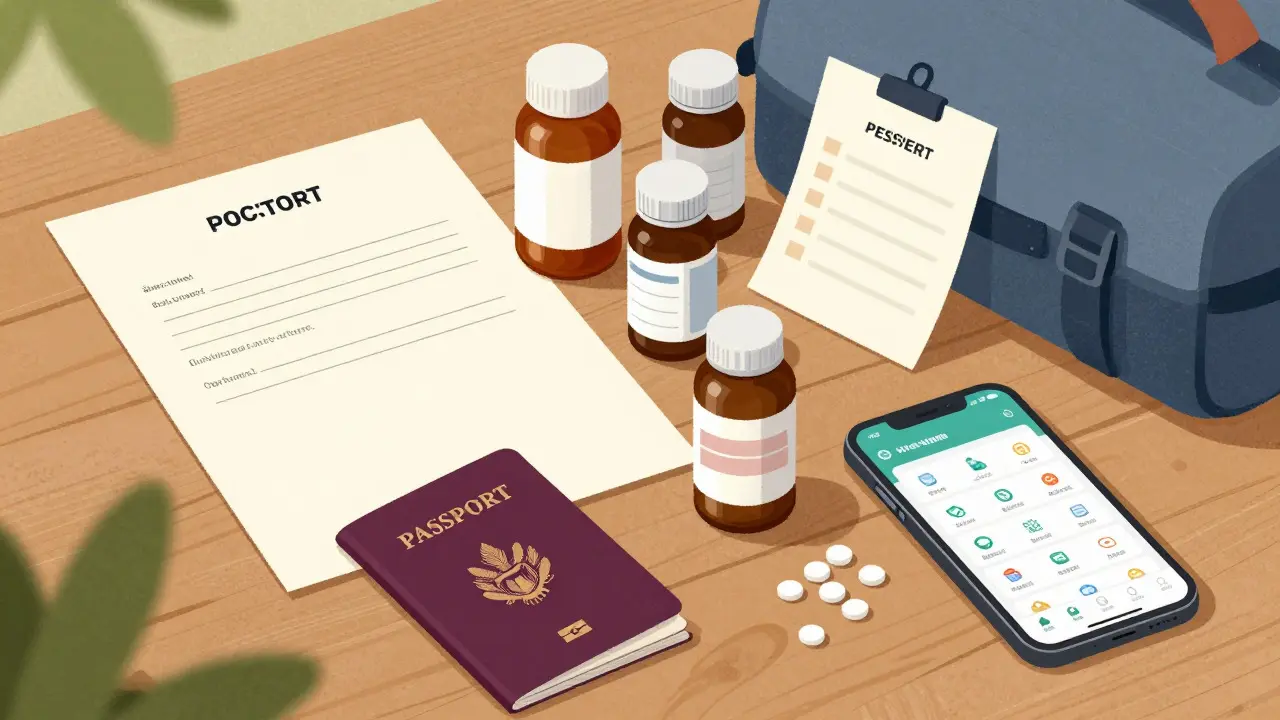
When you arrive at a foreign pharmacy, bring your doctor’s letter, your original medication bottles, and the list of generic names. Speak slowly and clearly. Ask the pharmacist to show you the active ingredient on the box. If they pull out a box with a different name, ask them to confirm the generic matches yours. Don’t hesitate to ask for clarification-it’s better to spend five minutes checking than to take the wrong drug.
Navigating Regulations and Customs
Some medications are controlled substances in one country but freely available in another, or vice versa. Opioids, stimulants, and even certain antihistamines may require special permits. Check the customs regulations of your destination country before you pack. For example, bringing codeine-based cough syrup into some Asian countries can lead to serious legal trouble.
In the U.S., the FDA allows travelers to bring up to a 90-day supply of personal-use medications. However, foreign rules vary. Always declare your medications at customs if required. Having a doctor’s letter helps explain why you’re carrying controlled substances, proving they are for legitimate medical use and not for resale or abuse.
What to Do If You Run Out
If you run out of medication while abroad, don’t panic. Visit a local pharmacy and present your doctor’s letter and empty bottle. Explain that you need a refill. The pharmacist will likely prescribe a short-term supply. In emergencies, hospitals can provide immediate care. Keep a copy of your insurance information handy, as many travel insurance plans cover emergency medication purchases.
Also, consider telehealth services. Some platforms allow you to consult with doctors licensed in your destination country. They can issue local prescriptions if needed. This is particularly useful for non-controlled medications where local availability is high.
Can I use Google Translate for my prescription?
Google Translate can help with basic communication, but it is not reliable for precise medical instructions. It may misinterpret dosage units or confuse similar-sounding drug names. Use it as a last resort for simple phrases, but always verify critical information with a pharmacist or a certified medical translator.
What is the difference between a brand name and a generic name?
A brand name is the trademarked name given by a manufacturer, like Advil or Tylenol. A generic name is the scientific name of the active ingredient, like Ibuprofen or Acetaminophen. Generic names are standardized internationally, making them easier to identify across borders.
Do I need a doctor’s letter for every medication?
It is highly recommended for all prescription medications, especially controlled substances like opioids, ADHD meds, or strong anxiety drugs. Over-the-counter medications usually don’t require a letter, but having one for everything simplifies customs checks and pharmacy visits.
How do I handle decimal differences in dosages?
Be aware that many countries use commas for decimals (e.g., 2,5 mg) while the U.S. uses periods (2.5 mg). Always clarify the unit (mg vs g) and ask the pharmacist to repeat the dose back to you. Visual confirmation of the pill imprint can also help.
Are there apps that help find medication equivalents abroad?
Yes, Drugs.com International is a popular resource that lists equivalent medications in various countries. Additionally, some local pharmacy apps in destinations like Japan or Germany allow you to search for ingredients. Always cross-reference with a pharmacist.