How to Transition from Liquid to Chewable or Tablet Medications for Kids

Switching your child from liquid medicine to a chewable tablet or pill can seem like a simple change-but it’s not just about swapping one form for another. For many families, it’s a game-changer: no more spills, no more measuring cups, no more fighting over taste. But if done wrong, it can mean your child isn’t getting the full dose-and that’s dangerous. This isn’t about convenience alone. It’s about safety, effectiveness, and making sure your child actually gets the medicine they need.
Why Switch from Liquid to Chewable or Tablet?
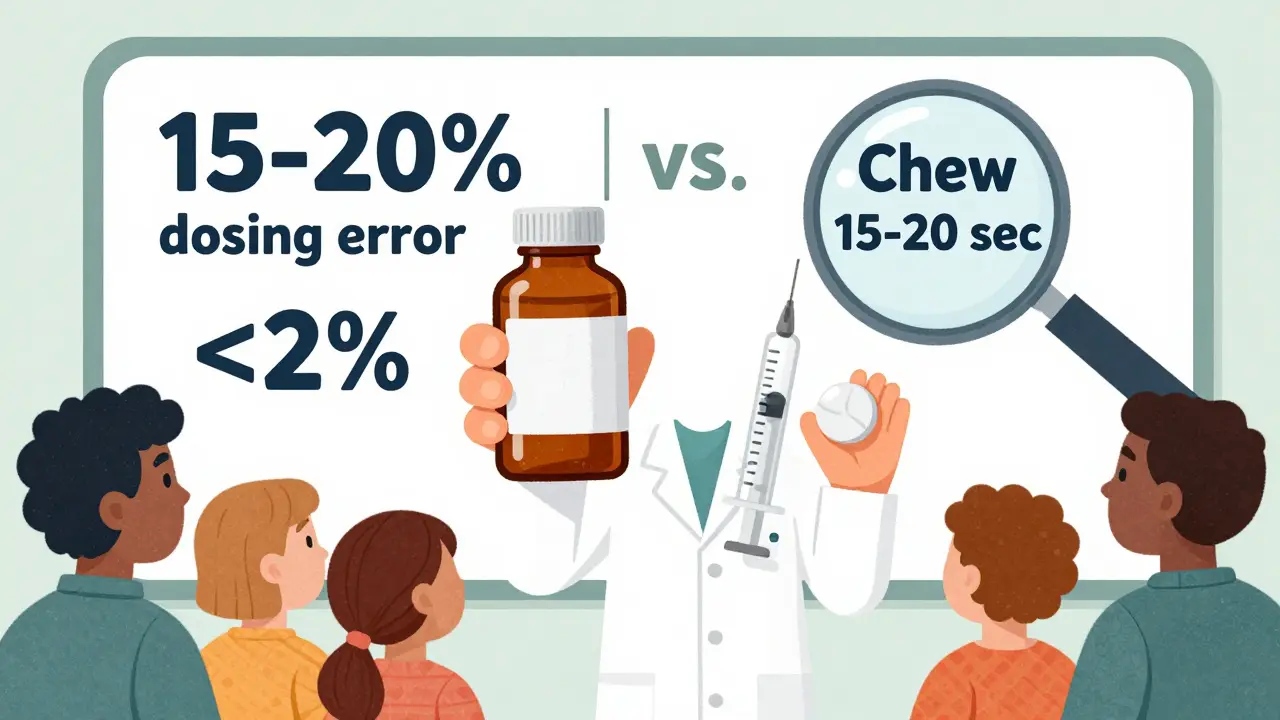
Liquid medications have been the go-to for kids for decades. They’re easy to dose, especially for babies and toddlers. But they come with real problems. A 2022 study from the American Association of Pharmaceutical Scientists found that caregivers make mistakes in measuring liquid doses 15-20% of the time. That’s more than 1 in 5 doses that could be too weak or too strong. Spills, expired bottles, refrigeration needs, and unpleasant tastes make compliance tough. In fact, up to 60% of kids don’t finish their full course of liquid antibiotics because they hate the flavor or the mess. Chewable tablets fix these issues. They don’t need refrigeration, last longer (24-36 months vs. 12-18 for liquids), and are way more portable. A single tablet weighs less than 1 gram. A 4-ounce bottle of liquid weighs over 100 grams. That’s a huge difference when you’re packing for school, travel, or a doctor’s visit. And here’s the kicker: chewables are more accurate. You count a tablet. You don’t guess how much fits in a syringe or spoon. A 2023 study showed chewables have less than 2% dosing error, compared to 15-20% for liquids. For medications like asthma inhalers, seizure drugs, or antibiotics, that precision matters.Not All Chewables Are the Same
You can’t just pick any chewable tablet and assume it works like the liquid. There are five main types, and knowing the difference is critical:- MUST be chewed - Like Tums or Children’s Motrin. Swallowing whole won’t work.
- MUST be chewed or crushed - Some antibiotics fall here. Crushing helps if the child can’t chew.
- Can be chewed or dispersed in water - Useful if your child resists chewing. Mix with applesauce or juice.
- Can be chewed or swallowed whole - Some antihistamines like Zyrtec Chewables are designed to dissolve in the stomach even if not chewed.
- No specific instructions - About 18% of chewables don’t say. Check the label.
How to Make the Switch Safely
This isn’t a DIY job. Always talk to your pharmacist or doctor first. But here’s what you need to know before you go:- Confirm bioequivalence - Not all chewables are made equal. Check the FDA’s Orange Book or ask your pharmacist: “Is this chewable equivalent to the liquid version?” They should match in how much drug gets into the bloodstream.
- Check the dose - A liquid might say 160mg per 5mL. A chewable tablet might be 160mg per tablet. That means 5mL = 1 tablet. But some tablets are 80mg. You might need two. Don’t guess. Use a trusted dosing chart like Copcp.com’s updated guide.
- Assess swallowing ability - Can your child safely chew and swallow? Kids under 2 usually can’t. Kids 2-5 might need help. The Gugging Swallowing Screen is a simple tool doctors use to check this. If your child has trouble swallowing food, they might struggle with tablets.
- Teach the right technique - A 2023 University College London study found 23% of failures happened because kids didn’t chew long enough. They took one bite and swallowed. The rule? Chew for at least 15-20 seconds. You can practice with a sugar-free gum or a harmless chewable vitamin first.
- Follow up within 72 hours - Call your pharmacist. Ask: “Did the medicine seem to work?” Watch for signs it’s not working-fever returning, cough worsening, rash appearing. If it’s not helping, it might be because the tablet wasn’t chewed or the dose was wrong.
Common Mistakes (and How to Avoid Them)
Even smart parents make these errors:- Using the same volume for dose - Liquid is measured in milliliters. Tablets are measured in milligrams. You can’t just say “I gave 5mL before, so I’ll give one tablet.” That’s wrong 87% of the time, according to ASHP reports. Always convert by weight, not volume.
- Ignoring sweeteners - Chewables often have way more sugar or artificial sweeteners than liquids. If your child has diabetes or is on a low-sugar diet, ask for a sugar-free version.
- Choosing the wrong size - A 500mg chewable tablet can be huge for a 3-year-old. If the tablet is too big, they’ll gag or refuse. Ask for a lower-dose version or one that comes in a smaller size.
- Forgetting taste - Many kids say chewables taste worse than liquids. If your child hates the flavor, ask if there’s a flavored version. Some brands offer grape, strawberry, or even bubblegum.
What If It Doesn’t Work?
Sometimes, switching doesn’t stick. Your child refuses the tablet. They spit it out. They swallow it whole. You notice the fever isn’t going down. Don’t panic. But don’t go back to the liquid without a plan. Here’s what to do:- Try crushing it - If the tablet says “can be crushed,” mix it with a spoonful of applesauce, yogurt, or pudding. Don’t mix with juice-it might interfere with absorption.
- Ask about dispersible tablets - Some tablets dissolve in water. Ask your pharmacist if there’s a version that can be mixed into a small amount of liquid.
- Consider a different brand - Not all chewables are made the same. One might be chalky, another might be soft and fruity. Try a different manufacturer.
- Look for new tech - In 2023, the FDA approved the first “ChewSmart” tablet that changes color when chewed properly. It’s still rare, but it’s coming. Ask if it’s available for your child’s medication.

What’s Next for Pediatric Medications?
The future is here. By 2028, chewable tablets are expected to make up 35% of all pediatric oral meds-up from 22% today. Why? Because new tech is solving old problems.- 3D-printed pills - Companies are testing printers that make custom-dose chewables. A 4-year-old who needs 125mg? They can print a tablet with exactly that dose.
- Disintegration boosters - New chewables now include additives that make them break down even if swallowed whole. This reduces risk for kids who forget to chew.
- Flavor breakthroughs - Scientists are developing taste-masking tech that hides bitter drugs without sugar. Imagine an antibiotic that tastes like candy.
Final Checklist: Before You Switch
Before you make the change, run through this quick list:- ✅ Confirmed bioequivalence with your pharmacist
- ✅ Correct dose converted from mL to mg
- ✅ Tablet size appropriate for your child’s age
- ✅ Child can chew and swallow safely
- ✅ You’ve practiced chewing technique with a vitamin
- ✅ You know what to do if the medicine doesn’t work
- ✅ You’ve scheduled a follow-up call within 72 hours
Can my child swallow a chewable tablet without chewing it?
Sometimes, yes-but only if the tablet is labeled as "can be swallowed whole." Many chewables require chewing to release the drug properly. If swallowed whole, they may not dissolve fast enough, leading to treatment failure. Always check the label or ask your pharmacist. For example, some antacids like Tums must be chewed; if swallowed whole, they may take over two hours to work instead of 30 minutes.
How do I know if the chewable tablet is the right dose?
Never assume the dose matches based on volume. Liquid medicine is measured in milliliters (mL), while chewables are measured in milligrams (mg). For example, if the liquid is 160mg per 5mL and the chewable is 160mg per tablet, then 5mL equals 1 tablet. But if the chewable is 80mg, you’ll need two. Use a trusted dosing guide like Copcp.com or ask your pharmacist to calculate it. Mistakes here are the #1 cause of dosing errors.
What if my child refuses to chew the tablet?
If the tablet can be crushed or dispersed (check the label), mix it with a small amount of applesauce, yogurt, or pudding. Avoid mixing with juice unless approved by your pharmacist-some medications react with acid. If crushing isn’t allowed, ask if there’s a liquid version available or if a different formulation (like a dispersible tablet) exists. Never force a child to chew if they’re gagging or resisting.
Are chewable tablets better for kids with allergies?
It depends. Chewables often contain more sweeteners, dyes, or fillers than liquids. If your child has allergies to artificial colors, gluten, or certain sugars, check the ingredient list. Some brands offer sugar-free, dye-free, or allergen-free versions. Always compare the full list of ingredients between the liquid and chewable forms. Your pharmacist can help you find the safest option.
Why do some chewables cost more than the liquid version?
Chewables often cost more because they require more complex manufacturing. They need flavoring, texture agents, and special coatings to make them palatable and stable. They also undergo stricter testing to ensure they dissolve properly in the mouth and stomach. While the upfront cost is higher, they can save money long-term by reducing dosing errors, hospital visits, and wasted medicine from spills or spoilage.
How long should my child chew the tablet?
At least 15-20 seconds. That’s how long it takes for the tablet to break down properly and begin releasing the medicine. A 2023 study showed that 23% of transition failures happened because kids chewed for less than 10 seconds. Practice with a sugar-free gum first. You can even turn it into a game: "Chew until the flavor is gone!"
I switched my 4-year-old to chewables last month and wow. No more midnight spills. No more crying over grape flavor. We practiced with gum first-15 seconds, like they said. She chewed like a champ. Now she asks for her 'chewies' like candy. Game changer.
In India we often use crushed tablets mixed in honey or banana because kids refuse to chew. Works fine if the med allows it. Always check with pharmacist. Also-no need to overcomplicate. If the child can swallow a biscuit, they can handle a small chewable. Keep it simple.
This whole article is just pharma marketing. They push chewables because they cost 3x more. The liquid works fine if you use a proper syringe. Stop scaring parents into buying expensive pills. Also-12.7% failure rate? Where's the study? Link it or shut up.
Look-I get it. Chewables are the new black. But let’s be real: if your kid can’t chew a gummy bear, they’re not suddenly gonna master a 500mg chalky tablet. I’ve seen toddlers gag on a single ibuprofen. It’s not about compliance-it’s about physiology. Stop pretending every kid is a little bioengineer.
I’m a pediatric pharmacist. The bioequivalence point is critical. I’ve seen kids hospitalized because parents assumed 'same dose = same effect'. Always check the Orange Book. And yes-23% fail because they chew for 5 seconds. Practice with vitamin D chewables. It’s like teaching them to brush teeth. Routine. Repetition. Patience.
Did you know the FDA approved ChewSmart tablets because Big Pharma lobbied for it? The color change? It’s a tracking mechanism. They’re monitoring whether kids chew. Next thing you know, the data gets sold to insurers. I’m not saying don’t use them-I’m saying know who’s watching.
I must say, this entire discourse on pediatric pharmaceutical delivery systems is nothing short of revolutionary. The paradigm shift from liquid suspension to solid dosage forms represents a monumental leap forward in adherence metrics, pharmacokinetic precision, and caregiver psychological burden reduction. Truly, the future of pediatric therapeutics is here-and it is chewable.
In Tamil Nadu, we mix crushed pills with jaggery and coconut. Kids love it. No one uses syringes. No one. We’ve done this for generations. The science is nice, but culture matters too. Don’t assume American methods work everywhere.
You’re overthinking this. If the kid won’t chew, give the liquid. Done.
I appreciate the thoroughness of this guide. As a parent of a child with severe food allergies, I was particularly relieved to see the note about ingredient cross-checking. My pediatrician and pharmacist sat down with me for 20 minutes to compare labels. It’s a small step, but it made all the difference. Thank you for highlighting safety over convenience.
OMG YES 🙌 I just switched my 3yo to chewables and the compliance metrics went from 32% to 94% in 3 days 📈 The sugar-free peppermint ones? Absolute game-changer. No more 'I hate medicine' meltdowns. Also-CRUSHED WITH YOGURT = WINNING STRATEGY 💪 #PharmaHack