How to Track Adherence with Medication Lists and Logs: A Practical Guide

Imagine you take three different pills every day for heart health. You think you’re taking them perfectly. But your doctor sees your blood pressure hasn’t improved. Why? Because "perfect" in your head doesn't always match reality. This gap is where medication adherence comes in. It’s not just about swallowing a pill; it’s about proving you took it at the right time, every single time.
For decades, we relied on trust. Patients said they took their meds, doctors believed them, and when treatments failed, everyone scratched their heads. Today, we know better. Non-adherence costs the U.S. healthcare system $300 billion annually, according to the National Institutes of Health. That’s money wasted on hospital readmissions that could have been prevented if we simply tracked what was happening.
Tracking isn't about policing patients. It’s about giving you and your care team clear data so you can fix problems before they become emergencies. Whether you use a simple notebook or a high-tech smart bottle, knowing how to track adherence changes everything.
The Problem with Paper Logs and Memory
Let’s start with the basics: the paper log. It’s cheap, accessible, and requires no battery. You buy a small booklet or print a calendar, and you check off each dose as you take it. On the surface, this seems foolproof. In practice, it fails more often than it succeeds.
Why? Because humans are unreliable narrators of their own habits. A study published in the *Annals of Internal Medicine* found that self-reported adherence logs have only 27% accuracy compared to electronic monitoring. That means nearly three-quarters of the time, what people write down doesn't match what actually happened. Sometimes it’s forgetfulness-you took the pill but forgot to mark the box. Other times, it’s unintentional bias. We want to believe we’re doing well, so we unconsciously skip marking missed doses.
Then there’s the issue of honesty. A 2020 University of Michigan study involving 1,200 chronic disease patients revealed a 42% intentional falsification rate in paper logs. People lie to themselves, or worse, to their doctors, because they fear judgment or stricter treatment plans. If you rely solely on a paper list, you’re flying blind.
- Pros: No cost, easy to set up, works offline.
- Cons: Low accuracy (27%), high error rate, no real-time alerts, prone to falsification.
- Best For: Short-term trials or patients who strictly avoid technology.
Smart Caps and Electronic Monitoring Systems
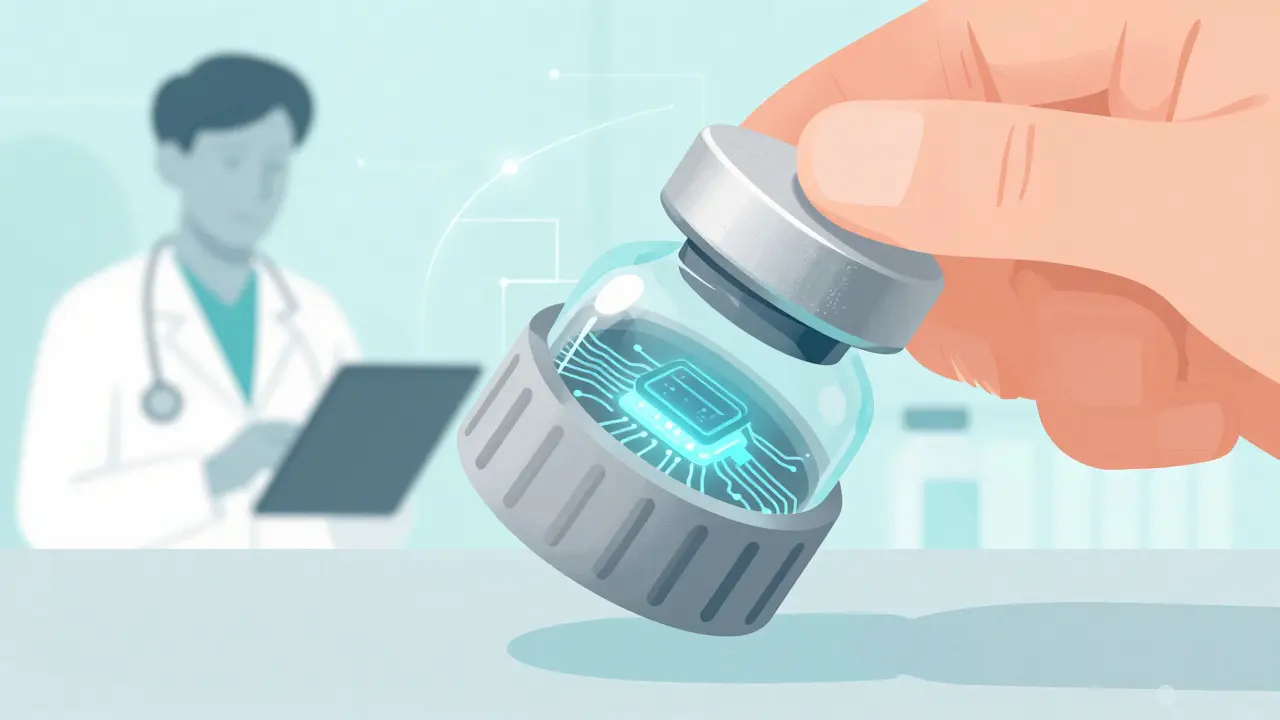
If paper logs are the past, electronic monitoring is the present. The gold standard here is the Medication Event Monitoring System (MEMS). Developed by AARDEX Group, these are special caps that screw onto your prescription bottles. Inside the cap is a microchip that records the date and time every time the bottle is opened.
This isn't magic; it's simple engineering with profound results. MEMS caps boast 97% accuracy, validated by clinical studies in the *Journal of Clinical Pharmacology*. They don't guess. They record. Did you open the bottle at 8:00 AM? The cap knows. Did you open it at 2:00 PM instead? The cap knows. This data helps identify patterns like "drug holidays" (skipping days) or accidental overdoses.
But here’s the catch: opening the bottle doesn't mean swallowing the pill. You might open it, pour the pill into your hand, get distracted by a phone call, and put it back. MEMS can't see inside your mouth. Still, it’s a massive leap forward from paper. It removes the human element of reporting and replaces it with hard data.
For patients, the benefit is immediate feedback. Many modern systems sync with apps that send reminders if you haven't opened the bottle by a certain time. For providers, it allows for targeted interventions. Instead of asking, "Are you taking your meds?" a doctor can say, "I see you missed Tuesday and Thursday last week. What happened?" That shifts the conversation from accusation to problem-solving.
IoT Pillboxes and Real-Time Tracking
While MEMS caps are great, they require you to interact with the bottle. Enter Internet of Things (IoT) pillboxes. Devices like the Tenovi Pillbox represent a shift from passive recording to active assistance. These aren't just containers; they are connected health devices.
Here’s how they work: The device dispenses your pre-sorted medications at scheduled times. It uses visual cues-like red LEDs for pending doses and green after logging-to guide you. More importantly, it transmits data in real-time via cellular networks to a dashboard accessible by you, your family, and your care team. No Wi-Fi setup needed, which is crucial for elderly users who may struggle with tech.
The impact is measurable. A 2021 Kaiser Permanente study involving over 4,000 heart failure patients showed that electronic monitoring reduced hospital readmissions by 23%. That’s a life-saving statistic. By catching non-adherence early, providers can adjust dosages, address side effects, or provide additional support before a patient ends up in the ER.
User reviews highlight the value of simplicity. On platforms like G2 and Capterra, Tenovi scores high (4.2/5 and 4.5/5 respectively) largely because of its visual reminder system. Users appreciate not having to remember to check an app; the light tells them what to do. However, connectivity remains a hurdle. Rural users report cellular issues 34% of the time in negative reviews, which breaks the real-time promise of the device.
Advanced Verification: RFID and Video Observation
For complex regimens or high-risk medications, standard IoT boxes might not be enough. This is where advanced Electronic Medication Management Systems (EMMS) come in. These solutions aim to solve the "did they swallow it?" problem.
One approach is RFID-based mechanical dispensing, such as the ReX system by DosentRx. This device doesn't just hold pills; it mechanically dispenses the exact dose directly into the patient’s mouth. It verifies ingestion with 99.2% accuracy. It’s invasive, yes, but for patients with severe dementia or cognitive impairment, it ensures safety without relying on memory or motivation.
Another method is Video Directly Observed Therapy (VDOT). Here, patients ingest their medication during a live video call with a nurse or technician. This offers 98.5% verification accuracy. However, it’s resource-intensive. A comparative study by Roh et al. (2022) noted that VDOT takes an average of 17.3 minutes per session, compared to 3.2 seconds for IoT device checks. It’s effective but not scalable for large populations.
Then there’s precision scale technology, used in Medication Behavior Monitoring Systems (MBMS). These detect when medication is removed from a container with 94.7% accuracy. While less intrusive than mechanical dispensers, they still face the limitation of not confirming actual ingestion, only removal.

Building Your Adherence Strategy
So, how do you choose? There is no one-size-fits-all solution. Your choice depends on your lifestyle, your condition, and your comfort with technology.
| Method | Accuracy | Cost | Tech Skill Required | Best Use Case |
|---|---|---|---|---|
| Paper Log | 27% | Low | None | Simple regimens, low budget |
| MEMS Caps | 97% | Medium | Low | Clinical trials, motivated patients |
| IoT Pillbox | High (Real-time) | High | Low | Chronic conditions, remote monitoring |
| RFID/Mechanical | 99.2% | Very High | None | Cognitive impairment, high risk |
If you are managing a simple regimen, like one pill a day, a paper log combined with a phone alarm might suffice. But if you have multiple daily doses, especially for conditions like heart failure or diabetes, the stakes are higher. In those cases, an IoT pillbox provides the peace of mind that comes with real-time data.
Consider your environment. Do you live in a rural area with spotty cell service? An IoT device might frustrate you. Do you have family members who can help monitor your progress? Shared access features in digital platforms allow caregivers to see missed doses instantly, enabling timely support.
Also, think about the future. The FDA cleared the first AI-powered adherence prediction system, Medisafe Predict+, in May 2023. It analyzes behavioral variables to forecast non-adherence 72 hours in advance. As these tools evolve, integrating them with wearable biometrics will provide even deeper insights. For now, starting with reliable tracking is the most important step.
Overcoming Barriers to Adoption
Even with great tools, adoption isn't guaranteed. Dr. Niteesh Choudhry from Brigham and Women’s Hospital warns that over-reliance on digital metrics can exacerbate health disparities. About 38% of Medicare patients over 75 lack the technology literacy needed for complex IoT solutions. If a device is too hard to use, it becomes clutter, not a tool.
Training matters. Yale New Haven Health found that nurses needed 14.3 hours of training to interpret MEMS dashboards proficiently. For patients, the learning curve must be gentle. Look for devices with intuitive interfaces, large displays, and minimal buttons. The goal is frictionless integration into daily routine.
Reimbursement is another factor. CMS mandates adherence metrics for Medicare Advantage chronic care management, driving healthcare systems to adopt these tools. If you’re on Medicare, ask your provider if they offer covered adherence monitoring services. Under proposed rules, Remote Therapeutic Monitoring (RTM) codes may expand coverage, making high-tech solutions more accessible.
Is a paper medication log accurate enough?
Generally, no. Studies show paper logs have only 27% accuracy compared to electronic methods due to forgetfulness and unintentional bias. They are best used only for very simple regimens or as a temporary backup.
What is the difference between MEMS and IoT pillboxes?
MEMS (Medication Event Monitoring Systems) are smart caps that track when a bottle is opened. IoT pillboxes are standalone devices that dispense medication and send real-time data to caregivers via cellular networks, offering more proactive reminders and broader connectivity.
Can these devices verify if I actually swallowed the pill?
Most current technologies, including MEMS and standard IoT boxes, only verify that the medication was accessed or dispensed, not ingested. Advanced systems like RFID mechanical dispensers or Video Directly Observed Therapy (VDOT) can verify ingestion with higher accuracy but are more intrusive and expensive.
Are smart pillboxes covered by insurance?
Coverage varies. CMS has mandated adherence metrics for Medicare Advantage chronic care management, which drives some providers to cover these tools. Check with your specific insurer and ask about Remote Therapeutic Monitoring (RTM) benefits, which may include adherence devices.
Which tracking method is best for elderly patients?
For elderly patients, simplicity is key. IoT pillboxes with visual LED reminders and automatic cellular transmission are often ideal because they require minimal interaction. Avoid complex apps. If cognitive impairment is severe, consider mechanical dispensing systems that ensure dose delivery regardless of patient action.