How to Prevent Look-Alike Packaging Confusion in the Pharmacy
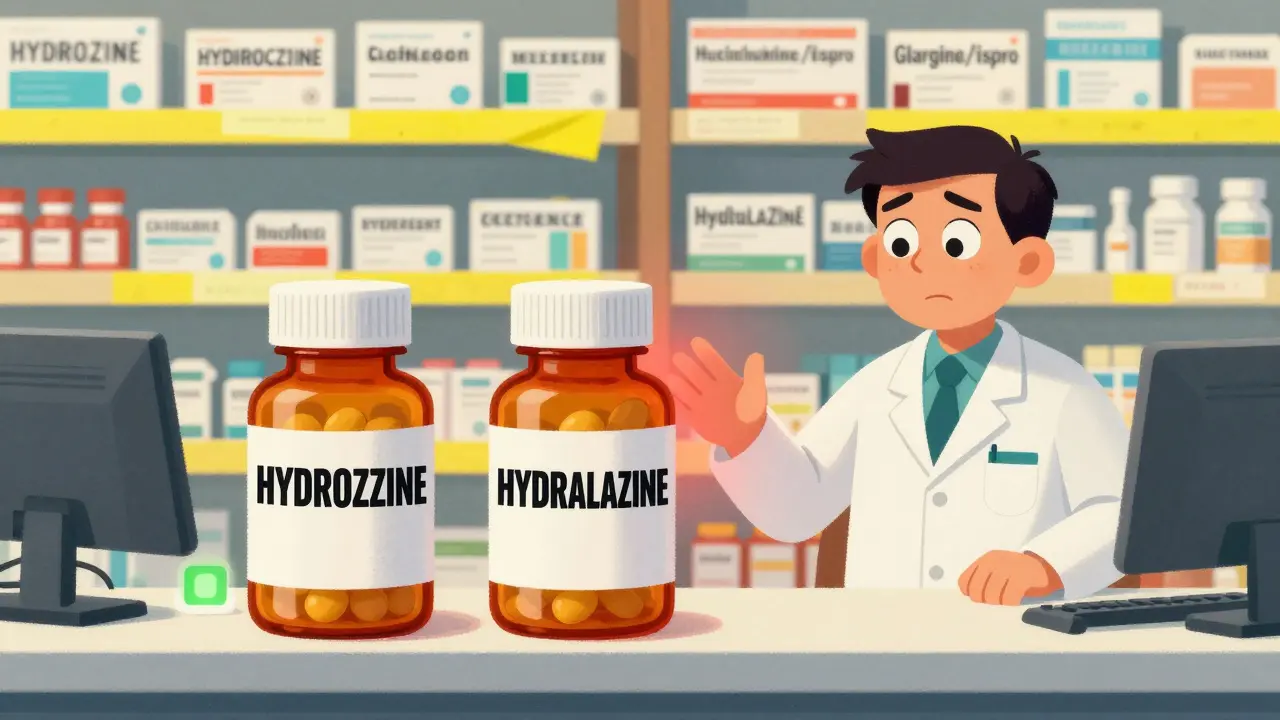
Every year, thousands of patients in the U.S. get the wrong medication-not because of a doctor’s mistake, but because two pills look too much alike. One bottle says hydralazine, another says hydroxyzine. One label has insulin glargine, another has insulin lispro. To the untrained eye, they’re nearly identical. In a busy pharmacy, under pressure, with 20 prescriptions waiting, it’s easy to grab the wrong one. And that’s how a simple packaging mix-up becomes a life-threatening error.
Why Look-Alike Packaging Is a Silent Killer
It’s not just about names that sound alike. The real danger comes from packaging that looks alike. Similar colors, fonts, shapes, and layouts make it hard to tell drugs apart-even for experienced pharmacists. The Institute for Safe Medication Practices (ISMP) reports that about 18% of all medication error reports in the U.S. are tied to look-alike or sound-alike (LASA) drugs. That’s roughly 10,000 incidents a year. And it’s not just a hospital problem. Community pharmacies see these errors too, especially during drug shortages when substitutions are common.The FDA estimates that 20% of medication errors stem from confusing packaging and labeling. These aren’t theoretical risks. Real people have died from mixing up heparin and saline bags, or giving the wrong insulin. In one documented case, a patient received a full vial of concentrated insulin instead of the diluted version-because the bottles were nearly identical in size and color. The result? Severe hypoglycemia, brain damage, and a $3 million lawsuit.
Physical Separation: The Simplest Fix
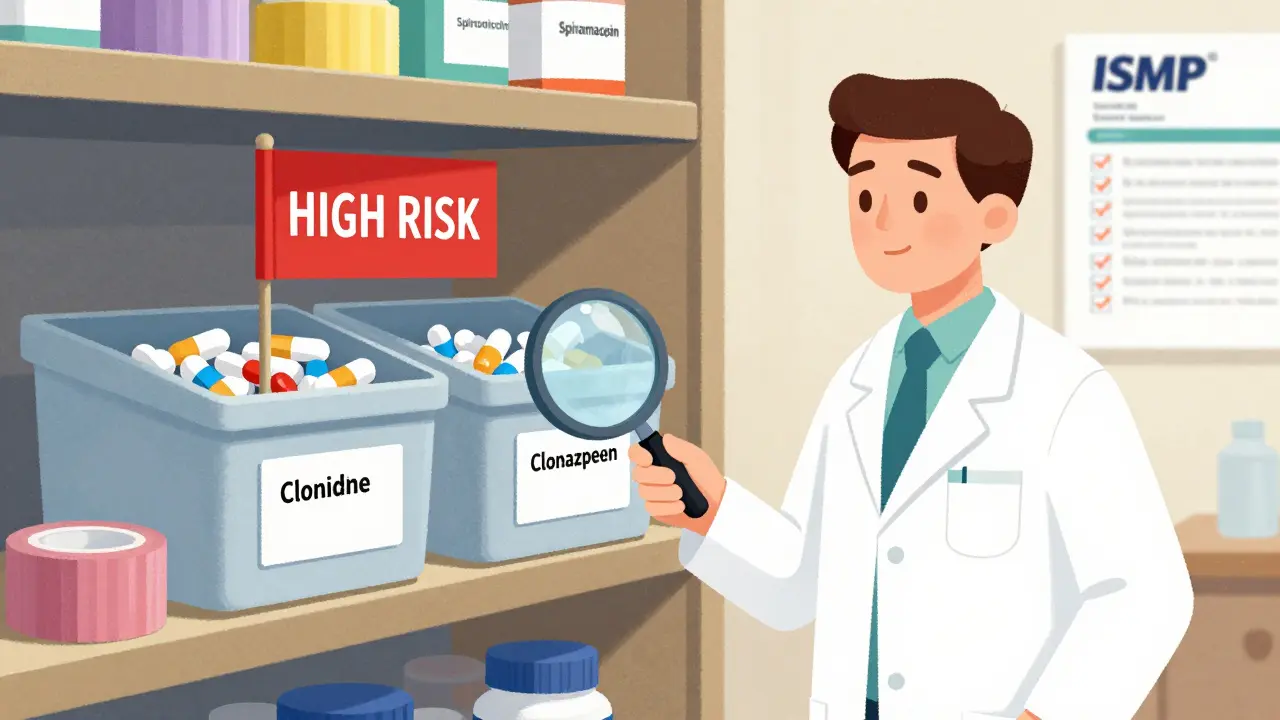
The most effective and cheapest way to stop these errors? Keep look-alike drugs apart.Store similar medications in different sections of the pharmacy. Don’t put spironolactone and spiramycin next to each other. Don’t place clonidine and clonazepam in the same drawer. A 2020 study from the University of Arizona found that physical separation reduced dispensing errors by 62%. That’s not a small win-it’s a game-changer.
You don’t need fancy equipment. Shelf dividers, colored tape, or even just moving a bin a few inches away can make a difference. One community pharmacy in Nova Scotia used bright yellow labels on high-risk pairs like alprazolam and azathioprine. Within six months, wrong-drug dispensing dropped by 75%. The cost? Under $200.
But space is tight in many pharmacies. If you’re working in a small storefront, get creative. Use vertical storage, labeled bins, or even a dedicated “high-risk” shelf. The goal isn’t perfection-it’s enough distance to make you pause before grabbing.
Tall Man Lettering: Making Differences Visible
When two drug names are almost the same, the fix isn’t just about placement-it’s about how they’re written.Tall Man Lettering (TML) uses capital letters to highlight the parts of the name that differ. Instead of writing hydroxyzine and hydralazine, you write HYDROXYZINE and HYDRALAZINE. The capitalization draws the eye to the key difference: XYZINE vs. LAZINE.
Studies show TML reduces selection errors by 47%. It’s not magic, but it’s science. The FDA and ISMP both recommend it for high-risk pairs. And it’s easy to implement-if your pharmacy software supports it.
But here’s the catch: not all systems do it the same way. A 2022 survey found only 68% of hospitals use standardized TML formats. If your EHR shows DObutamine and your hospital’s system shows DoBUTamine, you’re still at risk. Consistency matters. Work with your vendor. Demand that your system follows ISMP’s official list of LASA pairs, updated quarterly.
And don’t forget: TML only fixes name confusion. It doesn’t help if the bottles look the same. That’s why you need layers.
Barcode Scanning: The Safety Net
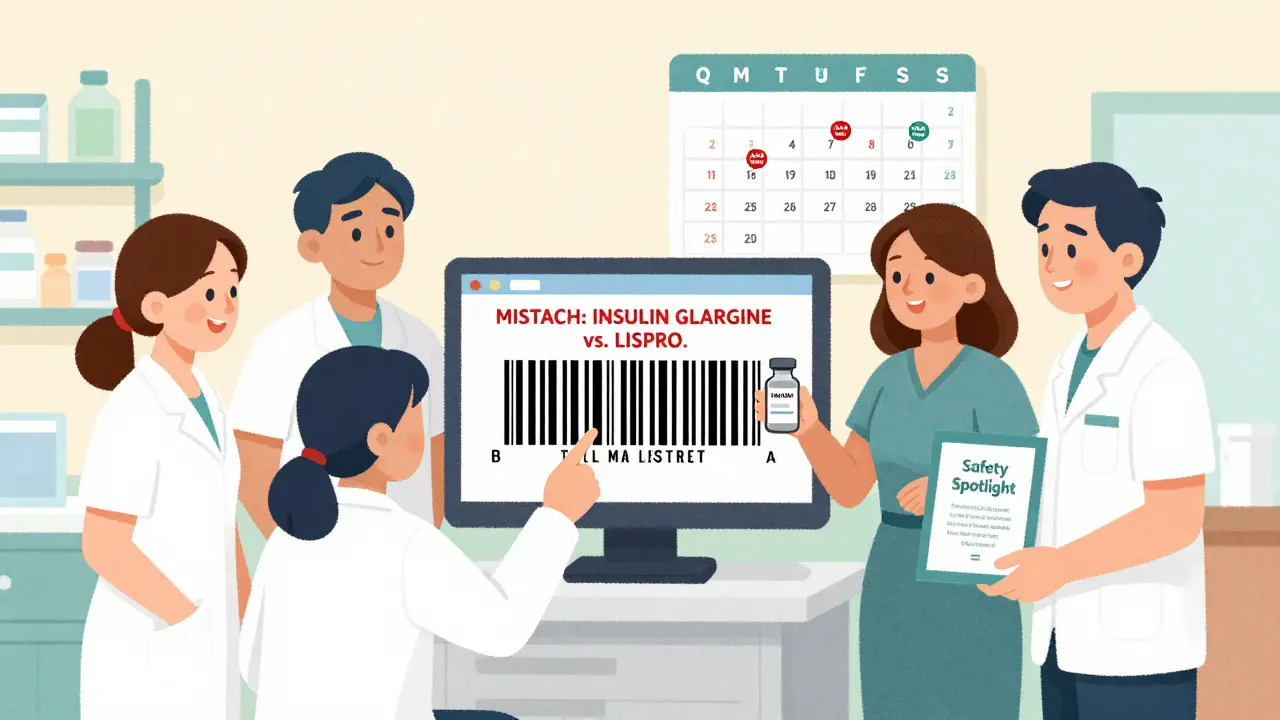
The most powerful tool in the pharmacy’s arsenal? Barcode scanning.When a pharmacist scans the drug, the system checks it against the prescription. If the barcode doesn’t match, it alerts you. No guesswork. No assumptions. Just a clear “no.”
A 2021 AHRQ report found barcode scanning reduces medication administration errors by 86%. That’s the highest reduction rate of any single strategy. At Mayo Clinic, combining barcode scanning with physical separation eliminated 100% of heparin/saline mix-ups over a 12-month period.
But it’s not foolproof. About 5-12% of staff still bypass scanning-especially during rush hours. One study from UC San Francisco found pharmacists skipped scans when they were “sure” they had the right drug. That’s human nature. So don’t rely on scanning alone. Make it mandatory. Tie it to your quality checks. And train staff to treat every scan as a critical step, not a formality.
The cost? $15,000 to $50,000 per pharmacy for full setup. But consider this: one preventable death can cost millions in lawsuits, lost licenses, and reputational damage. The ROI is clear.
Layered Defense: The Only Real Solution
No single strategy works perfectly. That’s why the best pharmacies use all three: physical separation, Tall Man Lettering, and barcode scanning.A 2023 study in the American Journal of Health-System Pharmacy found that combining all three reduced errors by 94%. That’s not a coincidence-it’s the result of defense in depth. If one layer fails, the next one catches it.
Michael Cohen, president of ISMP, says it best: “The most effective LASA prevention strategy is a layered approach.”
Think of it like a seatbelt, airbag, and driver training. One might save you. All three make you nearly invincible.
Start small. Pick your top three most dangerous pairs-like insulin glargine vs. insulin lispro, or clonidine vs. clonazepam. Separate them on the shelf. Apply TML in your system. Then add barcode scanning for those drugs first. Build from there.
What to Do When You Get a New Drug
New drugs arrive all the time. And they often come with new risks.Erin Fox from the University of Utah Health says: “When a new product arrives, review it for unexpected LASA risks.”
That means checking if it looks or sounds like any drug you already carry. Is the bottle shape similar? Is the label color close? Does the name start or end the same way? Use ISMP’s 2023 Tool for Evaluating the Risk of Confusion Between Drug Names. It takes 8-12 hours for a typical pharmacy to run a full assessment.
Don’t wait for someone to get hurt before you act. Proactive review beats reactive damage control.
Training and Culture: The Human Factor
Technology helps-but people still make the final decision.A 2023 survey found 78% of pharmacy directors say staff resistance is the biggest barrier to change. Why? Because it’s easier to grab the bottle than to pause, scan, double-check.
Change that culture. Make safety part of your daily routine. Include LASA checks in your daily huddles. Reward staff who catch near-misses. Celebrate when someone says, “Wait, that doesn’t look right.”
One pharmacy in Calgary started a “Safety Spotlight” board. Every week, they feature a staff member who prevented an error. It’s not about blame. It’s about pride in doing the right thing.
What’s Next? The Future of Medication Safety
The FDA just released new draft guidelines in February 2024, requiring standardized Tall Man Lettering for 25 high-risk drug pairs. ISMP added 17 new LASA pairs to their list in January 2024, including buprenorphine and butorphanol.And the future? Artificial intelligence is starting to scan packaging images to flag look-alike designs before drugs even hit the shelf. Pilot programs at Johns Hopkins are already detecting 98% of potential matches.
By 2030, experts predict comprehensive LASA prevention will be standard practice. The question isn’t if-it’s when your pharmacy will get there.
Right now, only 32% of community pharmacies have a full program. That means you’re ahead of the curve if you start now.
Where to Begin Today
You don’t need a big budget or a tech overhaul to start protecting patients.- Download ISMP’s free LASA risk assessment tool.
- Identify your top 3 most dangerous look-alike pairs.
- Physically separate them on the shelf-use tape, bins, or dividers.
- Check your pharmacy software: Does it use Tall Man Lettering for those pairs?
- Start scanning those three drugs with barcode readers-even if you don’t scan everything yet.
- Talk to your team. Ask them: “Have you ever picked up the wrong bottle?” Listen. Then act.
Medication safety isn’t about perfection. It’s about creating habits that make mistakes nearly impossible. The tools are there. The data is clear. The patients are counting on you.
What are the most common look-alike drug pairs in pharmacies?
Common look-alike pairs include insulin glargine and insulin lispro, hydralazine and hydroxyzine, clonidine and clonazepam, spironolactone and spiramycin, and dobutamine and dopamine. These pairs are frequently confused because of similar spelling, packaging, or pronunciation. ISMP updates its official list quarterly based on real error reports.
Does Tall Man Lettering really work?
Yes, when used consistently. Studies show Tall Man Lettering reduces selection errors by 47%. However, its effectiveness drops if different systems use different capitalization styles. For example, if one EHR shows DOBUTamine and another shows doBUTamine, confusion remains. Standardization across all systems is key.
Can I prevent look-alike errors without expensive technology?
Absolutely. Physical separation is free and reduces errors by up to 62%. Simple tools like colored labels, shelf dividers, or designated bins can make a big difference. Many community pharmacies have cut errors in half using just these low-cost methods.
Why do pharmacists sometimes skip barcode scanning?
Staff often bypass scanning during busy times, thinking they’re “sure” they have the right drug. But human memory is fallible. A 2021 study found that 12% of scans were skipped during peak hours. Making scanning mandatory and tying it to quality reviews helps overcome this habit.
How often should I review my pharmacy’s look-alike risks?
Review your drug inventory every time you receive a new medication. Also, run a full assessment using ISMP’s tool at least twice a year. New drugs enter the market regularly, and drug shortages can force substitutions that create unexpected risks.
Oh wow, another ‘wake up America’ post about pharmacies. Like we didn’t already know this? The FDA’s been screaming about this since 2007. But nope, still 32% of pharmacies are playing Russian roulette with insulin vials. 🤦♂️
And don’t even get me started on how some states still let pharmacists use sticky notes as ‘warning labels.’ I’ve seen a bottle of hydralazine with a Sharpie scribble that said ‘not hydroxyzine lol.’ That’s not negligence, that’s a crime.
you know what this is really about? its not the labels or the scanners its the fact that we stopped caring about details. we live in a world where people think ‘close enough’ is good enough. the bottle says insulin right? who cares if its glargine or lispro? its all sugar control amirite?
we used to be careful. now we just click ‘confirm’ and move on. thats the real problem.
India does this better. We dont need barcode scanners or tall man lettering. We have pharmacists who memorize 500 drugs by smell and texture. Your system is broken because you rely on machines. We rely on training. Simple.
Physical separation works. Period.
I work at a CVS in Ohio and we just started using colored tape for high-risk pairs. Yellow for insulin, red for clonidine/clonazepam. It’s not fancy, but now my coworker actually pauses before grabbing. She even said ‘wait, that’s the yellow one’ last week. I almost cried.
Also, we don’t scan everything yet… but we scan those three. And guess what? Zero errors since January.
OMG I KNEW THIS WAS A PROBLEM 😭
My grandma died because they gave her hydralazine instead of hydroxyzine. She was 82. She didn’t even know what she was taking. The pharmacy said ‘it’s close enough’ and the family sued but the insurance company settled for $12k. 12k for a life. 😤
Why is this still happening? Who’s protecting us? 🤬
I’ve trained over 200 pharmacists in rural India and the US, and let me tell you - the real magic isn’t in the tech. It’s in the culture. When you make safety a point of pride, not a compliance checkbox, people change. I once had a pharmacy owner who put a sign above the counter: ‘Your mistake could be someone’s last breath.’ He didn’t need scanners. His staff started double-checking because they felt responsible. That’s the real ROI.
I’m Canadian and we do this way better than the US. We have mandatory TML on all scripts, and our pharmacists get paid extra for doing safety checks. Also, we don’t have 20 prescriptions waiting while a nurse yells at you. We have time. We have respect. We have systems.
But hey, at least you’ve got TikTok now. Maybe someone will make a viral video about hydralazine vs hydroxyzine? Maybe that’s the only way this gets fixed.
so if you use tall man lettering but your ehr doesnt support it properly does it even matter like what if one system does DOBUTamine and another does doBUTamine isnt that just confusing the other way
Honestly I’m tired of hearing about this. Everyone knows the rules. If you’re making these errors you’re not qualified to be a pharmacist. Stop blaming the system. Blame the lazy people who don’t read labels. This isn’t rocket science. It’s basic attention. And if you can’t manage that, quit.
I just started as a pharmacy tech and I didn’t know any of this. My boss showed me the ISMP list and I was shocked. I thought ‘oh they’re just different names’ until I saw how similar the bottles look. Now I always pause. I even say ‘let me check’ out loud. It’s weird at first but now my coworkers do it too. It’s not about being perfect - it’s about being human.
I work in a small pharmacy in Kerala and we have zero barcode scanners. We use a simple system - every high-risk drug goes in a red bin, we write the full name in capital letters on the bin, and every time we grab one, we say the name out loud to our partner. It’s old school but it works. We’ve had zero errors in 4 years. The FDA should send someone to India to learn. Not the other way around. And yes, we do this even during rush hour. Because if you rush, you kill. No exceptions. No excuses. We don’t have lawsuits here - we have dignity.