How to Interpret Beyond-Use Dates for Compounded Medications

Imagine picking up a custom-made prescription. It’s tailored perfectly to your needs-maybe it’s a liquid version of a pill you can’t swallow, or an ointment without the allergens that usually bother your skin. The label has a date on it. But unlike the expiration date on a bottle of ibuprofen from the supermarket, this one is called a Beyond-Use Date (BUD). What does it actually mean? And why should you care if you miss it by just a few days?
The short answer is safety. A BUD isn't just a suggestion; it's the hard stop for when a compounded medication might start breaking down, losing its strength, or growing bacteria. Because these drugs are made fresh in a pharmacy rather than mass-produced in a factory, they don't have the same long shelf lives as commercial drugs. Understanding how these dates are set helps you trust your medication and stay safe.
What Is a Beyond-Use Date?
To get clear on this, we first need to separate two terms that often get mixed up: Expiration Date and Beyond-Use Date.
An expiration date belongs to commercially manufactured drugs. Before those drugs hit the shelves, companies like Pfizer or Johnson & Johnson run them through rigorous stability testing. They check how the drug holds up over months or years under specific conditions. The Food and Drug Administration (FDA) reviews this data. That’s why you can buy a box of aspirin today and know it will still work next year.
A Beyond-Use Date is different. It applies to Compounded Medications, which are custom-formulated drugs prepared by a pharmacist based on a doctor's prescription. These aren't FDA-approved products in the traditional sense because they are made specifically for individual patients. Since there’s no massive factory stability study for every unique mixture, the compounding pharmacy must assign a date after which the preparation shall not be used. This definition comes directly from the United States Pharmacopeia (USP), the gold standard for drug quality in the U.S.
Think of it this way: An expiration date is like the warranty on a new car. A BUD is more like the oil change interval for a custom-built engine-it depends entirely on what parts were used and how it was built.
Why Do Compounded Drugs Need Shorter Dates?
You might wonder why a compounded cream or liquid can't last as long as a store-bought one. The main reason is preservation. Most commercial drugs contain preservatives designed to kill bacteria and keep the chemical structure stable for years. When a pharmacist compounds a medication, they often remove these preservatives because many patients are allergic to them or simply don't want them in their medicine.
Without strong preservatives, the risk of microbial contamination rises quickly. According to the American Society of Health-System Pharmacists (ASHP), the primary purpose of a BUD is to identify the time by which the preparation must be used before it faces risks of chemical degradation, physical changes, or bacterial growth.
There’s also the issue of formulation. If a pharmacist turns a solid tablet into a liquid suspension, they are adding water and other ingredients (excipients). Water is a breeding ground for microbes. Furthermore, changing the pH level to make a drug taste better or absorb faster can speed up how fast the active ingredient breaks down. A 2023 study found that compounded formulations with altered pH levels degraded 3.7 times faster than their commercial equivalents. That’s why the clock starts ticking much sooner.
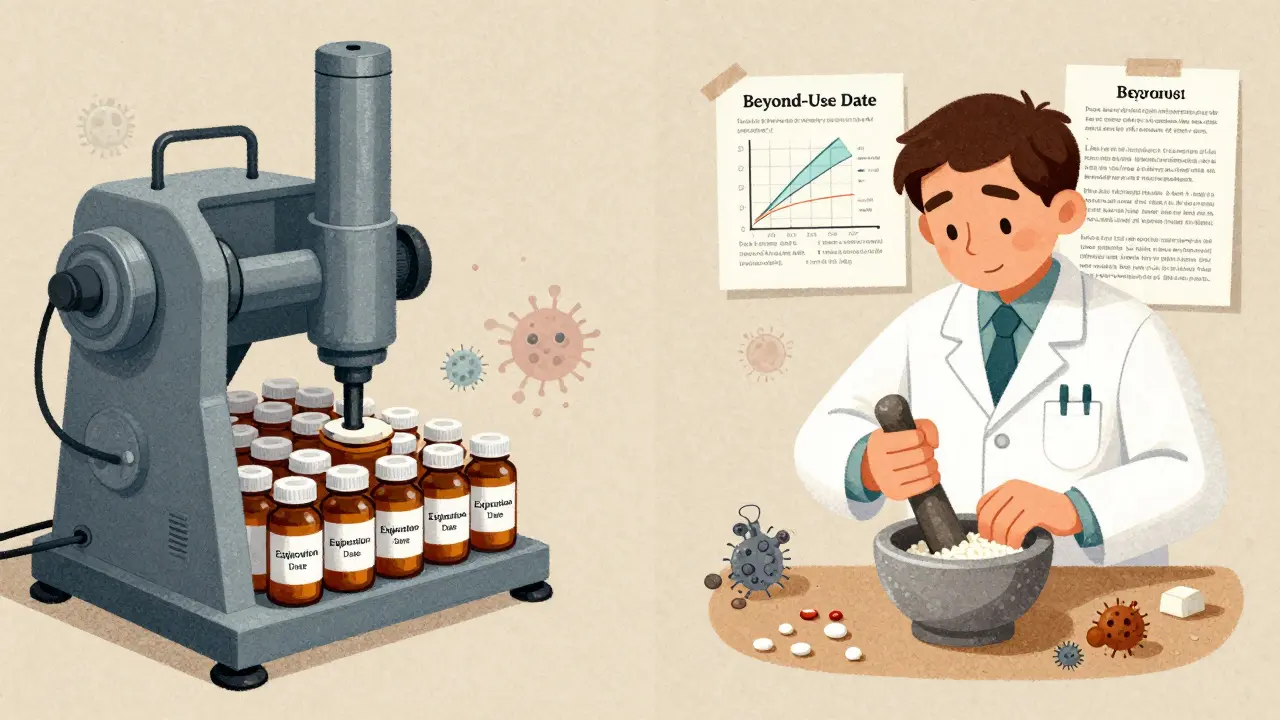
How Pharmacists Determine the Date
Pharmacists don't just pick a number out of thin air. They follow strict guidelines, primarily from USP Chapter 797, which provides the regulatory framework for compounding sterile preparations. There are four main ways they figure out the BUD:
- Product Labeling: Using information provided by the manufacturer of the raw drug substance.
- Manufacturer Consultation: Calling the company that makes the active ingredient to ask about stability.
- Literature Review: Checking trusted scientific databases and journals for similar formulations.
- Direct Testing: Performing actual stability tests on the specific batch being made.
Direct testing is the gold standard. It involves using methods like High Performance Liquid Chromatography (HPLC) to see exactly how much of the active drug remains over time. However, this is expensive and time-consuming. As a result, many pharmacies rely on literature or manufacturer data. Dr. Qiang Liu, a research supervisor at ArLok, notes that while literature-based dating is common, it introduces assumptions. He emphasizes that "the only truly valid beyond use date is obtained through product-specific studies supported by scientific data."
When pharmacists use literature, they have to match the exact formula, container type, and storage conditions. Even small differences can change stability by up to 58%, according to laboratory testing. If the match isn't perfect, they must err on the side of caution and assign a shorter date.
Risk Levels and Maximum Time Limits
Not all compounded medications are created equal. Some are simple, like mixing two pills together. Others are complex, like creating a sterile injection for surgery. USP <797> categorizes these into three risk levels, each with its own maximum BUD limits. These limits apply to Compounded Sterile Preparations (CSPs):
| Risk Level | Description | Max BUD (Room Temp) | Max BUD (Refrigerated) |
|---|---|---|---|
| Low-Risk | Made in clean environment, minimal manipulation | 48 hours | Up to 14 days (extended with testing) |
| Medium-Risk | More complex steps, multiple ingredients | 30 hours | Up to 9 days |
| High-Risk | Non-sterile ingredients converted to sterile, high complexity | 24 hours | Up to 3 days |
If your medication is stored in the fridge, it might last longer, but only if the specific formulation is proven to be stable at cold temperatures. Never assume refrigeration extends the life indefinitely. For example, some creams separate or freeze-thaw cycles can break down the active ingredient.
Common Mistakes and Safety Pitfalls
Even with strict rules, errors happen. The FDA has issued warning letters to compounding pharmacies for assigning BUDs that are too long. In 2022, inappropriate BUD extension was the third most common violation cited by the FDA. Why does this happen?
One major pitfall is the container. Many patients receive medication in syringes or small vials. However, the FDA warns that syringes are not approved devices for long-term storage. Plastic can leach chemicals into the drug, or the drug can degrade the plastic. Despite this, a survey found that over 40% of retail compounding pharmacies still assign BUDs for syringe-stored products based on data from glass vials. This is dangerous because the material interaction changes the stability profile completely.
Another issue is "extrapolation." Sometimes a pharmacist sees a study showing a drug is stable for 30 days and assumes their slightly different version will also last 30 days. But as noted earlier, excipients can alter degradation pathways by up to 63%. Assuming stability without direct evidence is a gamble with patient health.
In 2021, the FDA recalled over 1,200 compounded sterile products from a single pharmacy because incorrect BUD assignments led to microbial contamination. Patients got sick because the medicine was used past its safe window. This highlights why understanding the BUD is critical for everyone involved.
What You Should Do as a Patient
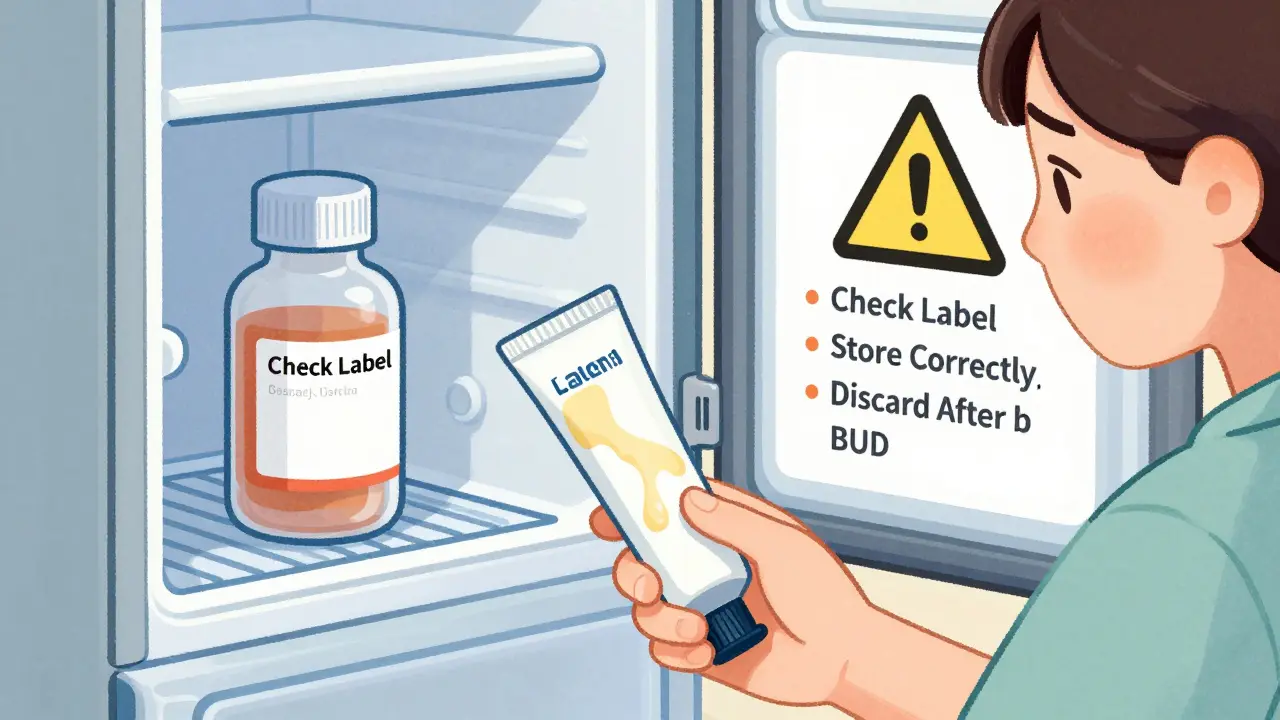
So, how do you protect yourself? Here is a practical checklist for handling compounded medications:
- Check the Label Immediately: Look for the BUD. It should be clearly printed. If it’s missing or unclear, call the pharmacy right away.
- Follow Storage Instructions: If the label says "Refrigerate," do not leave it on the counter. Temperature fluctuations can accelerate degradation. If it says "Room Temperature," keep it away from heat sources like stoves or windowsills.
- Don't Use Expired Meds: Once the BUD passes, throw it away. The drug may not work, or worse, it could harbor bacteria. This is especially true for eye drops, injections, and liquids.
- Ask Questions: If you’re prescribed a compound that needs to be taken for six months, ask the pharmacist how the BUD is determined. Are they using direct testing? Literature? Knowing this builds trust.
- Monitor for Changes: Even before the BUD, look for signs of spoilage. Has the color changed? Is there a weird smell? Did the texture become gritty? If so, stop using it and contact your provider.
Remember, compounding pharmacies exist to help you when commercial options fail. They provide vital services for people with allergies, children who can’t swallow pills, or patients needing precise hormone doses. But this flexibility requires extra vigilance regarding safety dates.
The Future of Stability Testing
The industry is moving toward stricter standards. The USP proposed revisions in 2024 that would require direct stability testing for any BUD exceeding 30 days. This aims to reduce reliance on general literature and ensure every long-lasting compound is scientifically verified. Technologies like real-time stability monitoring systems are also emerging, helping pharmacies track degradation in real-time rather than guessing.
As personalized medicine grows-with projections showing compounded medications making up nearly 20% of prescriptions by 2030-the importance of accurate BUD interpretation will only increase. By staying informed, you become an active partner in your healthcare, ensuring that your custom medication is both effective and safe.
Can I extend the Beyond-Use Date by freezing my medication?
Generally, no. Freezing can damage the chemical structure of many compounded medications, especially suspensions and emulsions. Unless the pharmacist explicitly states that the medication is freezer-stable, freezing it can render it ineffective or unsafe. Always follow the specific storage instructions on the label.
Why is the BUD on my compounded cream only 30 days?
Topical creams often lack strong preservatives to avoid skin irritation. Without these preservatives, bacteria can grow in the product within weeks. Additionally, the base of the cream (like petroleum or lanolin) can degrade or oxidize over time. A 30-day BUD is a common standard for water-containing topical preparations to ensure sterility and potency.
Is a Beyond-Use Date the same as an expiration date?
No. An expiration date is assigned by a manufacturer after extensive stability testing of a mass-produced drug. A Beyond-Use Date is assigned by a compounding pharmacist based on available data, literature, or limited testing for a custom-made preparation. BUDs are typically much shorter than expiration dates.
What happens if I take a compounded medication after the BUD?
You risk taking a medication that has lost its potency, meaning it won't treat your condition effectively. More dangerously, the medication may have developed microbial contamination (bacteria or fungi), which can lead to infections, especially if it's an eye drop, injection, or applied to broken skin.
Do all compounded medications have short Beyond-Use Dates?
Not necessarily. While many have short dates due to lack of preservatives, some non-aqueous (non-water-based) formulations can be stable for longer periods. However, the BUD is always determined by the specific ingredients and container. Always rely on the date provided by your pharmacist rather than assuming a standard length.