How Sleep Disruption Affects Weight Gain: The Science of Circadian Rhythm and Metabolism
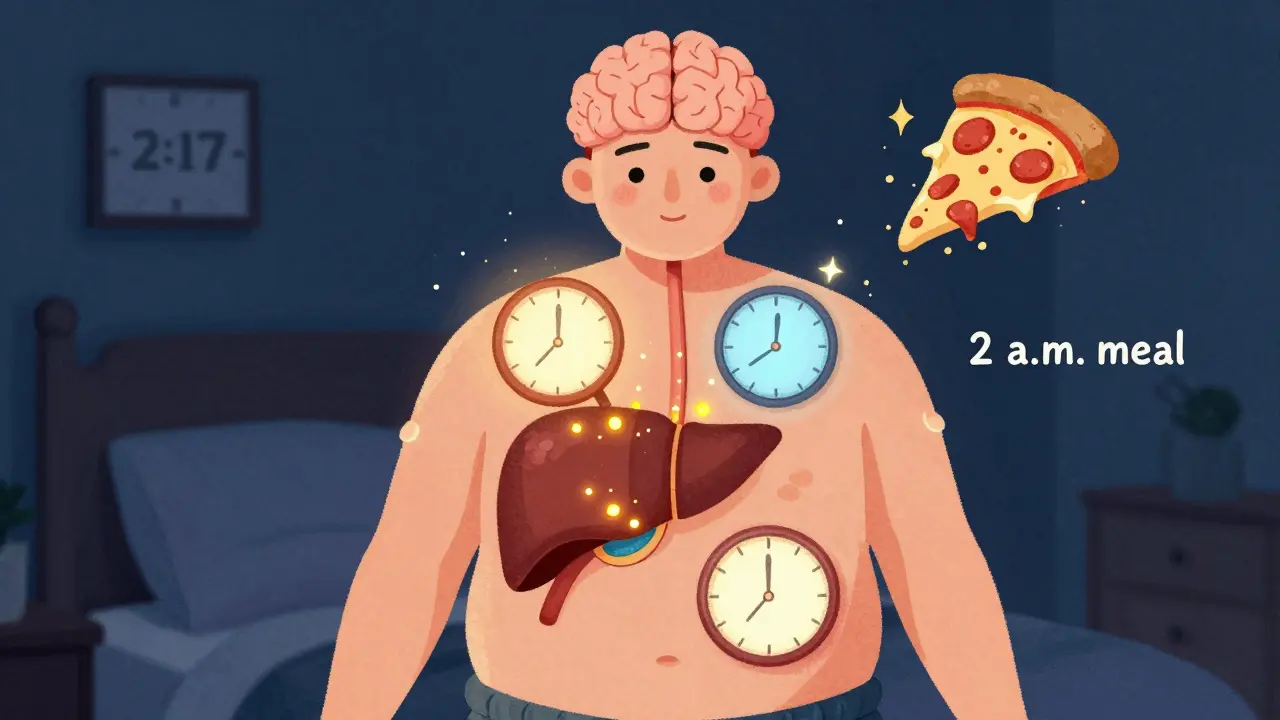
Why do you gain weight even when you’re eating the same amount? If you’ve tried cutting calories, counting macros, or hitting the gym harder - but the scale won’t budge - the problem might not be what you’re eating. It might be when you’re eating - and how much you’re sleeping.
Your Body Has a Clock, and It’s Running Out of Sync
Every cell in your body runs on a 24-hour rhythm called the circadian clock. It’s not just about feeling tired or awake. This internal clock controls when your liver releases glucose, when your fat cells burn energy, when your stomach digests food, and when your brain decides if you’re hungry or full. The master clock sits in your brain, but every organ - liver, pancreas, fat tissue - has its own version, all synced by light, food, and sleep. When you stay up late, eat at 2 a.m., or work nights, your body gets mixed signals. Your liver thinks it’s daytime and starts making glucose. Your fat cells stop burning fat. Your hunger hormones go haywire. This isn’t just "feeling off." This is metabolic chaos. A 2014 study in PNAS found that people working night shifts burned 55 fewer calories per day - about the energy in a small banana - just because their bodies were out of sync. That’s not much, right? But here’s the catch: at the same time, they ate 250+ extra calories a day. That’s a net gain of 150+ calories daily. In a year, that’s nearly 17 pounds of weight gain - without eating more junk food or skipping workouts.Why Late-Night Eating Makes You Fat
Your body isn’t built to process food at night. When you eat after dark, insulin sensitivity drops by 20-25%. That means your body can’t move sugar from your blood into your cells efficiently. Sugar stays in your bloodstream longer. Your liver turns it into fat. Your pancreas works overtime, and over time, it burns out. A 2022 review in Nature Reviews Endocrinology confirmed that eating during your biological night - even if the calories are the same - leads to worse blood sugar control and more fat storage. It’s not about the pizza. It’s about the time. Think about it: your ancestors didn’t eat at midnight. They ate when the sun was up. Your body still expects that. When you eat at 1 a.m., your digestive system is supposed to be asleep. It’s like trying to run a car engine while the battery’s dead - it sputters, overheats, and eventually breaks down.Sleep Loss Turns Your Brain Into a Food Junkie
Lack of sleep doesn’t just make you tired. It rewires your brain’s reward system. A 2016 study from the University of Chicago showed that when people slept only 4 hours a night for four days, their appetite jumped by 22%. But it wasn’t just hunger - it was cravings. The desire for carbs and sugary snacks spiked by 33%. Brain scans showed their reward centers lit up like Christmas trees when they saw images of cookies and chips. Their rational control centers? Shut down. You’re not weak. You’re biologically hijacked. Your body thinks you’re in survival mode. It’s screaming for quick energy. And guess what gives that? Sugar. Simple carbs. Processed snacks. That’s why you reach for the chips at 2 a.m. - not because you’re bored, but because your brain thinks you’re starving.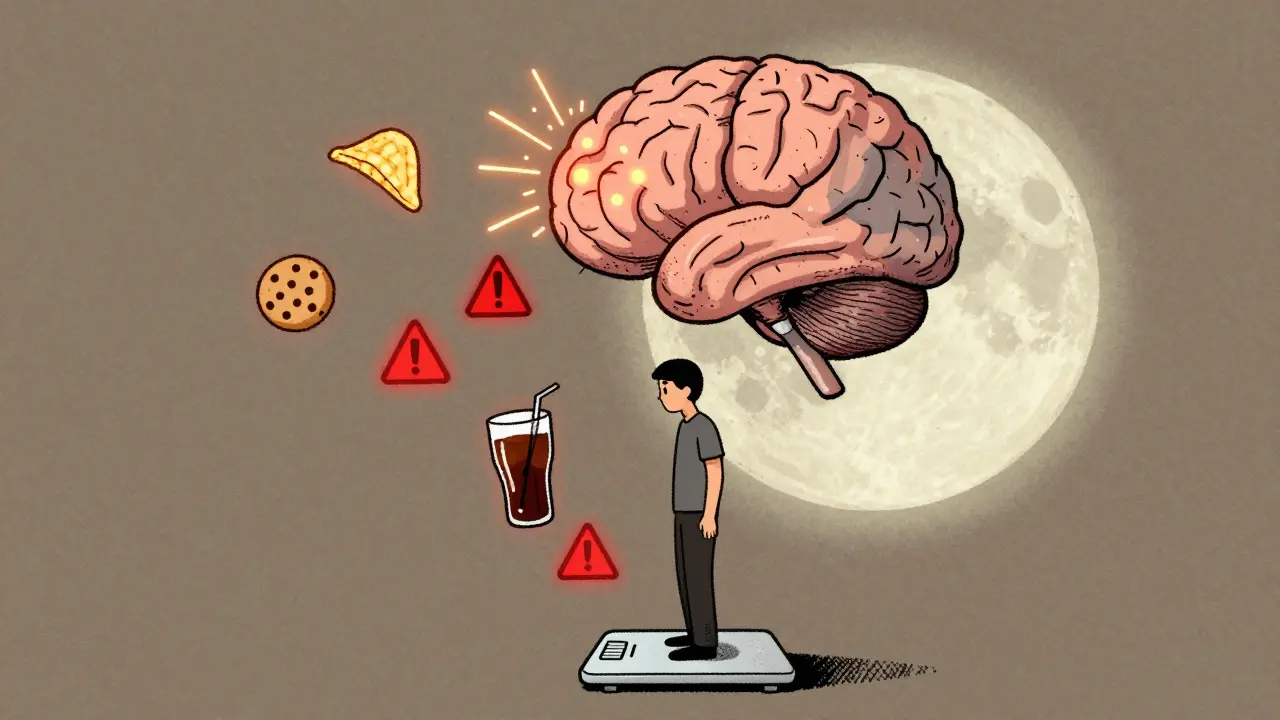
Shift Workers Are Living Proof
About 20% of the global workforce works nights or rotating shifts. And nearly 80% of them report gaining weight after starting shift work. One nurse on Reddit shared: “I gained 35 pounds in my first year of night shifts. I ate the same food. But at 3 a.m., my body was screaming for something. I couldn’t stop.” This isn’t anecdotal. A 2013 study by Dr. Frank Scheer found that shift workers gained 2.5 kg more than day workers over two years - even when their calorie intake was identical. The only difference? Timing. Their bodies were out of sync with their meals. The Endocrine Society reviewed 27 studies with 285,000 people and concluded that circadian disruption adds 5-10% to obesity risk - independent of diet and exercise. That’s not a side effect. It’s a driver.Time-Restricted Eating: The Simple Fix
You don’t need to starve yourself. You don’t need to buy expensive supplements. You just need to eat during daylight hours. Time-restricted eating (TRE) means limiting your food intake to a 10-hour window or less - ideally between sunrise and sunset. A 2019 study from the Salk Institute found that overweight adults who ate only between 8 a.m. and 6 p.m. lost 3-5% of their body weight in 12 weeks - without changing what they ate. The trick? Consistency. Not perfection. If you usually eat from 7 a.m. to 11 p.m., start by cutting the window to 8 a.m. to 10 p.m. for a week. Then shrink it to 8 a.m. to 9:30 p.m. The next week. Keep going until you’re eating within an 8-10 hour window. And here’s the kicker: your chronotype matters. Morning people (larks) do best with an 8 a.m. to 6 p.m. window. Night owls? Try 10 a.m. to 8 p.m. Pushing too early for night owls backfires - it increases stress and cravings.What Doesn’t Work (And Why)
Just sleeping more won’t fix it. If you sleep 9 hours but eat at 1 a.m., your metabolism is still broken. Sleep is only half the equation. Timing is the other. And no, “I’ll just burn it off at the gym” won’t work either. Exercise can’t undo the hormonal chaos caused by late-night eating. You can run 5 miles, but if your insulin is high and your fat cells are in storage mode, you’re just burning muscle, not fat. Also, don’t fall for the “eat less, move more” myth. That advice ignores the fact that your body isn’t a simple calculator. It’s a living system with rhythms. You can’t out-exercise a broken clock.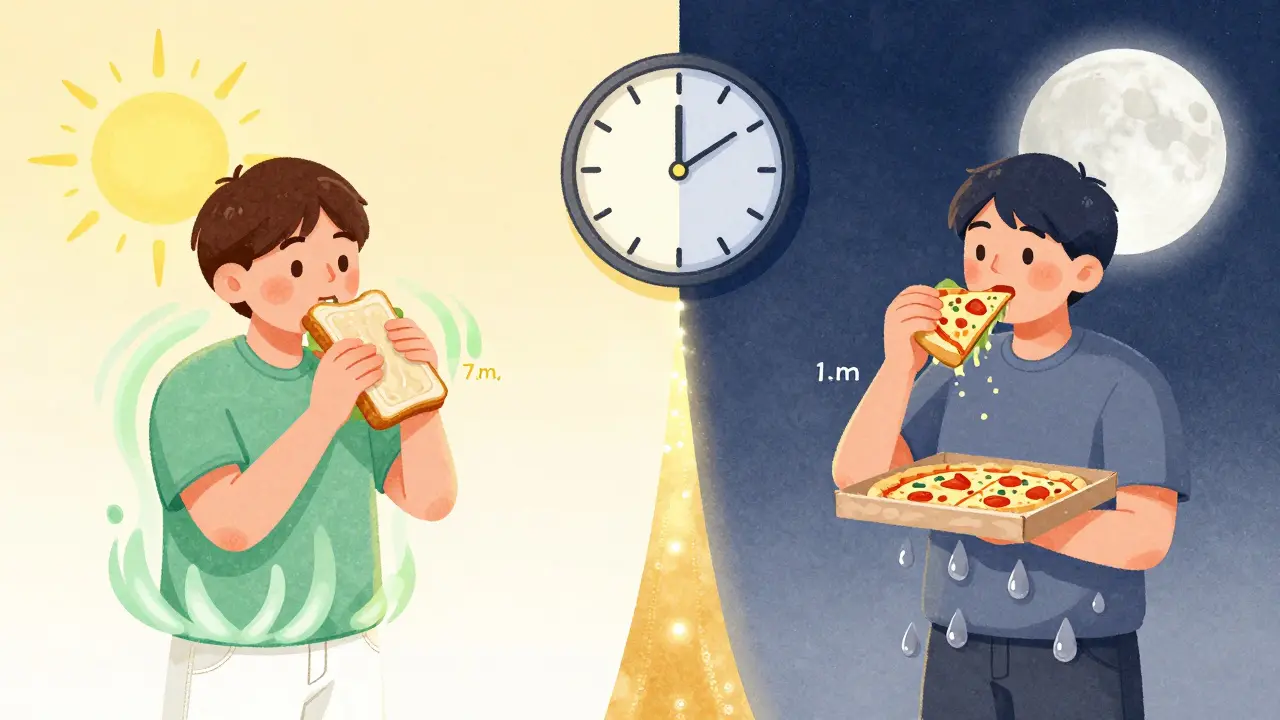
The Bigger Picture: Why This Matters Now
The global market for circadian health tools is projected to hit $2.8 billion by 2030. Why? Because people are finally seeing the connection. Kaiser Permanente’s pilot program for night shift workers cut weight gain by 42% by simply adjusting light exposure and meal timing. The FDA now requires drug trials for obesity to consider timing of treatment. Fitbit’s 2024 update includes a circadian alignment score that predicts 18% of weight change - more than steps or heart rate alone. This isn’t a fad. It’s biology. And it’s backed by decades of research - from mouse genes to human trials.Where to Start Today
You don’t need a lab or a coach. Start with these three steps:- Stop eating 3 hours before bed. Even if you’re not hungry, your body needs a fasting window to reset.
- Get morning light. Step outside for 10-15 minutes within 30 minutes of waking. This tells your brain it’s daytime and resets your clock.
- Keep your sleep and wake times within 30 minutes of each other - even on weekends. Consistency beats duration.
I used to eat pizza at 2 a.m. like it was a ritual. Then I started just stopping at midnight. Lost 12 pounds in 3 months without changing a single thing I ate. My jeans are literally falling off. 🤯
So let me get this straight - we’re blaming obesity on not being a 19th-century farmer? My grandpa worked 16-hour shifts, ate at midnight, and lived to 92. He also smoked, drank, and never heard of ‘circadian rhythm.’
OMG YES. I’m a night owl and I used to think I was just lazy. But after I started eating only until 9 p.m. and got morning sunlight? My energy is insane. I’m not even trying. My body just… works now. 🌞🍕➡️🥗
It’s fascinating how the modern world has systematically dismantled our evolutionary biology - yet we still cling to the delusion that willpower is the solution. The fact that the Endocrine Society has confirmed this is not a ‘trend’ but a biological imperative speaks volumes about the institutional ignorance of public health policy. We’re not failing. We’re being failed by design.
And yet, here we are, lecturing people to ‘just eat earlier’ as if that’s a privilege available to those working three jobs, caring for children, or living in apartments without blackout curtains. The irony is breathtaking.
People don’t understand that this isn’t about discipline - it’s about obedience. Your body isn’t a car you can tune up with a wrench. It’s a sacred temple with a divine schedule. When you eat at 2 a.m., you’re not just eating - you’re defiling your own biology. And then you wonder why you feel like garbage? It’s not a coincidence. It’s karma.
And don’t even get me started on those who say ‘I sleep 9 hours.’ Sleep isn’t a battery you charge. It’s a rhythm. You can’t just dump 9 hours into a broken clock and expect it to chime.
I used to think I was just ‘bad at diets.’ Turns out I was just a sacrilegious midnight snack thief.
Interesting how the science is finally catching up to what traditional medicine has known for centuries - that timing is everything. But let’s be honest: this isn’t just about metabolism. It’s about control. The food industry profits from chaos. They want you hungry at midnight. They want you craving sugar because that’s when you’re vulnerable. This isn’t biology - it’s capitalism disguised as biology.
I’ve seen patients lose weight just by shifting their meals. No supplements. No keto. No intermittent fasting gimmicks. Just… eat when the sun’s up. It’s almost too simple. Which is why no one wants to believe it.
Bro. I work nights. I eat at 3 a.m. I’m not gonna stop. You think I’m gonna go home and sleep at 6 a.m. then wake up at 11 a.m. to eat breakfast? Nah. I got bills. I got kids. I got a boss who thinks ‘sleep’ is a luxury. You wanna fix this? Fix the system. Don’t tell me to ‘just eat earlier’ like I’m a petulant toddler.
Also - ‘morning light’? My apartment faces a brick wall. I work in a warehouse with no windows. So thanks for the advice, sunshine guru.
I just started not eating after 8 p.m. and I feel way less bloated. Not even sure why I waited this long. My grandma used to say ‘don’t eat after dark’ - turns out she was right.
They say circadian rhythm but what they really mean is ‘western sleep norms.’ My people in Nigeria eat late, sleep late, wake late - and we don’t get fat. We eat rice and beans at midnight and still run 5k in the morning. This is just another white man’s problem dressed up as science. They want you scared of your own culture.
Let’s cut the nonsense. This isn’t ‘biology.’ This is a glorified version of ‘eat less, move more’ with fancy graphs. You’re blaming the victim for not being able to afford a quiet bedroom, blackout curtains, or the luxury of not working two jobs. Meanwhile, Big Pharma is selling ‘circadian supplements’ for $80 a bottle. Wake up.
The real issue? Poverty. Stress. Food deserts. Not whether you ate at 1 a.m. or 11 p.m. Your ‘science’ is just a distraction from systemic failure.
Thank you for presenting this information with such clarity and scientific rigor. The integration of chronobiology with metabolic health represents a paradigm shift in nutritional science, and your synthesis of peer-reviewed literature is both comprehensive and accessible. I would be honored to share this with my colleagues in clinical endocrinology, as it underscores the necessity of temporal considerations in patient care. The implications for public health policy are profound and warrant immediate attention.