How Europe's Tendering Systems Drive Generic Purchasing: A Complete Guide

Imagine spending €2 trillion a year. That is roughly what the European Union spends annually on public procurement. It is not just buying office supplies; it is building railways, upgrading energy grids, and hiring IT services across 27 member states. For businesses looking to sell in Europe, understanding how this money moves is critical. The system isn't designed to be easy-it is designed to be fair, transparent, and competitive. But for many suppliers, especially smaller ones, it feels like a maze of paperwork and strict rules.
This guide breaks down the reality of European tendering systems. We will look at how these systems handle generic purchasing, why the rules exist, and how you can actually win contracts without getting lost in the bureaucracy. Whether you are a small tech firm or a large construction company, knowing the mechanics of the EU procurement market is your first step toward securing those high-value deals.
The Core Principles Behind the Rules
To understand the current system, you have to look at where it started. The modern framework traces back to Directive 77/62/EEC from 1977. At its heart, the system was built on three non-negotiable pillars: advertising contracts community-wide, banning discriminatory technical specs, and using objective criteria for awarding deals. These principles were tightened over the decades, notably with Directive 80/767 after the 1979 GATT Agreement and Directive 88/295/EEC, which made open tendering the standard.
Today, the heavy lifting is done by Directive 2014/25/EU. This directive governs procurement by entities in water, energy, transport, and postal services. It applies to contracts above specific financial thresholds. Why does this matter? Because if your contract falls below that threshold, you might escape some of the stricter EU rules, but you also lose the guarantee of cross-border competition. If it is above, you must play by the book. The goal is simple: prevent corruption, ensure value for public money, and allow a company in Finland to compete fairly against one in Spain for a project in Belgium.
The proportionality principle is perhaps the most important rule for suppliers. It means requirements must match the contract size. You cannot demand €10 million in annual revenue for a €1 million contract. This protects small and medium-sized enterprises (SMEs) from being squeezed out by giants, although, as we will see, the administrative burden remains a huge hurdle.
Choosing the Right Procedure: Open vs. Restricted vs. Competitive
Not all tenders are created equal. The European Commission outlines several procedures, each with distinct advantages and pitfalls. Knowing which one you are facing changes your strategy entirely.
| Procedure Type | Best Used For | Key Advantage | Major Drawback |
|---|---|---|---|
| Open Procedure | Straightforward purchases with clear specs | Maximum transparency and competition | High admin burden for authorities; lower success rate per bid |
| Restricted Procedure | Complex projects requiring pre-qualification | Filters unqualified bidders early | Barriers to entry for new players; longer timeline |
| Competitive Dialogue | Innovative projects where needs are unclear | Flexibility to shape solutions with suppliers | Risk of favoritism; inconsistent application across states |
| Framework Agreements | Recurring purchases over time | Predictable revenue once qualified | High upfront effort; risk of few mini-tenders awarded |
The Open Procedure is the most common, accounting for about 45% of EU tenders. Any supplier can submit a full tender. It is transparent, but it is also exhausting. Authorities receive hundreds of bids, making it hard for any single bidder to stand out unless their proposal is flawless.
The Restricted Procedure takes a two-step approach. First, you request participation and prove you are qualified. Only then do you get to submit a tender. This reduces the workload for evaluators but creates a "gatekeeper" effect. New market entrants often struggle here because they lack the track record required for pre-selection.
For truly complex projects, like smart grid infrastructure, the Competitive Dialogue allows buyers to talk to suppliers before finalizing requirements. Dr. Anna De Lillo from Bocconi University notes that while this fosters innovation, it is prone to inconsistency. In her 2022 analysis, she highlighted that poor documentation in these dialogues leads to legal challenges. If you enter a dialogue, ensure every interaction is documented. Ambiguity is your enemy.
Finally, there are Framework Agreements. Think of these as VIP lists. Once you are on the list, you compete in "mini-tenders" for specific jobs. It sounds great until you realize the qualification process can take months. Sophie Laurent, a French SME owner, shared a painful experience: her company spent immense effort qualifying for a €200,000 framework but only received two mini-tenders in 18 months. Do the math before you apply.
Evaluation Matters: The Rise of MEAT
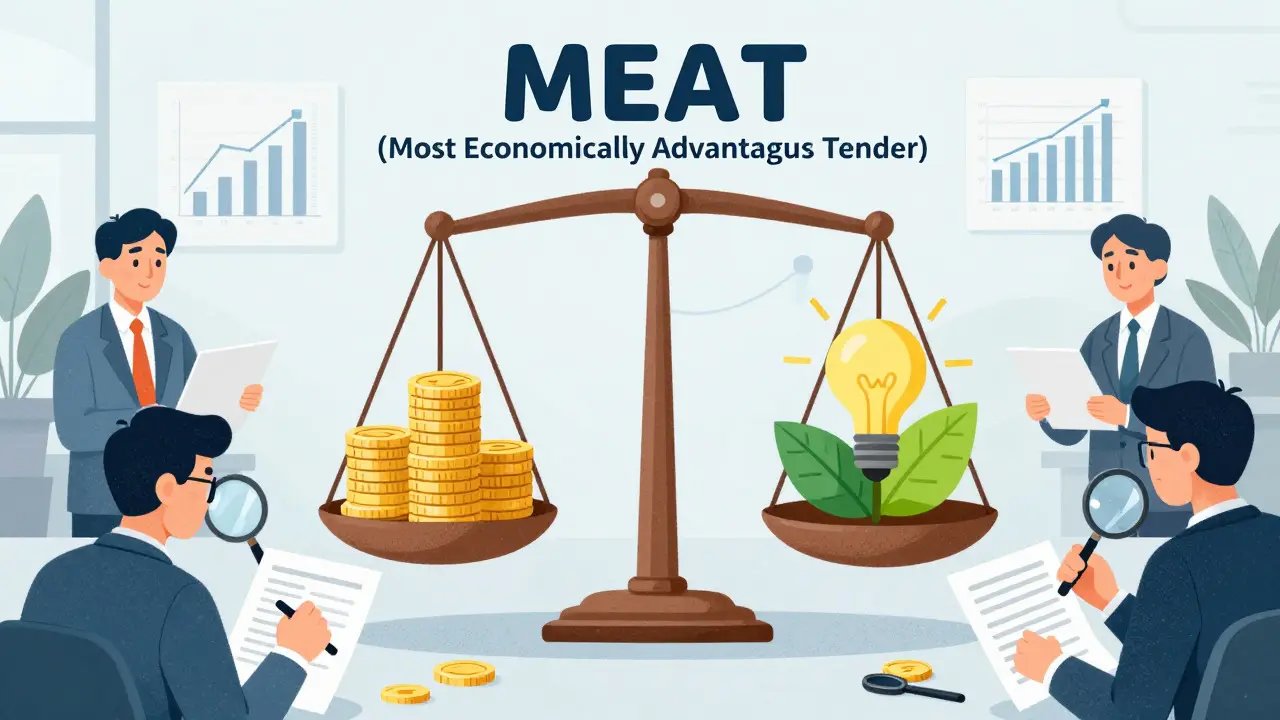
Gone are the days when the lowest price always won. The EU now emphasizes MEAT, which stands for Most Economically Advantageous Tender. This method evaluates bids based on a combination of price and quality. For complex ICT and infrastructure projects, MEAT has been shown to generate 12-18% better value outcomes than lowest-price-only approaches, according to research published in the Journal of European Public Policy.
Here is how it works in practice. The contracting authority sets weights for different criteria. Price might count for 40%, while technical quality, sustainability, and innovation make up the remaining 60%. A recent amendment to Directive 2014/25 requires that quality criteria carry at least 50% weight in high-value tenders. This is a game-changer for innovators. If you have a greener, more efficient solution, you can command a higher price and still win.
However, clarity is key. Dr. Sarah Compson, author of 'Public Procurement in the EU', warns that ambiguous requirements cause 68% of supplier complaints. If the scoring rubric is vague, your best idea might be rejected arbitrarily. Always ask for clarification during the pre-tender phase. If the authority’s response is unclear, document it. This protection could save you from a costly legal battle later.
The Digital Shift and Administrative Burden
You cannot navigate today’s system without going digital. The Tenders Electronic Daily (TED) is the central hub for all EU tenders. Registering for TED alerts is step one. Step two is dealing with the sheer volume of data. The adoption of electronic procurement has skyrocketed, reaching 76% of tenders in 2022. But the experience varies wildly by region.
A 2023 Eurochambres survey revealed a stark divide. Dutch and Danish procurement portals received user ratings of 4.6 out of 5 for clarity. Some Eastern European platforms scored a dismal 2.8 out of 5. This fragmentation is a major pain point. As a supplier, you need to adapt to different digital interfaces, document formats, and submission protocols depending on where the contract is located.
The administrative load is crushing for small businesses. The same survey found that SMEs spend an average of 117 hours per tender submission, compared to 78 hours for larger enterprises. Why the difference? Larger firms have dedicated procurement teams. SMEs often have the CEO doing the bidding. This disparity contributes to the fact that 41% of small businesses abandon tender opportunities due to complexity.
To combat this, the EU launched the European Single Procurement Document (ESPD). This online platform aims to standardize self-declarations, reducing the need to resubmit the same certificates repeatedly. Early reports suggest it cuts administrative burdens by 40% in participating states. Use it. It is one of the few tools working in your favor.
Strategic Tips for Winning EU Contracts
Winning in this environment requires more than a good product. It requires strategy. Here are actionable steps based on real-world data:
- Master CPV Codes: The Common Procurement Vocabulary is how tenders are classified. Misclassifying your bid is a fast track to rejection. In 2022, 23% of rejected bids failed simply because of wrong CPV codes. Double-check your classification against the official EU database.
- Engage Early: Don’t wait for the notice. Participate in pre-tender market consultations. The European Commission found that authorities who engage early reduce bid challenges by 34%. Building a relationship before the gun goes off gives you insight into what the buyer really values.
- Leverage Sustainability: Green criteria are no longer optional. By 2025, sustainability requirements will influence 85% of high-value tenders. Integrate circular economy principles into your proposal. Show how your solution reduces waste or carbon footprint. This aligns with the EU’s broader political goals and boosts your MEAT score.
- Form Consortia: If you are an SME, team up with others. Cross-border consortia allow you to pool resources, share risks, and present a stronger combined bid. This is particularly effective in restricted procedures where financial stability is a key selection criterion.
- Invest in Professional Certification: Data from the Chartered Institute of Procurement & Supply shows that certified procurement professionals achieve 28% higher success rates. If you don’t have an in-house expert, consider hiring a consultant for high-stakes bids.

Future Trends: AI and Strategic Autonomy
Looking ahead, the landscape is shifting again. Artificial Intelligence is entering the evaluation process. Pilot programs in France and Finland show that AI-assisted evaluation can speed up processing by 30% while maintaining 99.2% consistency in scoring. Prepare for algorithms to screen your initial qualifications. Your documentation must be perfectly structured and keyword-rich to pass these automated filters.
Geopolitics is also playing a role. The concept of "strategic autonomy" is gaining traction. For critical infrastructure, such as energy and defense, the EU may prioritize suppliers within the bloc or allied nations. This means non-EU companies might face additional scrutiny. Conversely, EU-based suppliers should highlight their local resilience and supply chain security.
The digital transformation is expected to cut procurement cycle times by 35% by 2027, according to Deloitte. Speed will become a competitive advantage. Companies that can mobilize quickly and respond to short deadlines will thrive. The old model of six-month preparation cycles is shrinking.
Conclusion: Navigating the Maze
European tendering systems are complex, but they are not impenetrable. They offer access to a €2 trillion market. The key is to respect the rules, leverage the digital tools available, and focus on quality over just price. By understanding the nuances of MEAT, avoiding CPV errors, and engaging early with authorities, you can turn a bureaucratic hurdle into a business opportunity. Stay informed, stay compliant, and bid smart.
What is the primary purpose of European tendering systems?
The primary purpose is to ensure fair, transparent, and competitive purchasing processes across the EU. This facilitates cross-border trade, prevents corruption, and ensures value for public money by allowing businesses from any member state to compete under equal conditions.
What does MEAT stand for in public procurement?
MEAT stands for Most Economically Advantageous Tender. It is an evaluation method that considers both price and quality factors, rather than just selecting the lowest bidder. Recent regulations require quality criteria to carry significant weight, often at least 50%, in high-value contracts.
How can small businesses overcome the administrative burden of EU tenders?
Small businesses can use the European Single Procurement Document (ESPD) to reduce repetitive paperwork. Forming consortia with other firms helps pool resources and expertise. Additionally, focusing on niche areas where competition is lower and leveraging pre-tender market consultations can improve efficiency and success rates.
What is the difference between an Open and a Restricted procedure?
In an Open procedure, any interested supplier can submit a full tender directly. In a Restricted procedure, suppliers must first go through a pre-qualification phase to prove they meet certain criteria before they are invited to submit a tender. Restricted procedures are used for more complex projects to filter out unqualified bidders.
Why are CPV codes important in tendering?
CPV (Common Procurement Vocabulary) codes classify goods and services. Correctly identifying the CPV code is crucial because it determines which suppliers see the tender and how the bid is evaluated. Misclassification is a leading cause of bid rejection, accounting for 23% of failures in 2022.