Heparin-Induced Thrombocytopenia: What You Need to Know About This Rare but Dangerous Side Effect
HIT Risk Assessment Tool
4Ts Risk Assessment
This tool helps assess your risk of Heparin-Induced Thrombocytopenia (HIT) using the 4Ts score. HIT is a dangerous immune reaction to heparin that causes low platelets and increases clot risk.
How much did your platelets drop?
When did your platelets drop after starting heparin?
Do you have new blood clots or clotting events?
Are there other reasons for low platelets?
Risk Assessment Result
Most people think of heparin as a simple, safe blood thinner. It’s used in hospitals every day - to keep IV lines open, prevent clots after surgery, or treat heart attacks. But for about 1 in 20 people on long-term heparin, something dangerous happens: their platelets crash, and their blood starts clotting instead of thinning. This isn’t a glitch. It’s heparin-induced thrombocytopenia - or HIT. And it can kill you if you don’t catch it in time.
What Exactly Is HIT?
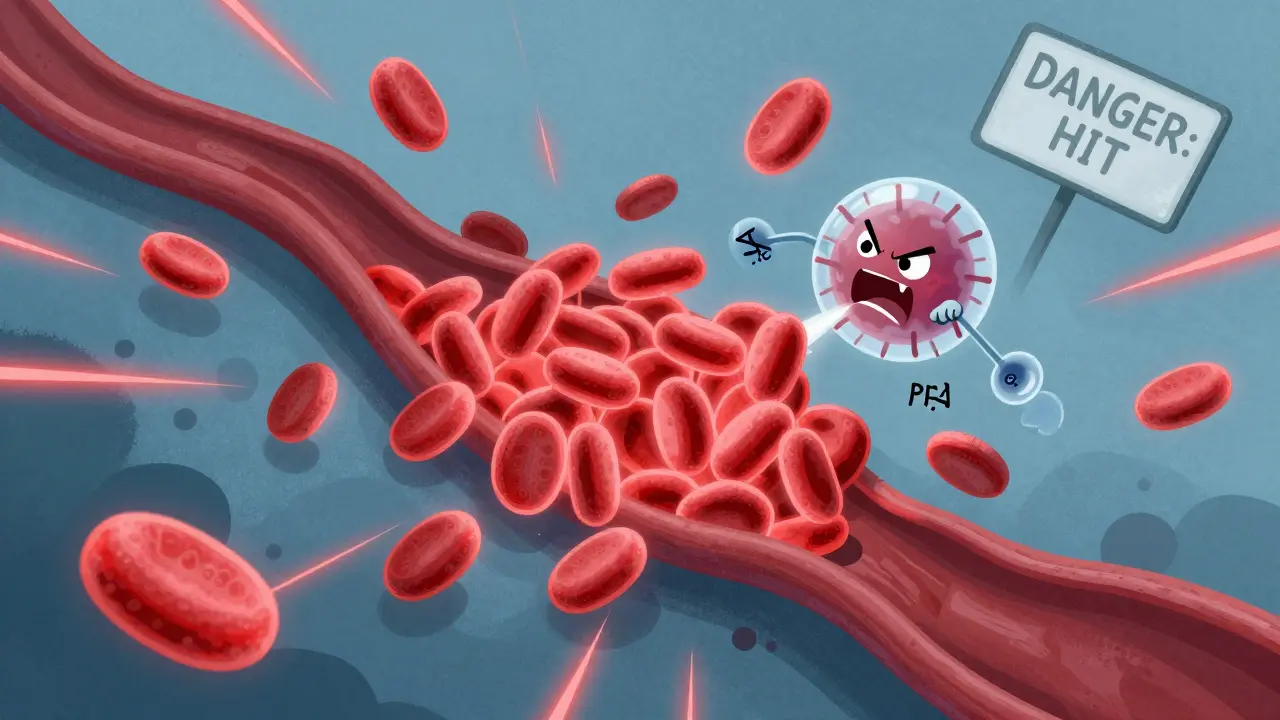
HIT isn’t just low platelets. It’s a dangerous paradox. You’re taking a drug to stop clots, but your body turns against you. Antibodies form against a protein called platelet factor 4 (PF4) that’s bound to heparin. These antibodies stick to your platelets, making them activate like crazy. They clump up, get used up, and your platelet count drops - often by half. At the same time, they flood your bloodstream with clotting signals. The result? You’re more likely to develop deadly clots than before you started heparin.This isn’t theoretical. About 50% of people with HIT develop clots - deep vein thrombosis in the legs, pulmonary embolism in the lungs, or even strokes and heart attacks. Some get skin damage at injection sites - dark, bruised, or blackened patches. Others lose fingers or toes to tissue death. If untreated, 20-30% of HIT patients with clots die.
Two Types of HIT - Only One Is Dangerous
Not all platelet drops from heparin are the same. There are two kinds:- Type I (benign): Happens within the first two days. Platelets dip a little, but no clots form. It’s harmless and goes away on its own. No treatment needed.
- Type II (immune): This is the real threat. It shows up 5 to 14 days after starting heparin. If you’ve had heparin in the last 100 days, it can hit as fast as 24 hours. This is the form that triggers clots. This is HIT.
Only Type II needs urgent action. Doctors call it Heparin-Induced Thrombocytopenia and Thrombosis (HITT) when clots are present. That’s when things turn critical.
Who’s at Risk?
HIT doesn’t strike randomly. Certain people are far more likely to get it:- Post-surgery patients: Especially those who’ve had hip or knee replacements. Up to 1 in 10 develop HIT.
- People on unfractionated heparin: This older form carries a 3-5% risk. Low molecular weight heparin (like enoxaparin) is safer - about 1-2% risk.
- People over 40: Risk doubles or triples compared to younger adults.
- Women: 1.5 to 2 times more likely than men.
- Those with recent heparin exposure: If you had heparin within the last 100 days, your immune system remembers it. Even a small dose now can trigger HIT fast.
Even low-dose heparin flushes in IV lines or heparin-coated catheters can cause it. About 1 in 5 HIT cases come from these hidden sources.
How Do You Know You Have It?
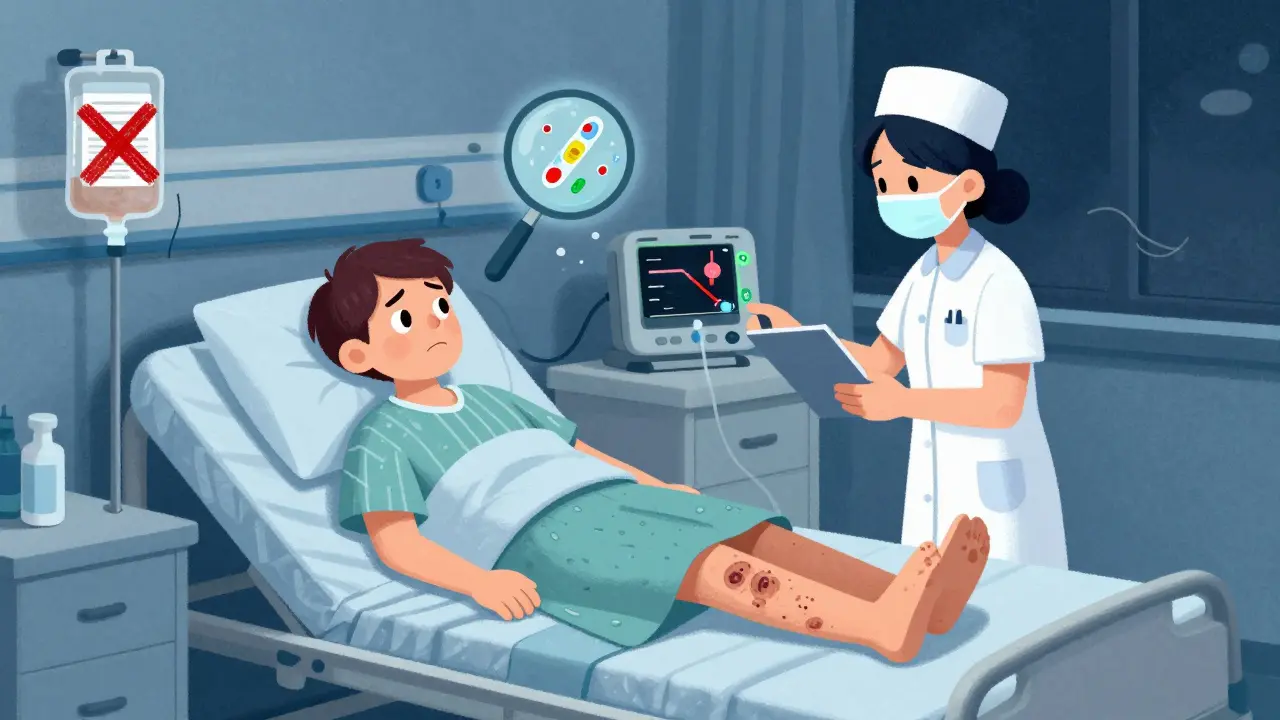
Symptoms don’t always scream “HIT.” That’s the problem. Many patients think it’s just a side effect - until they collapse.Look for these signs, especially after 5+ days of heparin:
- Sudden swelling, warmth, or pain in one leg (deep vein thrombosis)
- Shortness of breath, chest pain, fast heartbeat (pulmonary embolism)
- Dark, bruised, or black skin around injection sites
- Pain or discoloration in fingers, toes, nose, or nipples (acral ischemia)
- Fever, chills, dizziness, or anxiety - often mistaken for infection or panic
But the biggest clue? A platelet count that drops by 30% or more - especially if it falls below 150,000 per microliter. That’s when you need to act.
How Doctors Diagnose HIT
There’s no single blood test that confirms HIT. Instead, doctors use a two-step system:- The 4Ts Score: A simple checklist that looks at four things: How low are your platelets? When did they drop? Do you have clots? Are there other causes? A score of 6-8 means high risk. 4-5 is moderate. 0-3 is low. This step alone cuts down unnecessary testing by half.
- Lab Tests: If the 4Ts score is high, they run an antibody test (ELISA). It’s 95% sensitive - meaning it rarely misses HIT - but it gives false positives. So if it’s positive, they follow up with a functional test (serotonin release assay). That’s the gold standard - 99% specific. It confirms the antibodies are actually activating your platelets.
Even with perfect testing, 1 in 1,000 cases are missed. That’s why doctors don’t wait for lab results if the clinical picture is clear. If you’re on heparin, your platelets dropped sharply, and you’re showing signs of clots - they stop heparin immediately.
What Happens If You’re Diagnosed With HIT?
The first rule? Stop all heparin - right now. That includes flushes, heparin-coated catheters, even heparin locks in IV lines. Any heparin in your system can keep the reaction going.Then, you need a different blood thinner - one that doesn’t trigger HIT. The options:
- Argatroban: Given through IV. Used mostly in people with liver problems. Dose adjusted based on blood clotting tests.
- Bivalirudin: Preferred for patients having heart surgery. Also given by IV.
- Fondaparinux: A shot under the skin. Now recommended as first-line for non-life-threatening cases. Works well if your kidneys are okay.
- Danaparoid: Available in some countries. Not used in the U.S.
Never start warfarin (Coumadin) alone during HIT. It can cause skin necrosis - same as HIT - and make things worse. Warfarin can be added later, only after platelets recover above 150,000 and you’ve been on a safe alternative for at least 5 days.
Treatment lasts at least 3 months. If you had clots, you’ll need 3 to 6 months of anticoagulation. Some people need it for life.
Why This Matters - Even If You’re Not in the Hospital
HIT is rare - only 1-2% of people on heparin get it. But heparin is used in over a million U.S. patients every year. That means 50,000 to 100,000 cases happen annually. Many go undiagnosed.It’s not just a hospital problem. If you’ve had surgery and were sent home with heparin shots, you’re still at risk. If you’ve had a stroke, heart attack, or DVT and were put on heparin, you need to know the signs. If your leg swells up two weeks after your last shot - don’t ignore it. Call your doctor. Get your platelets checked.
Patients often report fear of permanent disability or never being able to use blood thinners again. That fear is real. But with early detection, most people recover fully. The key is speed.
What’s Changing in HIT Care?
The 2023 American Society of Hematology guidelines made big updates:- Fondaparinux is now preferred over argatroban for non-critical cases - because it’s easier to use and just as effective.
- Doctors are being pushed to use the 4Ts score before ordering expensive lab tests. This saves time, money, and avoids unnecessary treatment.
- New tests are in development that target PF4 without heparin. These could cut false positives from 15% to under 5%.
- Researchers are testing drugs that block PF4 from binding to heparin - potentially preventing HIT before it starts.
Despite decades of research, we still don’t fully understand why some people’s immune systems react this way. That’s why prevention is still limited. The best defense? Awareness.
What You Should Do
If you’re on heparin:- Know your platelet count. Ask for it before and after day 4 of treatment.
- Watch for swelling, pain, or skin changes - especially after day 5.
- If you’ve had heparin before, tell every doctor. Even if it was years ago.
- Don’t assume a low platelet count is just “normal.” Ask: Could this be HIT?
If you’ve had HIT:
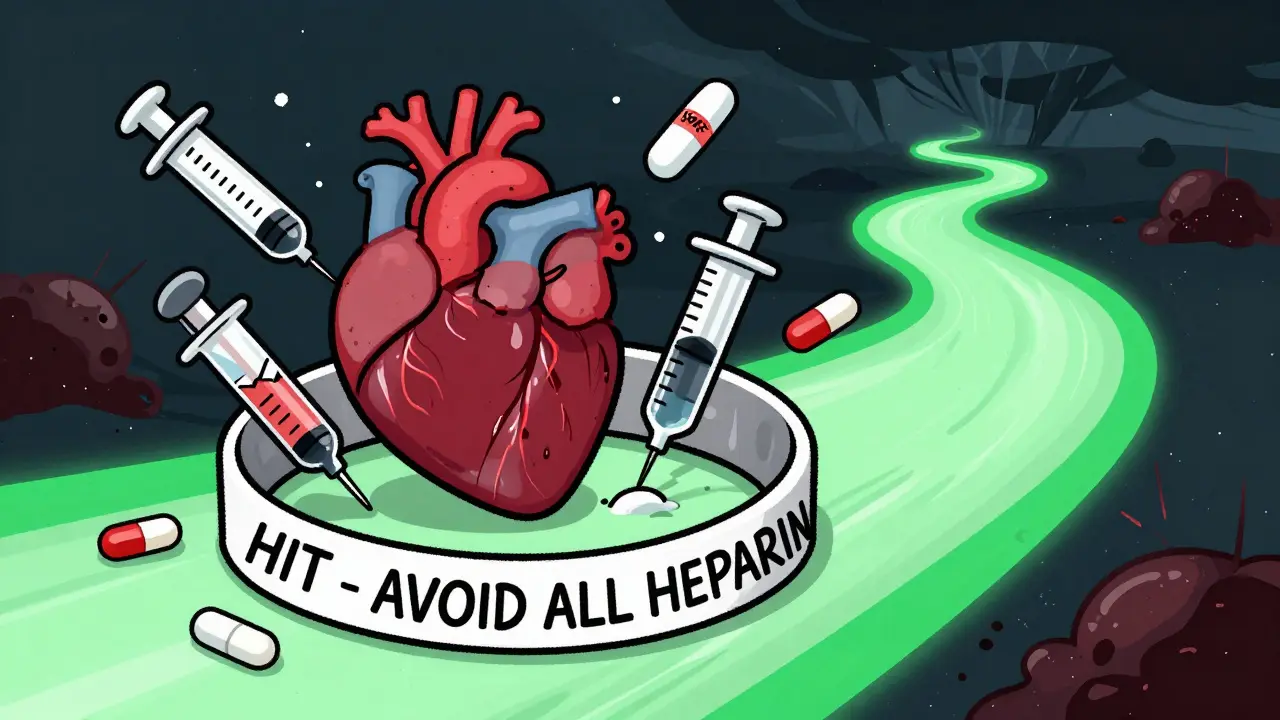
- Carry a medical alert card or bracelet saying “HIT - Avoid All Heparin Products.”
- Always tell new doctors, dentists, or ER staff before any procedure.
- Ask about alternative anticoagulants for future needs - like direct oral anticoagulants (DOACs), which don’t cause HIT.
HIT is rare. But when it hits, it hits hard. It’s not a side effect you can ignore. It’s a medical emergency disguised as a routine complication. If you’re on heparin, don’t wait for symptoms to get worse. Know the signs. Speak up. Your life might depend on it.
Can you get HIT from a heparin flush in an IV line?
Yes. About 15-20% of HIT cases are triggered by heparin used in IV flushes, catheter locks, or heparin-coated medical devices. Even tiny amounts can cause the immune reaction if you’ve been exposed before. Always ask if your IV or catheter contains heparin - and if you’ve had HIT, demand alternatives.
Is HIT the same as heparin allergy?
No. A true heparin allergy causes hives, swelling, or anaphylaxis - immediate reactions. HIT is an immune-mediated clotting disorder that develops days after exposure. It’s not an allergic response. It’s an autoimmune reaction. You can have HIT without any allergic symptoms.
Can you ever use heparin again after having HIT?
Almost never. Once you’ve developed Type II HIT, your body keeps the antibodies for years - sometimes for life. Re-exposure, even years later, can trigger a rapid, life-threatening reaction. Avoid all forms of heparin, including low-dose flushes. Use alternative anticoagulants like DOACs (apixaban, rivaroxaban) instead.
Does HIT go away on its own?
Type I HIT does - it’s harmless and resolves in a few days. But Type II HIT does not. Without stopping heparin and starting a different anticoagulant, clots will keep forming. Platelets may recover, but the risk of stroke, limb loss, or death stays high. HIT is not something you wait out.
How long after stopping heparin does HIT last?
The platelet count usually recovers in 5 to 10 days after stopping heparin - as long as you’ve switched to a safe anticoagulant. But the antibodies can linger for months or years. That’s why you must avoid heparin for life. The risk of recurrence remains, even if you feel fine.
Can HIT happen with low molecular weight heparin (like Lovenox)?
Yes. While unfractionated heparin carries a 3-5% risk, low molecular weight heparin still causes HIT in 1-2% of users. It’s less common, but not safe. If you develop a sudden drop in platelets after enoxaparin or dalteparin, HIT must still be ruled out.
Heparin is one of those drugs that feels like a medical miracle until it turns on you. I’ve seen it happen twice in the ICU - patients stable one day, then suddenly in shock from a pulmonary embolism, and the only clue was a platelet count that dropped like a stone. No fever, no rash, no obvious infection. Just a silent, deadly cascade. It’s not paranoia. It’s physiology.
Let’s be clear: HIT is not ‘rare’-it’s underdiagnosed because clinicians are lazy. They see a ‘low platelet count’ and assume it’s sepsis, or bone marrow suppression, or ‘just a lab error.’ They don’t bother with the 4Ts score. Why? Because it requires thinking. And thinking is inconvenient when you’ve got 12 patients and 30 minutes.
Also, fondaparinux? Really? It’s not FDA-approved for HIT. That’s off-label use dressed up as ‘guideline.’ Dangerous precedent. And don’t get me started on the ELISA test’s false positives-nearly half of them are meaningless. We’re over-testing, over-treating, and under-thinking.
OMG I just read this and my heart is pounding!! I had a heparin flush after my knee surgery and then my leg turned purple?? I thought it was just bruising?? I’m so scared right now I might have HIT?? I’m calling my doctor right now!!
This is one of the most important posts I’ve read in a long time. I’m a nurse, and I’ve seen how easily HIT gets missed-especially when patients are on low-dose heparin flushes or heparin-coated catheters. The fact that 1 in 5 cases come from these ‘harmless’ sources is terrifying. I’ve started asking every patient: ‘Have you ever had heparin before?’-even if it was 10 years ago. It’s not just about the current dose. It’s about immune memory.
And I agree with the point about not starting warfarin alone. I’ve seen skin necrosis happen because someone didn’t wait for platelets to recover. This isn’t just academic. It’s life-or-death.
Who benefits from this narrative? The pharmaceutical industry. They’ve spent decades pushing heparin as ‘safe’-then quietly introducing expensive alternatives like argatroban and fondaparinux. Now they’re telling you HIT is ‘common’ so you’ll switch to their drugs. The real risk? Overdiagnosis. The real danger? Unnecessary anticoagulation with drugs that have their own bleeding risks.
And why is there no mention of the fact that platelet counts naturally fluctuate? Why is every dip assumed to be HIT? This is fear-mongering disguised as medical education. The mortality rate of HIT is exaggerated. The ‘1 in 20’ statistic? That’s from old studies with high-dose unfractionated heparin. Today’s protocols are safer.
It is imperative to recognize that Heparin-Induced Thrombocytopenia, particularly Type II, represents a paradigmatic example of immune-mediated pathophysiology. The formation of IgG antibodies against the Platelet Factor 4-Heparin complex initiates a cascade involving FcγRIIa receptor activation, platelet granule release, and thrombin generation. This mechanism is distinct from allergic or anaphylactic responses, which are IgE-mediated and occur within minutes of exposure.
Furthermore, the diagnostic algorithm-utilizing the 4Ts score followed by confirmatory functional assays-remains the gold standard, despite emerging technologies. The serotonin release assay, while labor-intensive, provides specificity approaching 99%. Clinical judgment must precede laboratory confirmation when the pretest probability is high.
It is also noteworthy that the 2023 ASH guidelines, while pragmatic, have not yet been universally adopted. Institutional inertia remains a significant barrier to timely intervention.
Are you kidding me? You’re telling me I could get HIT from a simple IV flush? That’s insane. My mom had a catheter for a week after her heart surgery and they used heparin locks every day. She didn’t even know what HIT was. Now you’re saying she could’ve been walking around with a ticking time bomb? That’s malpractice. Hospitals should be required to disclose this risk before inserting ANY heparin-coated device. And why isn’t there a mandatory screening protocol? This is a systemic failure.
I’m going to sue someone over this. Someone needs to pay.
Knowledge is power. If you’re on heparin, you are not a passive patient-you are an active participant in your survival. Ask for your platelet count on day 4. Ask if your IV line contains heparin. Ask if you’ve had it before. Don’t wait for symptoms. Don’t wait for someone else to catch it. You are your own best advocate. This is not fear. This is responsibility. And if you’ve had HIT before? You carry a silent warning. Wear it. Say it. Live by it.
Look, I’m not a doctor, but I’ve watched enough medical dramas to know this: if you’re on heparin and your platelets drop, you’re probably fine. It’s just stress. Or bad lab work. Or maybe you drank too much coffee. This HIT thing sounds like a scare tactic to sell more drugs. We’ve been lied to about so many things-antibiotics, vaccines, cholesterol. Why should this be any different?
Also, why do doctors always blame the patient? ‘You didn’t speak up!’ Well, I didn’t know! Nobody told me. That’s on them. Not me.
The statistical prevalence of HIT is misleading. The 1-2% figure is derived from heterogeneous cohorts. In surgical populations, particularly orthopedic, the incidence is closer to 3.8% with unfractionated heparin. Furthermore, the diagnostic sensitivity of the ELISA assay is contingent upon the antigenic epitope targeted. Newer assays utilizing PF4-only complexes (without heparin) demonstrate superior specificity-reducing false positives from 15% to 4.7% in recent trials.
Moreover, fondaparinux is not universally effective. In patients with renal impairment (eGFR <30 mL/min), its half-life extends beyond 17 hours, increasing bleeding risk. Argatroban remains preferable in such cases. The ASH guidelines are evidence-based, but not universally applicable.
They don’t want you to know this: HIT isn’t caused by heparin. It’s caused by the glyphosate in the IV bags. The pharmaceutical companies add it to keep the heparin stable. But glyphosate binds to PF4 and triggers the immune response. That’s why it only shows up after 5-14 days-it takes time for the toxin to accumulate. And why do you think they push fondaparinux? Because it’s made by the same company that owns the glyphosate patents. This is a cover-up. They’re selling you a ‘safer’ drug that’s still contaminated. Wake up.
I’ve seen it. My cousin’s hospital had a spike in HIT cases right after they switched to a new IV fluid brand. They buried the report.
Thank you for writing this with such clarity. I’ve spent years working with patients who’ve survived HIT, and the trauma doesn’t end when the platelets recover. There’s a deep, quiet fear that lingers-the fear that any needle, any IV, any surgery could trigger it again. You don’t just need to avoid heparin. You need to be believed. Too many patients are dismissed as ‘overreacting’ when they say, ‘I had HIT before.’
This post gives them the language to fight back. And that’s more valuable than any lab test.
Wow. Another ‘medical horror story’ designed to make people afraid of hospitals. Next you’ll tell us that aspirin causes internal bleeding and penicillin turns you into a zombie. Heparin has been used for 80 years. Millions of doses. Millions of lives saved. And now you want us to panic because a few people developed clots? That’s not science. That’s clickbait.
Also, why are you blaming the patient for not knowing about HIT? You think a layperson is supposed to memorize the 4Ts score? Get real.
I’ve been there. Not me-but my sister. She got HIT after a C-section. They gave her heparin to prevent clots. Three days later, she couldn’t walk. Her leg was swollen. They thought it was a pulled muscle. Two weeks later, she had a pulmonary embolism. Almost died. They didn’t even test for HIT until she was in the ICU.
Now she can’t have any surgery without a blood clot specialist present. She carries a card. She tells every doctor. She cries every time she sees a syringe. And they tell her it’s ‘rare.’
It’s not rare. It’s just invisible until it’s too late.
Interesting. I had a heparin flush after my colonoscopy last year. My platelet count was 145,000 the next day. I didn’t think anything of it. Is that significant? Should I have asked for a follow-up? I’m not sure if I’m overthinking it or being smart.