Hearing Conservation Programs: Workplace Requirements and Testing
What Is a Hearing Conservation Program?
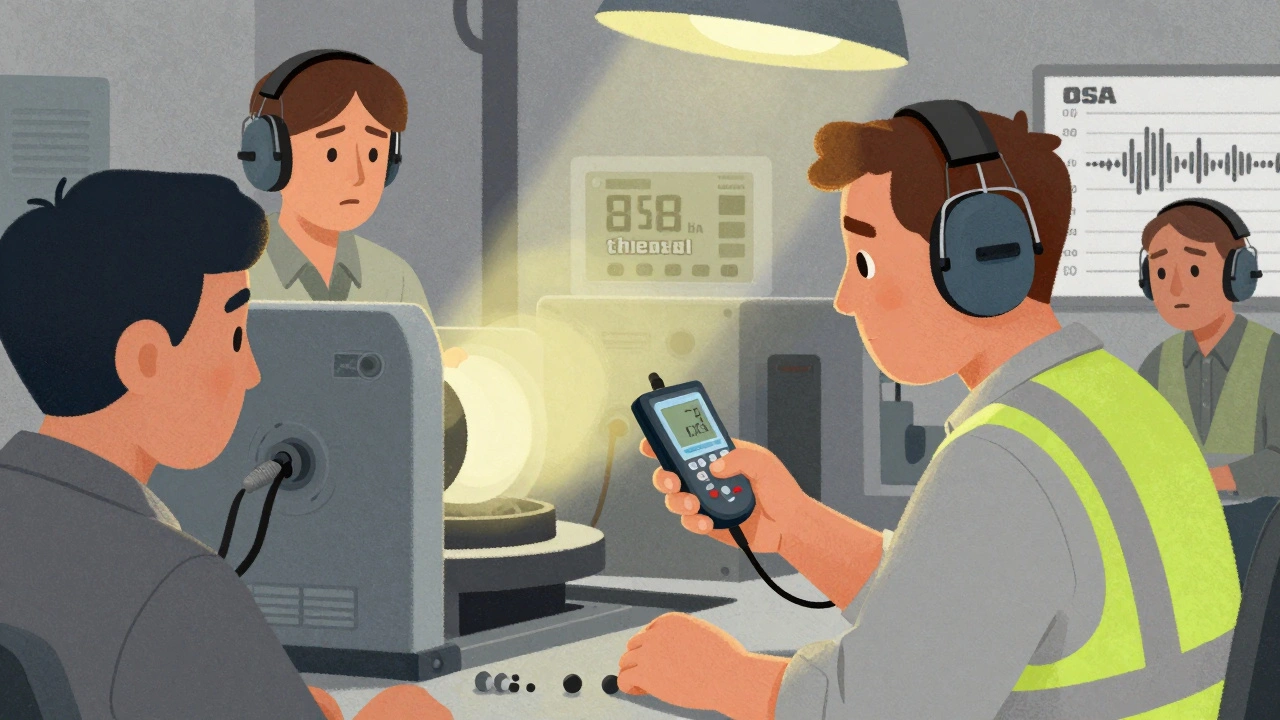
A hearing conservation program isn’t just a checklist-it’s a lifeline for workers exposed to loud noise every day. Think of it as a structured system employers must use to stop noise-induced hearing loss before it happens. Under OSHA’s 29 CFR 1910.95 regulation, any workplace where employees are exposed to 85 decibels (dBA) over an 8-hour shift is required to have one. That’s the sound of a lawnmower, a busy factory floor, or a jackhammer nearby. It’s not extreme-it’s common.
More than 22 million American workers face this risk every year. And it’s not just about discomfort. Once hearing is damaged by noise, it doesn’t come back. That’s why these programs exist: to catch problems early, protect hearing, and keep people working longer without disability.
Five Core Requirements of a Hearing Conservation Program
OSHA doesn’t leave room for guesswork. A valid hearing conservation program must include five non-negotiable parts. Skip one, and you’re violating federal law.
- Noise monitoring: Employers must measure noise levels using calibrated dosimeters or sound meters. This isn’t a one-time thing. Every time equipment changes, a new machine is added, or a layout shifts, retesting is required. The goal? Find where noise hits or exceeds 85 dBA.
- Audiometric testing: Every employee exposed to 85 dBA or more must get a baseline hearing test within six months of starting. After that, annual tests are mandatory. These aren’t just quick checkups-they’re precise, controlled exams done in quiet rooms that meet OSHA’s background noise standards.
- Hearing protection: Employers must provide a variety of earplugs and earmuffs. Not just one type. Workers need options because fit matters. One size doesn’t fit all. And they must be trained on how to insert earplugs correctly-most people get it wrong.
- Training: Every year, employees must get trained on how noise damages hearing, how protectors work, and why testing matters. This isn’t a 10-minute video. It’s interactive, clear, and repeated annually.
- Recordkeeping: Noise exposure records must be kept for at least two years. Audiometric test results? They stay with the employee’s file for as long as they work there. These aren’t just paperwork-they’re legal evidence.
How Audiometric Testing Works
Audiometric testing sounds technical, but it’s straightforward. The test checks how well you hear specific tones at different frequencies-usually 500, 1000, 2000, 3000, and sometimes 4000 and 6000 Hz. The test must be done after the worker has been away from workplace noise for at least 14 hours. Why? Because temporary hearing changes after a loud shift can mask real damage.
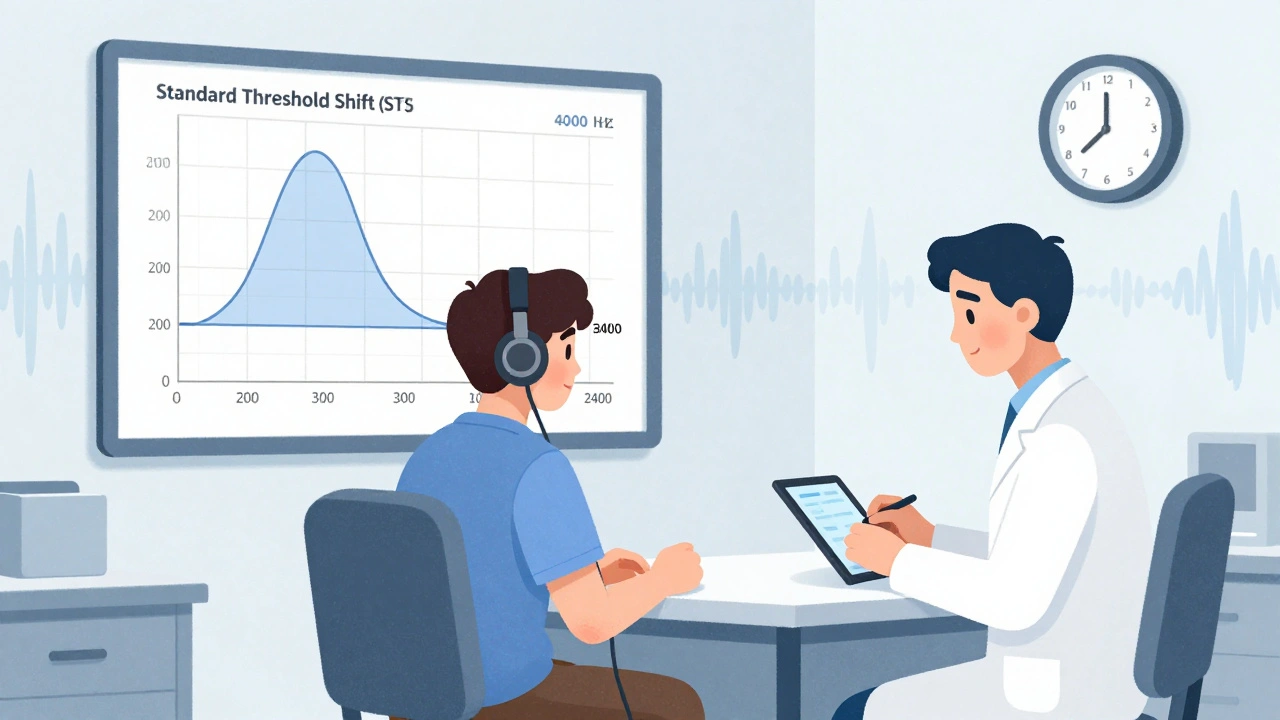
The baseline audiogram is the starting point. If a future test shows a shift of 10 dB or more at 2000, 3000, and 4000 Hz compared to the baseline, that’s called a Standard Threshold Shift (STS). This isn’t just a number-it’s a red flag.
When an STS is found, the employer has 30 days to act. They must:
- Notify the employee in writing within 21 days.
- Re-fit and retrain the employee on hearing protection.
- Offer a protector with higher noise reduction if needed.
- Refer the worker to an audiologist if there’s suspicion of a medical issue, like an ear infection or tumor.
Here’s what most employers miss: the baseline can be updated if the shift is confirmed as permanent. But you can’t keep flagging the same shift year after year. That’s not compliance-it’s negligence.
Why Hearing Protection Isn’t Just About Plugs
Many companies hand out foam earplugs and call it a day. That’s not enough. Studies show up to 70% of workers don’t insert earplugs correctly. That means they’re getting maybe 5 dB of protection instead of the 30 dB listed on the box.
Effective programs use fit-testing systems-devices that measure how well a protector seals in each individual’s ear. Some companies use real-time feedback tools that show workers, in seconds, whether they’re getting enough protection. If not, they try a different type: silicone plugs, custom molds, or earmuffs.
Employers must offer at least two types of protectors and let workers choose. Comfort leads to compliance. If someone’s earplugs itch or feel awkward, they’ll take them out. And then they’re unprotected.
Common Problems and Why Programs Fail
OSHA issued over 1,800 citations for hearing conservation violations in 2022. The top two reasons? Inadequate audiometric testing and poor training.
- Testing done wrong: Tests conducted in noisy rooms, using outdated equipment (like ANSI SC-1969 instead of S3.6-2018), or without the required 14-hour quiet period.
- Training that’s ignored: A 10-minute PowerPoint isn’t training. Workers need to understand why their hearing matters, not just what to wear.
- Low participation: Nearly 70% of safety managers report employees skip annual tests. Why? Scheduling conflicts, lack of awareness, or thinking, “I can still hear fine.”
- Recordkeeping gaps: Missing forms, lost files, or outdated noise maps. Auditors spot this fast.
Small businesses struggle the most. With fewer than 50 employees, 37% aren’t compliant. Why? Cost. A full program runs $250-$400 per employee a year. Audiometric testing makes up nearly half that. But here’s the truth: the cost of one worker’s hearing loss-lost productivity, workers’ comp claims, retraining-is far higher.
What’s Changing in 2025?
OSHA is updating its rules. The proposed changes, expected to be finalized in late 2024, include:
- Requiring newer audiometer calibration standards (ANSI S3.6-2018)
- Adding 4000 Hz and 6000 Hz to mandatory test frequencies
- Requiring protectors that reduce exposure below 90 dBA when noise exceeds 100 dBA
These aren’t just bureaucratic tweaks. At 100 dBA, even a 90 dBA limit isn’t safe. Experts say this change alone could prevent 150,000 cases of hearing loss each year. The cost will go up slightly-8-12% more-but so will protection.
What Works in Real Factories and Shops
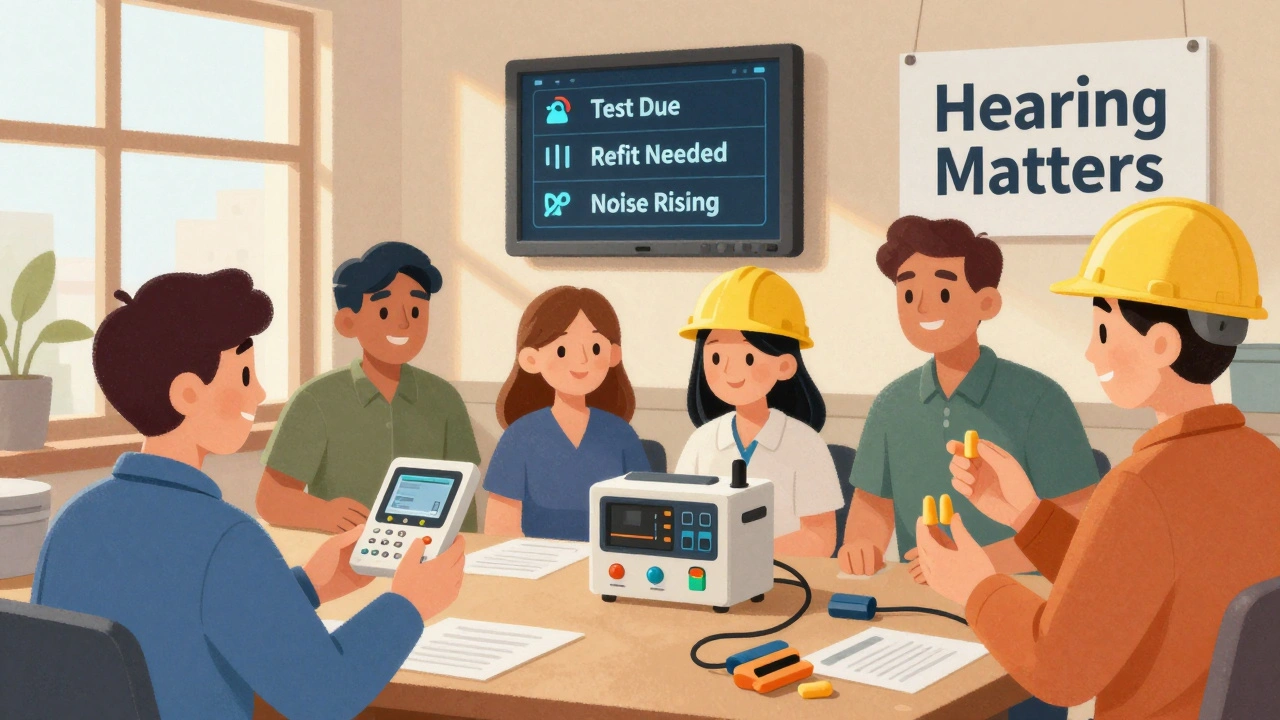
The most successful programs don’t just follow rules-they adapt. Companies using mobile audiometric testing units cut employee downtime by 60%. Instead of sending workers off-site, a technician comes to the plant during lunch or shift change. Attendance jumps. Testing gets done. Data gets recorded.
Some manufacturers use digital dashboards that track who’s due for a test, who needs refitting, and which areas have rising noise levels. Alerts pop up automatically. No one forgets.
And the results? Companies with strong programs see 5-10% higher productivity and 15-20% fewer absences. Workers feel safer. Managers feel confident. It’s not just about compliance-it’s about culture.
Is Your Workplace Compliant?
Ask yourself these questions:
- Have we measured noise levels in all high-risk areas within the last year?
- Are all exposed employees tested annually, with proper quiet time before the test?
- Do we offer at least two types of hearing protection-and train people on how to use them?
- Is training interactive, annual, and documented?
- Are audiometric records and noise exposure logs stored and up to date?
If you answered “no” to any of these, you’re at risk. Not just legally-but morally. Hearing loss is silent, slow, and permanent. But it’s also preventable.
What to Do Next
Start small. Pick one noisy area. Measure it. Talk to the workers there. Schedule a baseline test for the next month. Buy two types of earplugs and let them choose. Train them yourself-no videos. Ask them what they think.
You don’t need a big budget. You need attention. And consistency.
What noise level triggers a hearing conservation program?
A hearing conservation program is required when employees are exposed to noise at or above an 8-hour time-weighted average of 85 decibels (dBA). This is called the OSHA action level. At this level, employers must begin monitoring, testing, and providing hearing protection.
How often must audiometric testing be done?
Employees exposed to 85 dBA or higher must get a baseline audiogram within six months of first exposure. After that, annual tests are mandatory. The test must be done in a quiet room, and the worker must be free from workplace noise for at least 14 hours before the test.
What is a Standard Threshold Shift (STS)?
An STS is a change in hearing of 10 dB or more at 2000, 3000, and 4000 Hz compared to the baseline audiogram. It’s a warning sign that noise exposure is damaging hearing. Employers must act within 30 days by retraining, refitting protectors, and offering better protection if needed.
Can employers use any earplugs?
No. Employers must provide a variety of hearing protectors-like foam plugs, silicone plugs, and earmuffs-and let workers choose what’s comfortable. They must also train workers on how to insert and use them properly. A protector that doesn’t fit well offers little to no protection.
What happens if a worker refuses to wear hearing protection?
Employers must enforce the use of hearing protection in designated areas. If a worker refuses, they may be removed from the noisy area until they comply. Training should explain why this is non-negotiable-not just for rules, but for their long-term hearing health.
Do small businesses have to follow these rules too?
Yes. OSHA rules apply to all employers, regardless of size. However, small businesses (fewer than 50 employees) have a higher non-compliance rate-37% compared to 18% for larger companies. Mobile testing services and low-cost training tools can help small workplaces meet requirements without high costs.
Is hearing loss from noise reversible?
No. Noise-induced hearing loss is permanent. Once the hair cells in the inner ear are damaged, they don’t regenerate. That’s why prevention through hearing conservation programs is critical-there’s no cure after the damage is done.
How much does a hearing conservation program cost?
The average cost is $250-$400 per employee per year. Audiometric testing makes up 45-55% of that cost. While it seems expensive, the cost of one worker’s hearing loss-including lost productivity, medical claims, and retraining-is often five to ten times higher.
This is absolutely critical stuff. I work in manufacturing, and I’ve seen coworkers lose their hearing by 40. Seriously. 40. And they didn’t even realize it until they couldn’t hear their kids call them at dinner. OSHA’s 85 dBA threshold? That’s not a suggestion-it’s a lifeline. And if your company thinks handing out foam plugs and calling it a day is enough, they’re not just cutting corners-they’re cutting ears. Don’t let them.
I used to think earplugs were for people who couldn’t handle noise until I started working on the assembly line. Now I wear custom molds every shift and I’m so grateful. The training made all the difference-not the video, but the guy who actually showed us how to roll and insert them. One hand. One twist. One click. That’s all it takes. And yeah, it’s annoying at first but your future self will thank you. No one ever says ‘I wish I’d ignored my hearing’
Let me be blunt: most American workplaces are performing performative compliance. You cite OSHA 1910.95 like it’s gospel, but the reality is that 90% of audiometric tests are conducted with uncalibrated equipment or in rooms that violate ANSI S3.6-2018 standards. And don’t even get me started on the ‘training’-it’s usually a 7-minute YouTube clip played in a breakroom with a diesel generator running outside. This isn’t safety. It’s theater.
I love that you mentioned fit-testing. My plant started using those real-time feedback devices last year and suddenly everyone’s wearing their plugs right. Like, actually right. I didn’t even know you could measure how well they sealed until I saw my own numbers pop up on a screen. Wild. Now we’ve got a leaderboard for best fit. Yeah, it’s a little silly-but it works. 🙌
This is why India leads in industrial safety. We don’t need fancy OSHA guidelines. Our workers have been exposed to 110 dB for decades and still function perfectly. This American obsession with ‘hearing protection’ is soft. You think your ears are fragile? We work near blast furnaces and still hear our mothers call us for dinner. Stop coddling workers.
I work at a small shop with 12 people. We didn’t have a program until last month. We bought two kinds of plugs, did a 15-minute talk during lunch, and used a free app to log noise levels. We got our baseline tests done through a mobile clinic that came to the parking lot. Cost? Less than $1500 total. No fancy dashboards. Just people who care. You don’t need a budget-you need a heartbeat.
Let’s talk about the elephant in the room: the 70% of workers who don’t insert earplugs right. That’s not a training failure-that’s a design failure. Why are we still using foam plugs that require a three-step ballet just to get them in? We need smarter, simpler, more intuitive protection. Silicone flanges. Push-to-fit molds. Even smart plugs that glow if they’re not seated. Innovation isn’t optional anymore. We’re talking about permanent nerve damage here. Get creative.
I appreciate the thoroughness of this post. It is, indeed, a comprehensive overview of the regulatory and operational requirements surrounding hearing conservation. However, I must respectfully note that while compliance is necessary, the psychological dimension-employee buy-in, perceived autonomy, and workplace culture-is often underemphasized. When workers feel that their comfort and preferences are genuinely considered, adherence increases exponentially. It’s not about enforcement. It’s about respect.
This is all just corporate virtue signaling. You people act like hearing loss is some tragic epidemic. Newsflash: people get old. Their ears wear out. You want to protect hearing? Don’t let them work in noisy environments. Or better yet-don’t hire them. Stop pretending this is about health. It’s about liability. And the cost? It’s a tax on productivity.
Why is this even a thing? Can't people just use their ears?