Global Medication Safety: How Countries Regulate Drugs Differently

Global Drug Regulation Explorer
Select a regulatory authority below to view detailed comparison metrics. This tool helps patients and professionals understand the fragmentation in global drug safety standards.
FDA (USA)
Centralized Title 21 CFREMA (EU)
Hybrid Eudralex Vol. IVHealth Canada
MRA Ties Food & Drugs ActTGA (Australia)
Centralized Therapeutic Goods ActWHO
Non-Binding GMP Standards| Authority | Avg. Approval Time | Key Characteristic | Safety Concordance* |
|---|---|---|---|
| FDA | 10.2 Months | Single agency accountability | Low vs EU |
| EMA | 12.7 Months | National flexibility | Variable |
| Health Canada | ~12-14 Months | Strong EU alignment via MRA | High with EU |
| TGA | ~12-16 Months | High US concordance | 79% w/ US |
| WHO | Variable | Global standard setter | N/A |
Imagine you’re a patient in Toronto, taking a new blood pressure medication. You assume it’s safe because your doctor prescribed it and the pharmacy handed it over with a label. But what if that same pill, approved in Canada, faced a completely different scrutiny process in the United States or Europe? Or worse, what if a drug deemed safe in one country was pulled from shelves in another due to side effects no one caught in time? This isn’t hypothetical. A landmark study found only 10.3% concordance in safety warnings issued by Australia, Canada, the UK, and the US for the same prescription medicines. That means when regulators speak, they often aren’t saying the same thing. For patients traveling abroad or buying meds online, this fragmentation is a real risk.
The Big Players: Who Actually Decides What’s Safe?
When we talk about drug regulation, we’re mostly talking about five major authorities that control nearly 95% of the $1.5 trillion global pharmaceutical market. These aren’t just bureaucratic gatekeepers; they are the primary shield between experimental compounds and human bodies. The most prominent is the FDA, which stands for the United States Food and Drug Administration. It operates under Title 21 of the Code of Federal Regulations and has legally binding force within the US. Unlike many other systems, the FDA is highly centralized. One agency makes the call, which creates consistency but can also create bottlenecks during emergencies.
Across the Atlantic, the landscape is more complex. The EMA, or European Medicines Agency, doesn’t work alone. It coordinates with National Competent Authorities (NCAs) across all 27 EU member states. They operate under Eudralex Volume IV, a set of rules with binding legal force across Europe. This hybrid system allows for national flexibility but introduces complexity. If you’re a pharma company trying to launch a drug here, you might face different requirements in France than in Germany, even though both follow EU law.
Then there’s Health Canada, which enforces the Food and Drugs Act. Since 2019, Canada has had a Mutual Recognition Agreement (MRA) with the EU, meaning inspections and certifications often cross-pollinate. This helps Canadian companies export faster and brings European standards closer to home. In the Southern Hemisphere, Australia’s TGA (Therapeutic Goods Administration) follows the Therapeutic Goods Act 1989. While independent, it shows high alignment with US decisions-about 79% concordance on safety issues-but less so with Europe.
Finally, we have the WHO (World Health Organization). Here’s the catch: WHO guidelines are not legally binding. They don’t approve drugs for sale in specific countries. Instead, they set global reference standards, particularly Good Manufacturing Practices (GMP), which over 150 countries adopt voluntarily. For developing nations in Africa and Asia, WHO standards are often the baseline, filling gaps where local regulatory capacity is still building.
How Approval Processes Actually Work
You might think approval is a simple stamp of yes or no. It’s not. It’s a marathon of data review, inspection, and negotiation. In the US, the FDA average approval time for a new drug was 10.2 months in 2022. The process is linear: preclinical testing, three phases of clinical trials, then a New Drug Application (NDA). The FDA reviews everything, including manufacturing facilities, before granting permission.
In the EU, the timeline stretches to an average of 12.7 months for centralized procedures, which apply to novel medicines like biologics or cancer treatments. For generics, however, decentralized procedures allow individual countries to approve drugs independently, leading to varied timelines. This difference matters. If you’re waiting for a cutting-edge oncology drug, the EU actually approved 12.7% more of these therapies in 2022 than the FDA did, partly because their risk-benefit frameworks are slightly more permissive for severe conditions.
| Authority | Legal Basis | Approval Model | Avg. Approval Time (2022) | Key Characteristic |
|---|---|---|---|---|
| FDA | Title 21 CFR | Centralized | 10.2 Months | Single agency accountability |
| EMA | Eudralex Vol. IV | Hybrid (Centralized + National) | 12.7 Months | National flexibility, complex navigation |
| Health Canada | Food and Drugs Act | Centralized with MRA ties | ~12-14 Months | Strong EU alignment via MRA |
| TGA (Australia) | Therapeutic Goods Act | Centralized | ~12-16 Months | High US concordance, low EU alignment |
| WHO | Non-binding Guidelines | Prequalification Program | Variable | Global standard setter, not approver |
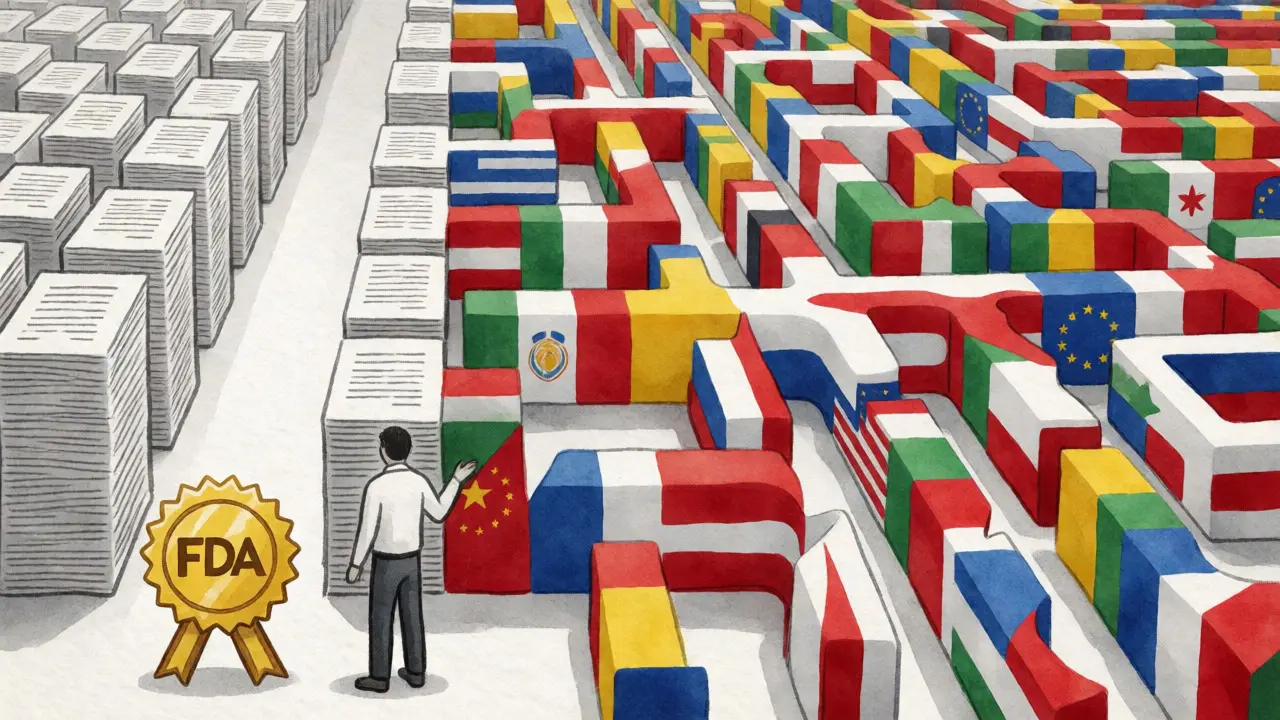
The Safety Warning Gap
Getting a drug approved is half the battle. Keeping it on the market safely is the other half. This is where things get messy. When a new side effect emerges, does every country pull the drug at the same time? Rarely. The aforementioned study showing 10.3% concordance in safety advisories highlights a dangerous fragmentation. If a heart medication causes rare liver damage in Japan, will Canada know immediately? Will the US ban it next week?
Dr. Thomas Frieden, former CDC Director, called this "therapeutic confusion." He warned that up to 200 million patients annually use medications approved in multiple jurisdictions, putting them at risk if alerts don’t travel fast enough. The International Alliance of Patients’ Organizations reported that safety alerts reach only 42% of patients in low-income countries. Why? Fragmented communication channels. In Nigeria or Bangladesh, a warning issued by the FDA might take months to filter down to local pharmacies, if it arrives at all.
Interestingly, physicians report mixed satisfaction with how these alerts work. In the US, 83% of clinicians found MedWatch advisories timely. In Europe, 71% rated EMA reports as comprehensive, though some found them overly technical. The EU networked approach allowed for coordinated action within 14 days during the Vioxx crisis, compared to 28 days in the US, according to Professor Hans-Georg Eichler of the EMA. Speed versus thoroughness is a constant trade-off.

What This Means for Pharma Companies
If you’re a drug developer, navigating these differences costs money and time. Establishing global regulatory compliance infrastructure averages $1.2 million per company. Documentation is heavy: an FDA submission for a new molecular entity can hit 20,000 pages. An EMA centralized procedure might require 18,000. That’s a lot of paper, or increasingly, digital data.
Pediatric investigation requirements are a common headache. The US Pediatric Research Equity Act demands specific studies for children, while the EU Pediatric Regulation has its own distinct rules. 61% of companies reported difficulties reconciling these in 2022. To help, the International Council for Harmonisation (ICH) has been working to align standards. Their ICH E6(R3) guidelines were adopted by 89% of major jurisdictions by mid-2023, reducing clinical trial documentation by 22%. It’s progress, but slow.
Industry preferences split along geographic lines. 78% of US-based companies prefer the FDA’s "predictable but rigid" framework. They like knowing exactly what’s required. Conversely, 65% of EU-based companies favor the "flexible but complex" EU system, valuing the ability to adapt to national nuances. Neither system is perfect, but each offers a different kind of certainty.
The Future: AI and Harmonization
Regulation is evolving. The FDA’s Modernization Act 2.0 eliminated mandatory animal testing for certain drugs, aiming to cut approval times by 18-24 weeks. The EU’s Pharmaceutical Strategy targets a 25% streamlining of authorization by 2025. But the biggest shift is technology. AI-assisted regulatory review is predicted to reduce approval timelines by 30-40% by 2027. The FDA already uses AI tools that processed 43% of routine manufacturing inspections in 2022.
Harmonization remains the holy grail. The ICH roadmap aims for 75% alignment of major regulatory requirements across the US, EU, Japan, and Canada by 2028. Political and philosophical differences make full convergence unlikely soon, but better alignment means safer meds for everyone. As emerging markets like India’s CDSCO tighten GMP requirements and Africa’s new African Medicines Agency harmonizes rules across 22 states, the global net is tightening. For patients, this means fewer surprises when crossing borders-or clicking "buy" on an international pharmacy site.
Why do different countries approve different drugs?
Countries have different legal frameworks, healthcare priorities, and risk tolerances. For example, the EU may approve more oncology drugs due to a more permissive risk-benefit assessment for severe diseases, while the US might focus more on rare disease therapies. Additionally, clinical trial data must meet specific regional standards, such as pediatric requirements, which vary by jurisdiction.
Is the FDA stricter than the EMA?
Not necessarily stricter, but different. The FDA is centralized and often faster for initial approvals (10.2 months vs. 12.7 months for EU centralized). However, the EMA’s hybrid system allows for national adaptations. Studies show the EU approved more oncology drugs in 2022, while the FDA approved more rare disease therapies, reflecting different strategic focuses rather than one being universally "stricter."
Do safety warnings happen at the same time globally?
No. A comparative analysis found only 10.3% concordance in safety advisories among Australia, Canada, the UK, and the US. This means a drug might be flagged for safety issues in one country while remaining unflagged in another, creating risks for travelers and those using imported medications.
What role does the WHO play in drug regulation?
The WHO sets non-binding global standards, particularly for Good Manufacturing Practices (GMP). It does not approve drugs for sale in specific countries. Instead, its guidelines serve as a reference for over 150 countries, especially in developing regions where local regulatory agencies may rely on WHO prequalification programs to ensure quality.
How long does it take to get a drug approved worldwide?
There is no single "worldwide" approval. Each major jurisdiction (US, EU, Canada, etc.) requires separate submissions. While harmonization efforts like the ICH are reducing duplication, companies still face significant resource demands, with documentation reaching up to 20,000 pages per region and approval processes taking over a year in each major market.