Generic Drug Patents: How Exclusivity Periods Vary Across Countries
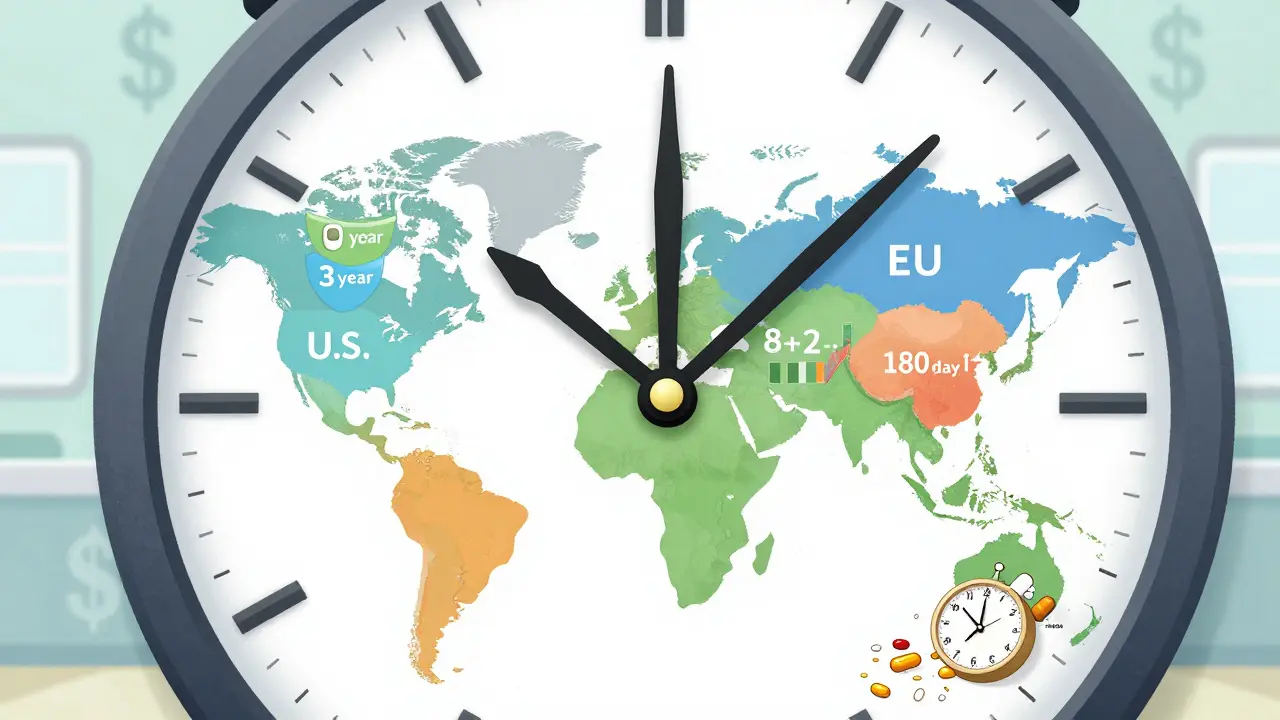
When a brand-name drug hits the market, it doesn’t stay alone for long. But how long it stays exclusive-before cheaper generics show up-depends entirely on where you live. In the U.S., Canada, the EU, or Japan, the rules are different. And those differences affect who gets access to affordable medicine, when, and why.
How Long Do Patents Last? It’s Not What You Think
Most people assume a drug patent lasts 20 years. That’s technically true-the patent clock starts ticking from the day the inventor files it, not when the drug is approved. But here’s the catch: drug development takes 10 to 15 years. By the time a pill gets approved by regulators, only 5 to 10 years of patent life are left. That’s not enough to recoup the average $2.3 billion spent on R&D per drug.
That’s why countries added extra layers. These aren’t patents. They’re called exclusivity periods. They don’t protect the invention. They protect the data used to prove the drug is safe and effective. No generic company can use that data to get approved until the exclusivity runs out-even if the patent expired years ago.
The U.S. System: A Maze of Rules
The U.S. has the most complex system. It layers five different types of exclusivity on top of patents:
- 5-year New Chemical Entity (NCE): No generic can even try to copy a brand-new drug for five years.
- 3-year exclusivity: For new uses, new formulations, or new delivery methods-like a pill that dissolves under the tongue instead of being swallowed.
- 7-year orphan drug exclusivity: For drugs treating rare diseases (fewer than 200,000 U.S. patients). This one’s been a game-changer-12 new treatments for multiple myeloma were approved because of it.
- 6-month pediatric exclusivity: If a company tests a drug on kids, they get six more months of protection. It’s a reward, but also a strategy.
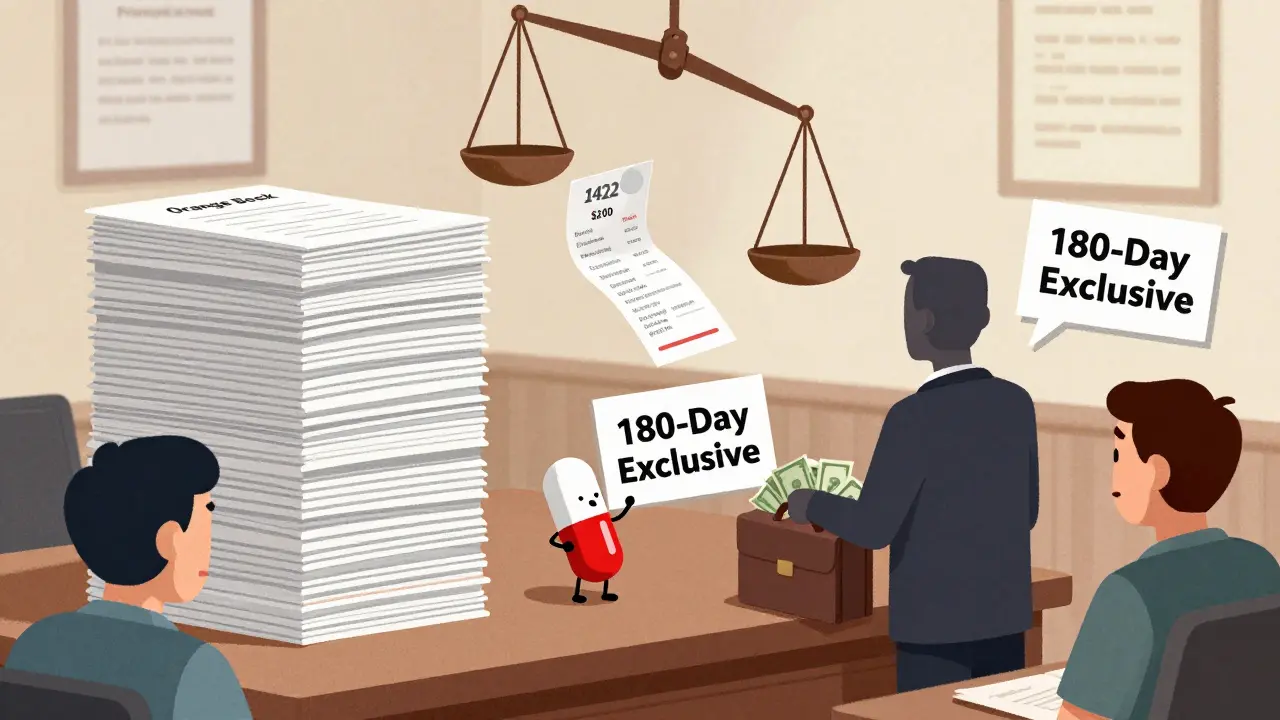
- 180-day generic exclusivity: This is the big one. The first generic company to challenge a patent and win gets a 180-day head start on the market. No one else can sell the same generic during that time. That’s worth hundreds of millions.
But here’s the dark side: companies pile on dozens of patents-sometimes over 100-for one drug. The average brand-name drug now has 142 patents listed in the FDA’s Orange Book. This creates legal chaos. Generic makers have to fight through court cases just to get started. And sometimes, the brand company pays the generic maker to wait. That’s called a “pay-for-delay” deal. In 2013, the Supreme Court ruled these deals aren’t automatically illegal-but they’re still common. In 2023, 78% of U.S. pharmacists said they saw delays in generic availability because of these settlements.
Europe: The 8+2+1 Rule
The EU takes a cleaner, more predictable approach. Their system is called 8+2+1:
- 8 years of data exclusivity: Generic companies can’t use the brand’s clinical trial data to get approval.
- 2 years of market exclusivity: Even after those 8 years, the generic can’t be sold yet.
- 1-year extension: If the brand company adds a new, important use during the first 8 years, they get one more year.
So total protection? Usually 11 years. Sometimes 12. No 180-day bonus for the first challenger. No patent thicket games. That makes it easier for generics to enter-but also gives brand companies less room to stretch protection.
Canada follows the same model. So do Australia and New Zealand. But the EU’s system has a flip side: trade deals like CETA (Canada-EU trade agreement) force countries with cheaper generics to respect these data exclusivity rules-even after patents expire. That’s why HIV drugs stayed expensive in South Africa for over a decade after their patents expired.
Japan and China: Tighter Rules, Slower Access
Japan gives 8 years of data exclusivity and 4 years of market exclusivity. That’s 12 years total. China changed its rules in 2020, jumping from 6 to 12 years of data protection. Brazil followed in 2021 with 10 years. These moves were meant to attract drugmakers-but they’ve slowed down access to affordable medicines in middle-income countries.
In places like India and Thailand, where generics are a lifeline, regulators still let companies skip data exclusivity if the patent has expired. That’s why India makes 60% of the world’s generic drugs. But global trade pressure is pushing those countries to tighten rules too.
Why This Matters: Billions at Stake
Between 2023 and 2028, $356 billion in global brand drug sales will face generic competition. In the U.S., when a generic enters, the brand’s sales drop 80-90% within a year. That’s why companies fight so hard to delay generics.
Take Keytruda, Merck’s cancer drug. Its effective market protection stretched from 8.2 years to 12.7 years thanks to patent extensions and exclusivity tricks. That’s not unusual. A 2022 study found that big pharma companies get an average of 38 extra patents per drug-not for new science, but for tiny changes: a new coating, a different dosage form, a new packaging.
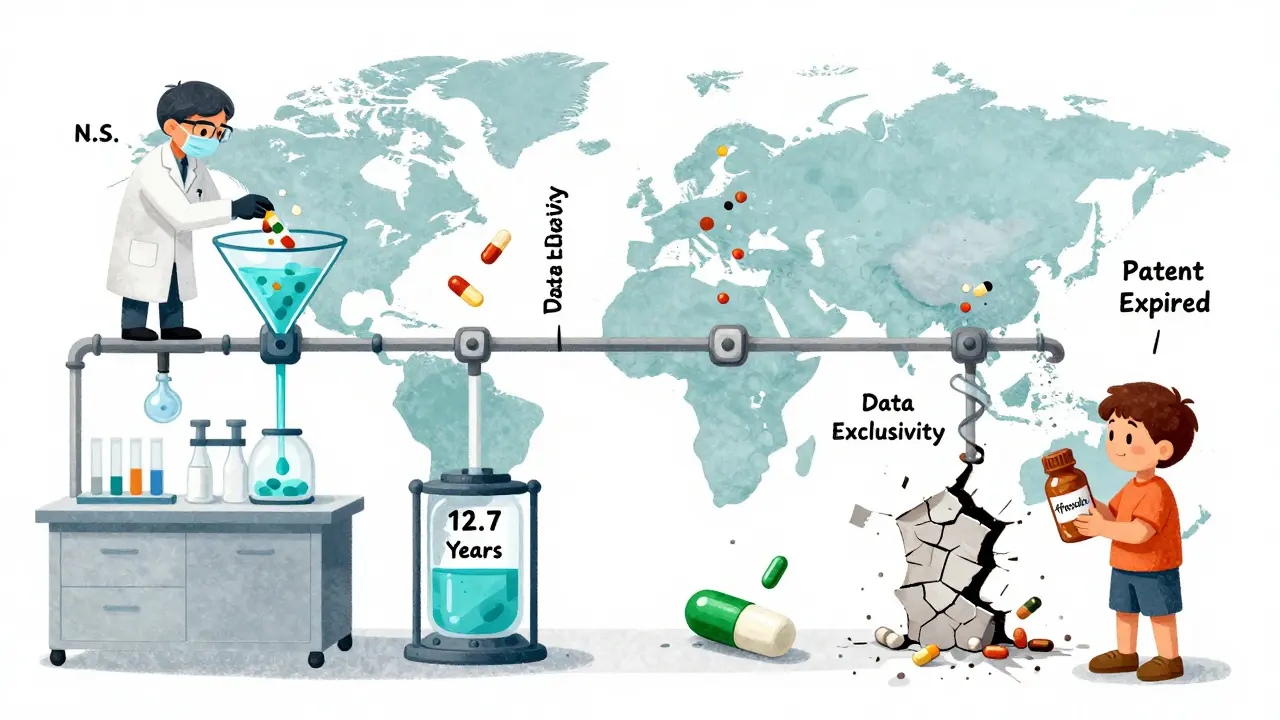
Meanwhile, patients wait. The World Health Organization found that in low-income countries, generics arrive 19.3 years after a drug’s first approval. In high-income countries? Just 12.7 years. That’s a 6.6-year gap in access. And it’s not because of patents alone. It’s because of data exclusivity rules that block generics even after patents expire.
What’s Changing? The Fight Isn’t Over
There’s pressure to fix this. In the U.S., lawmakers are pushing the Preserve Access to Affordable Generics and Biosimilars Act to ban pay-for-delay deals. The EU is considering cutting data exclusivity from 8 to 5 years for some drugs. Japan plans to speed up its patent review process. But big pharma isn’t backing down. PhRMA says without these protections, innovation would collapse.
Here’s the truth: innovation needs protection. But so does access. Right now, the system favors companies that game the rules over patients who need affordable drugs. The question isn’t whether exclusivity should exist. It’s whether it should last longer than the actual science behind the drug.
What’s Next for Generic Drugs?
By 2027, patent extensions and exclusivity periods will make up 45% of total market protection-up from 32% in 2020. That means even more delays. More legal battles. More money spent on lawyers instead of research.
Generic manufacturers are adapting. Some now spend $2-5 million just to build a legal strategy before they even make a pill. Others focus on drugs with weaker patent protection. A few, like Mylan with EpiPen, challenge 6 out of 12 patents-and redesign the product just enough to avoid infringement.
But for most patients, the system still feels rigged. A drug approved in 2015 might not have a generic until 2026. And that’s not because it’s too hard to copy. It’s because the rules were written to protect profits-not people.
How long does patent protection last for generic drugs in the U.S.?
The original patent lasts 20 years from the filing date, but because drug development takes so long, only 6-10 years remain after approval. Additional exclusivity periods-like 5-year NCE protection or 180-day generic exclusivity-can extend market control beyond the patent. In practice, many drugs have 12-15 years of exclusive sales before generics enter.
What is data exclusivity, and how is it different from a patent?
A patent protects the chemical formula or invention. Data exclusivity protects the clinical trial data submitted to regulators. Even if a patent expires, a generic can’t use the brand’s data to prove safety and effectiveness until data exclusivity runs out. In the U.S., data exclusivity lasts 5 years for new drugs; in the EU, it’s 8 years. This is often the biggest barrier to generic entry.
Why do some countries delay generic drugs even after patents expire?
Because of data exclusivity rules in trade agreements. For example, the EU’s 8-year data protection rule is enforced in countries like South Africa through trade deals. Even if a patent expires, generic makers can’t legally use the original data to get approval. That delays access by years-sometimes over a decade.
What is the 180-day exclusivity period in the U.S.?
It’s a reward for the first generic company to successfully challenge a brand-name patent through a Paragraph IV certification. That company gets 180 days of exclusive rights to sell the generic, with no competition. This incentive drives most generic challenges-but it’s also exploited through pay-for-delay deals, where brand companies pay generics to wait.
Can a generic drug enter the market before the patent expires?
Yes, but only if the generic company challenges the patent and proves it’s invalid or not infringed. In the U.S., this triggers the 180-day exclusivity. In the EU, generics can’t enter until exclusivity ends-even if the patent is weak. Courts in the U.S. often rule on these challenges, while the EU relies on regulatory timelines.
Do all countries have the same exclusivity rules?
No. The U.S. uses multiple overlapping exclusivities (5, 7, 3, 6-month, 180-day). The EU uses 8+2+1. Japan gives 8 years data + 4 years market. Canada matches the EU. Low-income countries often have no data exclusivity, allowing faster generic entry. Trade deals are pushing more countries toward stricter rules, even if it hurts access.
The complexity of the U.S. exclusivity framework is not merely a regulatory quirk-it’s a meticulously engineered mechanism to extend monopolistic rents under the guise of innovation. The 180-day generic exclusivity provision, for instance, is not an incentive; it’s a cartelization tool. By granting a single firm temporary monopoly, the system incentivizes collusion rather than competition. This is not free-market economics-it’s regulatory capture dressed in legal jargon.
Moreover, the patent thicket strategy-142 patents per drug-is a textbook example of strategic obstructionism. It transforms the FDA approval process into a litigation gauntlet. The cost of navigating this maze is not borne by Big Pharma; it’s externalized onto taxpayers, insurers, and patients who wait years for affordable alternatives.
And let’s not pretend that orphan drug exclusivity serves altruistic ends. The majority of orphan-designated drugs target conditions with more than 200,000 patients. The threshold is arbitrary, easily gamed, and routinely exploited. This isn’t helping rare disease patients-it’s enriching shareholders under a humanitarian veil.
India’s refusal to enforce data exclusivity is the only sane policy in a broken global system. Why should we respect data from a $2.3B R&D claim when the drug was developed using public funding, clinical trial data from our own hospitals, and patents filed in the U.S. before India even had a regulatory framework? The WTO TRIPS agreement was never meant to be weaponized against developing nations.
PhRMA’s argument-that innovation collapses without exclusivity-is a lie. Most breakthroughs come from academia. The private sector merely packages and prices them. We don’t need 12 years of exclusivity. We need 2. The rest is rent-seeking.
And yes, we make 60% of the world’s generics because we refused to play their game. Until the West stops using trade deals to export their monopolies, the global South will keep doing what’s right-not what’s legal.
Man, I just read this whole thing and I’m sitting here thinking about my mom who takes 3 different meds and can’t afford the generics because they’re still not out yet. I get all the legal stuff, but at the end of the day, someone’s life is on the line here.
Like, I know companies need to make money, but 12 years? That’s longer than some kids are in college. And don’t even get me started on pay-for-delay-why is that even legal? It’s like paying someone not to show up to work.
Maybe we need a new system where the public gets a cut of the profits if taxpayer money helped fund the research? Just a thought. 🤔
This post completely ignores the moral responsibility of pharmaceutical companies. They are not charities. They are corporations whose fiduciary duty is to maximize shareholder value. To expect them to prioritize patient access over profit is naive.
Yes, exclusivity periods are long. But without them, there would be no innovation. No cancer drugs. No HIV treatments. No vaccines. The entire modern pharmaceutical industry is built on this model-and for good reason.
It’s not that I don’t care about affordability. It’s that I understand the trade-off. If you want cheaper drugs tomorrow, prepare for fewer breakthroughs in 10 years.
Okay but let’s be real-this whole system is a joke. I work in a pharmacy. I see patients skipping doses because they can’t afford the brand. I’ve had 80-year-olds cry because their insulin went from $30 to $300. And the reason? Some lawyer figured out how to patent a different color pill.
Meanwhile, Mylan made $10B off EpiPen while families paid $600 for a two-pack. And now they’re calling it ‘innovation’? 🤡
We need to ban pay-for-delay. We need to cap exclusivity at 5 years. We need to let generics in EARLY. And we need to stop pretending this is about science. It’s about money. And it’s killing people. 💔
I’ve been reading up on this for a while now. The 8+2+1 system in the EU is actually kind of elegant. It’s transparent, predictable, and doesn’t turn every new dosage form into a legal battle.
But here’s the thing nobody talks about: even if the EU gets it right, the U.S. system drags the whole world down. Because of trade deals, countries like South Africa and Thailand are forced to adopt U.S.-style rules-even when it hurts their people.
It’s not just about patents. It’s about power. Who gets to decide what’s fair? And why is it always the richest countries writing the rules?
So… like… wait. Are you saying that a drug can be approved in 2015 and still not have a generic in 2026? That’s wild. I thought generics were supposed to be cheap and fast.
Also, who even thought up the 180-day thing? That sounds like a plot from a corporate thriller. 😅
And why does every country have different rules? Can’t we just… agree? Like, on one system? I feel like I’m reading a legal textbook and not a health article.
Let me cut through the noise: the entire pharmaceutical model is a Ponzi scheme built on regulatory arbitrage. The U.S. and EU create artificial scarcity through data exclusivity-then export it globally via trade agreements. The result? A global monopoly on life-saving medicines.
India’s resistance is not ‘unethical.’ It’s revolutionary. Every generic pill produced there is an act of civil disobedience against intellectual property colonialism.
And let’s not forget: the $2.3B R&D figure is inflated by marketing spend. Over 30% of pharma budgets go to advertising-not R&D. So when they cry ‘innovation,’ what they mean is ‘profit maximization.’
It is an absolute outrage that any nation would permit such a grotesque distortion of public health policy. The notion that a company should be granted monopoly control over a chemical compound-derived from publicly funded research-for over a decade is not merely economically unsound; it is ethically indefensible.
Furthermore, the 180-day generic exclusivity provision is a perverse incentive structure that rewards litigation over innovation. It incentivizes patent trolling under the guise of generic competition.
One must ask: who benefits? Not the patient. Not the taxpayer. Not the healthcare system. Only the shareholders of multinational conglomerates whose sole purpose is to extract value from human vulnerability.
i read this whole thing and i think the us system is just too complicated. like why do we need 5 different types of exclusivity? it’s like they’re trying to confuse everyone so no one can challenge it.
also i didn’t know about the 180 day thing. that’s wild. so the first generic company gets to be the only one for half a year? that’s not competition, that’s a monopoly with a timer. 🤷♀️
The hypocrisy of Western nations is staggering: they preach free markets while constructing labyrinthine legal barriers to protect monopolies. The 8+2+1 system in Europe is a veneer of fairness-it still denies access for over a decade. Meanwhile, countries like India, which produce 60% of global generics, are demonized as ‘pirates’ for refusing to bow to rent-seeking regimes.
Patents were never meant to be perpetual. They were meant to incentivize disclosure-not entrench control. The fact that a drug’s exclusivity now exceeds its actual scientific novelty by 300% is not a feature. It is a catastrophe.
just wondering… if the patent clock starts when you file it, not when it’s approved… then why not file earlier? like, right after the idea? wouldn’t that give you more time? or is there a catch?
also, i didn’t realize data exclusivity was the real blocker. i thought it was just the patent. wow. this is way more messed up than i thought.
It is imperative to recognize that the erosion of intellectual property protections-however well-intentioned-will inevitably lead to the collapse of pharmaceutical innovation. Without robust, enforceable exclusivity periods, there is no financial justification for the immense risks inherent in drug development.
The suggestion that we shorten exclusivity to five years ignores the reality that 90% of drug candidates fail. Those failures are paid for by the profits of the few successes. To weaken protection is to guarantee fewer future treatments.
And while affordability is a moral imperative, it cannot be achieved at the cost of future medical progress. There is a balance-and we are dangerously close to losing it.
Interesting. You bring up India’s role-but have you considered the consequences of their model? When data exclusivity is ignored, multinational firms withdraw R&D investment from those markets. India has seen a 40% decline in clinical trials since 2018. The result? Fewer local innovations, fewer jobs, and less infrastructure.
There’s a reason why Brazil and China moved toward stronger exclusivity: they want to be part of the innovation ecosystem, not just the manufacturing hub.
It’s not black and white. We can’t have global access without global investment. And right now, the system is tilted toward short-term cost savings over long-term scientific advancement.