Drug Interactions Databases: Using FDA and WebMD Checkers Safely
Drug Interaction Database Comparison Tool
This tool helps you understand the differences between WebMD and DrugBank, based on the article content. Many users assume these tools are comprehensive, but they have critical limitations that could impact your safety. Check how they compare for your specific needs.
What do you need to check?
WebMD vs DrugBank Comparison
| Feature | WebMD (Free) | DrugBank (Free) | Best For |
|---|---|---|---|
| Checks for drug-drug interactions | Yes | Yes | General awareness |
| Shows interaction mechanism | No | Yes (enzyme pathways, protein binding) | Understanding why interaction occurs |
| Provides references to studies | No | Yes (with citations) | Clinical decision making |
| Checks drug-food interactions | Yes | Yes | General awareness |
| Checks drug-herbal interactions | Partial (1,200+ compounds) | Partial (limited in free version) | General awareness |
| Checks drug-condition interactions | Yes | Yes | General awareness |
| Shows pharmacogenomic factors | No | No | Clinical decision making |
| Updates for new drugs | Often delayed (up to 18 months) | Often delayed (up to 18 months) | None |
| Number of drugs allowed | Unlimited | 5 maximum | DrugBank for limited medications |
| Shows severity ratings | Yes (minor/moderate/major) | Yes (minor/moderate/major) | General risk assessment |
Critical Examples from the Article
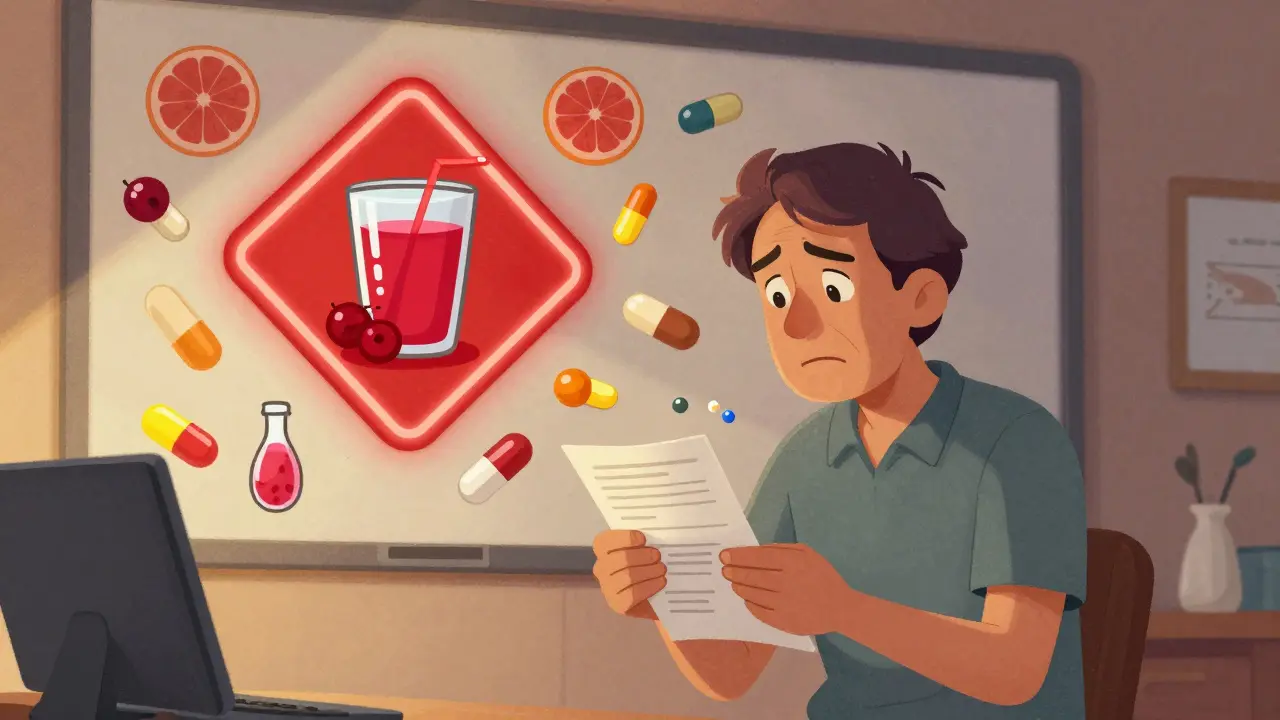
Warfarin + Cranberry Juice
WebMD incorrectly showed this interaction as safe, but INR levels can spike dangerously. This shows how even basic checks can miss critical interactions.
High RiskFluoxetine + Tramadol
WebMD might show "moderate interaction" but DrugBank explains it involves CYP2D6 inhibition increasing serotonin syndrome risk with evidence from studies.
Serotonin Syndrome RiskMetformin + Magnesium Supplement
No warning was shown in checkers, but this combination can cause lactic acidosis in some patients. Both tools missed this interaction.
Lactic Acidosis RiskSt. John's Wort + Birth Control
WebMD doesn't always flag this interaction reliably. St. John's Wort can reduce the effectiveness of birth control pills.
Birth Control Failure RiskKey Takeaways
Use WebMD for general awareness and patient education. Use DrugBank for clinical decision making when you need detailed mechanisms and references. Never rely solely on these tools for medical decisions. Always verify with a pharmacist or healthcare provider, especially for high-risk medications.
When you're taking multiple medications, it's easy to overlook how they might react with each other. A simple combo like warfarin and cranberry juice can send your INR levels through the roof. Or mixing a common painkiller with an antidepressant might trigger serotonin syndrome. These aren't rare edge cases-they happen every day. In the U.S. alone, over 1.3 million emergency room visits each year are tied to adverse drug events, and nearly 40% of those involve drug interactions. That’s why using reliable drug interaction databases isn’t optional-it’s essential.
What You Need to Know About FDA and WebMD Checkers
Many people assume the FDA runs its own public drug interaction checker. It doesn’t. The FDA’s role is to monitor drugs after they’re on the market. They track adverse events through systems like MedWatch and issue safety alerts when problems emerge. But they don’t offer a tool where you can type in your meds and get instant feedback. That gap is filled by third-party platforms like WebMD. WebMD’s Drug Interaction Checker is one of the most popular free tools online. It’s simple: you enter your medications, supplements, or even foods, and it tells you if there’s a potential conflict. No sign-up. No login. Just type and get results in under three seconds. It checks for drug-drug, drug-food, and drug-condition interactions. For example, it’ll warn you that grapefruit can interfere with statins, or that calcium supplements can reduce the absorption of thyroid medication. But here’s the catch: WebMD doesn’t show you the science behind the warning. It doesn’t explain whether the interaction is caused by how your liver processes the drugs, or if it’s a direct chemical clash. It just says “possible interaction.” That’s fine for general awareness-but not for making clinical decisions.How DrugBank Compares: Depth Over Simplicity
If you want to dig deeper, DrugBank is where the real clinical data lives. Created by researchers at the University of Alberta, it’s used by hospitals and pharmacies across North America. Its free version lets you check up to five drugs at once, but that’s where the simplicity ends. It tells you exactly how the interaction works-whether it’s a CYP450 enzyme inhibition, a change in protein binding, or a pharmacodynamic effect. It even cites peer-reviewed studies. For example, if you’re taking fluoxetine and tramadol, WebMD might say “moderate interaction.” DrugBank will tell you that both drugs inhibit CYP2D6, increasing the risk of serotonin syndrome, and link to the 2018 study in Pharmacotherapy that first documented this. It classifies severity as minor, moderate, or major, and includes references so you can verify the claim. The trade-off? DrugBank’s free version is limited. You can’t check more than five drugs at once. It doesn’t include herbal supplements in full detail. And it won’t tell you if your kidney function affects how the drugs are cleared-something that matters for older adults. That’s where clinical judgment still has to step in.Why Free Tools Miss Critical Risks
Both WebMD and DrugBank’s free tools have blind spots. One major gap is dietary supplements. WebMD’s checker only covers about 1,200 herbal compounds as of late 2023. But there are over 8,000 supplements on the market. St. John’s Wort, for instance, is known to reduce the effectiveness of birth control pills and antidepressants-but WebMD’s algorithm doesn’t always flag it reliably. DrugBank’s free tier doesn’t include pharmacogenomic data. That’s the science of how your genes affect how you process drugs. About one in three people have genetic variants that make them slow or fast metabolizers of common medications like codeine, clopidogrel, or SSRIs. If you’re a slow metabolizer, a standard dose of codeine can turn into a dangerous overdose. Neither WebMD nor DrugBank’s free tool asks about your DNA. Even more troubling: both platforms can lag behind new drugs. When fedratinib was approved in 2019, it took over 18 months for major databases to update their interaction profiles. During that gap, at least 12 patients developed severe thiamine deficiency because their doctors didn’t realize the drug blocked vitamin B1 absorption. That’s not a failure of the user-it’s a failure of the system.
Real-World Mistakes People Make
People often treat these checkers like truth machines. They assume “no interaction found” means it’s safe. That’s dangerous. One Reddit user shared that WebMD said warfarin and cranberry juice were safe. Then their INR spiked to 6.2-life-threatening territory. Another patient took metformin and a magnesium supplement, saw no warning, and ended up with lactic acidosis because their kidneys couldn’t clear the buildup. Even severity ratings get misread. A “moderate” interaction might sound manageable, but a 2021 study in Annals of Internal Medicine found that 18% of preventable hospital admissions came from interactions labeled “moderate.” That’s because “moderate” doesn’t mean “harmless.” It means “likely to cause trouble if you’re elderly, have liver disease, or are taking five other drugs.” The biggest mistake? Not checking food and condition interactions. Over 40% of serious drug interactions involve what you eat or your underlying health condition. NSAIDs like ibuprofen are fine for healthy people-but dangerous if you have heart failure. Antihistamines like diphenhydramine are okay for occasional use-but risky if you have glaucoma or an enlarged prostate. Neither WebMD nor DrugBank prompts you to enter your full medical history.When to Trust These Tools-and When Not To
Use WebMD if you’re a patient trying to understand why your doctor changed your prescription. Use it to ask informed questions. It’s great for spotting obvious red flags. Use DrugBank if you’re a clinician, pharmacist, or someone managing complex polypharmacy. Use it to dig into mechanisms, verify literature, and build confidence before making a change. But never rely on either tool as your final authority. Always:- Double-check high-risk combinations with primary sources like Micromedex or Lexicomp.
- Ask your pharmacist about supplements and OTC meds-they often know more than your doctor.
- Update your list of medications every time you start or stop something-even a new vitamin.
- Remember: if you’re over 65, taking five or more drugs, or have kidney/liver issues, you’re at higher risk. Extra caution is non-negotiable.
The Bigger Picture: Why This Matters
The global market for drug interaction software hit $1.2 billion in 2022. Why? Because the population is aging. In the U.S., 16% of adults take five or more medications daily. More drugs = more chances for conflict. But here’s the irony: while hospitals spend tens of thousands on enterprise systems like DrugBank’s API, patients are left with free tools that are incomplete, outdated, or misleading. The FDA doesn’t regulate these platforms. There’s no certification. No standard. No oversight. That’s why your personal checklist matters more than any app. Keep a printed list. Bring it to every appointment. Ask: “Could this interact with what I’m already taking?” Don’t wait for a tool to catch it. Be the safety net.What’s Next? AI and the Future of Drug Safety
The next wave is AI. Google’s Med-PaLM 2 model predicted novel drug interactions with 89% accuracy in 2023 trials. Stanford researchers found that large language models hallucinate interactions 22% of the time-meaning they invent risks that don’t exist. That’s why the FDA is pushing for “explainable AI” by 2026. Future tools will need to show their work: which study, which enzyme, which patient group. Blockchain-based personal drug records are also emerging. Imagine a system where your medication history, genetic data, and real-time lab results follow you securely. That’s the future. But for now, you’re still the most important part of the equation.Can the FDA’s drug interaction checker be accessed online?
No, the FDA does not operate a public-facing drug interaction checker. Its role is to monitor drug safety after approval through systems like MedWatch and adverse event reporting. It issues safety alerts and recalls, but does not provide a tool for users to check interactions between medications. For that, you need third-party platforms like WebMD or DrugBank.
Is WebMD’s drug interaction checker reliable for making medical decisions?
WebMD is useful for general awareness and patient education, but it should never be used to make clinical decisions. It lacks detailed pharmacokinetic data, doesn’t cover all supplements, and can miss interactions involving new drugs or genetic factors. A 2021 University of Florida study found 17% of its serotonin syndrome warnings lacked primary literature support. Always verify results with a pharmacist or clinician.
Why do drug interaction checkers miss so many interactions?
Most free tools don’t account for individual factors like kidney or liver function, age, genetics, or dietary habits. They also lag behind new drug approvals-sometimes by over 18 months. Herbal supplements are poorly tracked, and pharmacogenomic interactions (which affect 30-50% of patients) are excluded from free versions. Even major platforms like WebMD and DrugBank have documented gaps, especially with off-label uses and complex polypharmacy.
Should I trust DrugBank over WebMD?
DrugBank offers far deeper clinical detail, including enzyme pathways, evidence-based severity ratings, and primary literature citations. It’s the preferred tool for pharmacists and hospitals. But its free version limits you to five drugs and lacks patient-friendly explanations. WebMD is easier to use and better for quick checks. For accuracy, use DrugBank. For accessibility, use WebMD. But always confirm critical decisions with a healthcare provider.
Are there better alternatives to WebMD and DrugBank?
Yes. Medscape requires registration but offers stronger clinical depth. Drugs.com has a better mobile experience and higher user ratings. Pillo specializes in food-drug interactions with a patented algorithm. For healthcare professionals, Micromedex and Lexicomp are industry standards but require subscriptions. No single tool is perfect. The best approach is cross-referencing multiple sources and consulting a pharmacist.
Bro, I was on 7 meds last year and used WebMD like a bible. Then my INR hit 6.1 after cranberry juice. I thought it was safe. Turns out, WebMD didn't flag it. I ended up in the ER. DrugBank caught it immediately. Don't trust free tools like they're gospel. I'm not even mad, just woke up. 🤦♂️
It's not about the tools. It's about the illusion of control. We think algorithms can replace wisdom. But biology isn't a database. It's a symphony of chaos-genes, gut flora, circadian rhythms, stress hormones. No app sees that. We outsource our agency to a website and call it 'being proactive.' That's not safety. That's spiritual laziness. 🌌
Just wanted to add: I'm a pharmacist in rural Ohio. Every week, someone comes in with a printout from WebMD saying 'no interaction.' Then I check DrugBank and find a CYP3A4 inhibition they missed. The free tools are fine for curiosity-but never for decision-making. Always cross-reference with Micromedex or Lexicomp. And yes, St. John’s Wort? It’s a silent killer. 30% of patients don’t even know they’re taking it. 🙏
Oh wow. So we're supposed to trust a university project over a multi-billion-dollar company? How cute. DrugBank is just a glorified grad student’s thesis with citations. Meanwhile, WebMD reaches 100 million people monthly. You’re not protecting people-you’re gatekeeping knowledge. If I can’t access it in 3 seconds on my phone while I’m in line at CVS, it’s not useful. The system is broken because you want it to be. 🤷♀️
It is imperative to recognize that the absence of regulatory oversight for consumer-facing drug interaction platforms constitutes a systemic vulnerability in public health infrastructure. The FDA's non-involvement is not an oversight-it is a deliberate policy choice predicated on the assumption that liability rests with third-party entities. This creates a hazardous epistemic asymmetry wherein patients are encouraged to self-diagnose using non-validated tools. A standardized, federally endorsed, open-source interaction database-modeled on the WHO Model List of Essential Medicines-is not merely advisable; it is ethically non-negotiable.
Oh honey, you wrote a 2,000-word essay on why your doctor didn't check your meds? Congrats. You’re the first person to notice that free websites aren’t perfect. 🎉 I’ve been telling my 82-year-old mom for years: if you're taking more than 5 pills, you’re basically a chemistry experiment. But hey, at least you didn’t mix warfarin with turmeric and blame the app. 🤭
Thank you for this. I’m a nurse and I hand out printed medication lists to every patient over 65. I tell them: ‘Bring this. Every time. Even if you think it’s just a vitamin.’ I’ve saved lives this way. No app can replace human vigilance. You are not a data point. You are a person. And your life matters more than a 3-second search result. 💙
USA has 1.3M ER visits from drug interactions? LOL. That’s because we let everyone take pills like candy. Go to Germany. They make you fill out a 12-page form just to get ibuprofen. Maybe we need to stop being so damn lazy. Your meds aren’t snacks. Stop Googling and start listening.
As someone who works in clinical informatics in the UK, I’ve seen both sides. The NHS uses a custom system built on Micromedex and integrates with GP records. It flags interactions, renal clearance, and even seasonal changes (e.g., winter vitamin D drops affecting statin metabolism). But the real breakthrough? Pharmacists are embedded in primary care teams. No app replaces a human who knows your history, your diet, your anxiety, and your dog’s name. Technology helps. Humans heal. 🇬🇧