Anticholinergic Burden in Older Adults: How Common Medications Increase Dementia Risk

Many older adults take medications every day to manage common conditions - allergies, overactive bladder, depression, insomnia. But what if some of those pills are quietly harming their brains? The anticholinergic burden is a hidden threat that’s linked to memory loss, confusion, and a higher risk of dementia in people over 65. And the scary part? Most people - including many doctors - don’t realize how dangerous these drugs can be.
What Is Anticholinergic Burden?
Anticholinergic burden refers to the total effect of medications that block acetylcholine, a brain chemical essential for memory, attention, and learning. These drugs don’t just cause dry mouth or constipation. They interfere with brain function, especially in older adults whose brains are already more vulnerable. There are three main scales used to measure this burden: the Anticholinergic Cognitive Burden (ACB) scale, the Anticholinergic Risk Scale (ARS), and the Drug Burden Index (DBI). The ACB scale is the most widely used today. It rates drugs on a scale from 1 to 3:- Level 1 (Mild): Drugs like loratadine (Claritin)
- Level 2 (Moderate): Drugs like hydroxyzine (Vistaril)
- Level 3 (Strong): Drugs like diphenhydramine (Benadryl), oxybutynin (Ditropan), and amitriptyline
How These Drugs Damage the Brain
Acetylcholine isn’t just a general brain chemical. It’s critical in the hippocampus (memory center), the prefrontal cortex (decision-making), and the neostriatum (movement and focus). When anticholinergics block it, these areas start to slow down. Brain imaging studies show clear changes. A 2016 JAMA Neurology study found that older adults taking even moderate levels of anticholinergic drugs had 4% less glucose metabolism in brain regions affected by Alzheimer’s. That’s not a small drop - it’s the same pattern seen in early dementia. MRI scans from the Indiana Memory and Aging Study revealed something even more alarming: people on anticholinergics lost brain volume 0.24% faster per year than those not taking them. Over five years, that adds up to noticeable shrinkage - especially in areas tied to memory. It’s not just structure. Function suffers too. The ASPREE study, which followed over 19,000 people aged 70 and older for nearly five years, found that for every one-point increase in ACB score:- Executive function (planning, problem-solving) declined by 0.15 points per year
- Episodic memory (remembering events or conversations) dropped by 0.08 points per year
Long-Term Use = Higher Dementia Risk
It’s not just about taking one pill. The longer you take anticholinergics, the worse the damage becomes. A landmark 2015 study in JAMA Internal Medicine followed over 3,400 older adults for more than 10 years. Those who took strong anticholinergic drugs for three years or more had a 54% higher risk of developing dementia compared to those who took them for less than three months. Even people who didn’t have memory problems at the start were affected. And it’s not just prescription drugs. Over-the-counter sleep aids and allergy pills are major culprits. Diphenhydramine - the active ingredient in Benadryl, Tylenol PM, and many sleep aids - is a Level 3 anticholinergic. Yet millions of seniors take it nightly, thinking it’s harmless. The FDA received over 1,200 reports of cognitive side effects from anticholinergics between 2018 and 2022. Confusion, memory loss, and delirium were the most common. Many of these cases were avoidable.
Who’s Most at Risk?
It’s not just about age. People with existing cognitive issues, Parkinson’s, or a family history of dementia are more vulnerable. But even healthy seniors aren’t safe. The most commonly prescribed anticholinergics in older adults include:- First-generation antihistamines: Diphenhydramine (Benadryl), chlorpheniramine
- Overactive bladder drugs: Oxybutynin, tolterodine, solifenacin
- Tricyclic antidepressants: Amitriptyline, nortriptyline
- Antipsychotics: Chlorpromazine, quetiapine (used off-label for sleep or agitation)
- Anti-nausea drugs: Promethazine, prochlorperazine
Real Stories: What Happens When People Stop
The good news? The damage isn’t always permanent. On AgingCare.com, caregivers shared stories of dramatic improvements after stopping anticholinergics. One woman’s mother, who had been confused and disoriented for months, returned to her normal self within two weeks after stopping oxybutynin for overactive bladder. Her doctor had no idea the medication was the cause. The DICE trial, which studied 286 older adults, showed that after 12 weeks of reducing anticholinergic drugs, participants improved by 0.82 points on the Mini-Mental State Exam (MMSE). That’s a measurable gain in memory and thinking skills. But here’s the catch: it takes time. Symptoms don’t vanish overnight. Deprescribing - safely stopping these drugs - usually takes 4 to 8 weeks. Some people need longer. And it must be done under medical supervision. Suddenly quitting can cause withdrawal symptoms like increased heart rate, sweating, or worsening bladder symptoms.What Doctors Should Be Doing
The American Geriatrics Society’s 2023 Beers Criteria clearly states: avoid strong anticholinergics in older adults. Yet a 2022 study found that only 39% of nursing home residents with high anticholinergic burden had their meds reviewed within three months of being flagged. Primary care doctors say they need about 23 minutes per patient to properly review all medications for anticholinergic risk. But most appointments last 15 minutes or less. Tools like the ACB Calculator app (launched in 2024 by the American Geriatrics Society) help. Doctors can enter a patient’s medication list and instantly see the total burden. It’s free, simple, and built into many electronic health records now.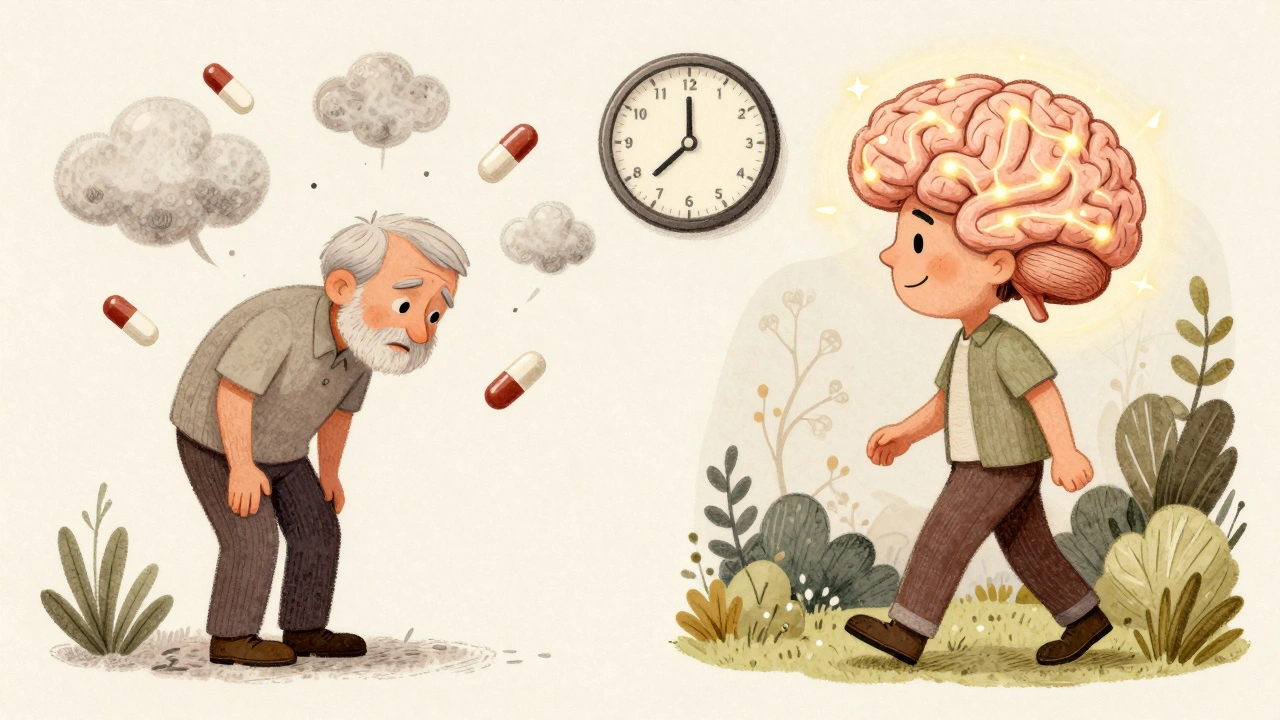
What You Can Do
If you or a loved one is over 65 and taking any of these drugs:- Make a full list: Write down every medication - including OTCs, supplements, and sleep aids.
- Ask your doctor: ‘Is this drug anticholinergic? What’s the risk to my memory?’
- Ask about alternatives: For allergies, try non-sedating antihistamines like loratadine. For overactive bladder, consider pelvic floor therapy or mirabegron (Myrbetriq), which has minimal brain effects. For depression, SSRIs like sertraline are safer than amitriptyline.
- Don’t stop cold turkey: Work with your doctor to taper off safely.
- Track changes: Note any improvements in focus, memory, or confusion after reducing or stopping a drug.
What’s Changing Now
The tide is turning. The FDA now requires stronger warning labels on anticholinergic medications. Johnson & Johnson discontinued long-acting oxybutynin in 2021. Pfizer pushed solifenacin (VESIcare), which has less brain penetration, into the market. The National Institute on Aging is funding a $14.7 million study (CHIME) to test whether actively reducing anticholinergic burden can delay or prevent dementia. Early results are expected by 2027. Experts now consider anticholinergic burden one of the top 10 modifiable risk factors for dementia - meaning it’s something we can actually change. A 2024 analysis found that nearly 80% of high-burden prescriptions were for conditions with safer alternatives. We’re not talking about rare cases. We’re talking about routine, preventable harm.Final Thoughts
Medications are meant to help. But when they quietly erode memory and thinking, we need to rethink what ‘help’ really means. The anticholinergic burden isn’t a theoretical concern. It’s a real, measurable, and often reversible threat to cognitive health in older adults. The tools to fix it exist. The evidence is clear. What’s missing is awareness - and the courage to ask the right questions.Can anticholinergic drugs cause dementia?
Yes, long-term use of anticholinergic drugs is linked to a higher risk of dementia. Studies show people who take strong anticholinergics for three years or more have a 54% greater chance of developing dementia compared to those who use them briefly. The risk builds over time and is dose-dependent - meaning more drugs or higher doses mean higher risk.
What are the most common anticholinergic drugs in older adults?
The most common include diphenhydramine (Benadryl, Tylenol PM), oxybutynin (Ditropan) for overactive bladder, amitriptyline and nortriptyline for depression or pain, and chlorpheniramine for allergies. Many of these are available over the counter, so people often don’t realize they’re taking anticholinergics.
Can stopping these drugs improve memory?
Yes. In clinical trials, older adults who reduced or stopped anticholinergic medications showed measurable improvements in memory and thinking within 8 to 12 weeks. One study found a 0.82-point increase on the MMSE cognitive test after deprescribing. Many caregivers report clearer thinking and less confusion in loved ones within weeks of stopping drugs like Benadryl or oxybutynin.
Are there safe alternatives to anticholinergic drugs?
Yes. For allergies, use loratadine (Claritin) or cetirizine (Zyrtec) instead of Benadryl. For overactive bladder, mirabegron (Myrbetriq) is a non-anticholinergic option. For depression, SSRIs like sertraline or citalopram are safer than tricyclics. For sleep, behavioral changes or melatonin are better than diphenhydramine. Always talk to your doctor before switching.
How do I check my anticholinergic burden?
Use the free ACB Calculator app from the American Geriatrics Society. You can also ask your pharmacist or doctor to review your medications using the Anticholinergic Cognitive Burden scale. Write down every pill you take - including OTCs - and ask: ‘Is this anticholinergic? What level is it?’ A total score of 3 or more is considered high risk.
Why don’t doctors always know about this risk?
Many doctors were never trained to think about anticholinergic burden. Prescribing habits are slow to change, especially for common conditions like insomnia or bladder issues. Also, patients often don’t mention OTC meds. A 2021 survey found that 63% of older adults weren’t told about cognitive risks when prescribed these drugs. Awareness is growing, but it’s still not routine.
My grandma was on Benadryl every night for years. One day she just... snapped out of it after we switched her to melatonin. No more confusion, no more wandering around at 3am. Took her two weeks to feel like herself again. Why isn’t this common knowledge?
The data here is irrefutable. Anticholinergic burden is not a theory-it’s a public health crisis disguised as standard care. Over 5 million older Americans are being quietly poisoned by OTC drugs their doctors never warned them about. This isn’t negligence. It’s systemic failure. Time to stop treating seniors like passive recipients of pills and start treating them like people with brains that matter.
I’ve seen this firsthand with my dad. He was on amitriptyline for nerve pain and kept forgetting where he put his keys-or even his own name sometimes. His doctor said it was just ‘aging.’ We switched him to gabapentin and non-drug pain management. Within six weeks, he was telling stories from 1972 like they happened yesterday. I wish more people knew how reversible this can be.
THIS IS THE MOST IMPORTANT THING I’VE READ ALL YEAR. I’M TELLING EVERYONE. MY MOM WAS ON OXYBUTYNIN FOR 7 YEARS. SHE THOUGHT SHE WAS JUST ‘GETTING OLD.’ THEN SHE STOPPED. SHE STARTED READING BOOKS AGAIN. SHE RECOGNIZED HER OWN GRANDKIDS. THIS ISN’T A SIDE EFFECT-IT’S A CRIME. WE NEED A MOVEMENT.
so like... benadryl is bad? wait but i thought it was just for allergies? and sleep? my aunt takes it every night and she’s 80 and seems fine? maybe its just me but this feels kinda scary lol
thank you for writing this 🙏 i’ve been scared to say anything but i’ve noticed my uncle’s memory got worse after he started that bladder med. now i know why. i’m printing this out to show his doctor. he’s gonna hate it but he needs to know. 💙
Big Pharma’s latest scheme to make seniors dumber so they’ll need more meds. The FDA? Complicit. The AMA? Bought off. They want you dependent. Diphenhydramine? A tool of control. They don’t want you thinking clearly-they want you docile. Wake up. This isn’t medicine. It’s chemical subjugation.
Interesting. In India, many elderly take antihistamines for colds or sleep without knowing the risks. Doctors rarely explain. Maybe we need community health workers to spread awareness-like how we do for diabetes or hypertension. This isn’t just a US problem.
The neurochemical cascade here is fascinating. Acetylcholine isn’t just a neurotransmitter-it’s the gatekeeper of synaptic plasticity in aging brains. When you chronically block it, you’re not just causing sedation; you’re disrupting long-term potentiation, which is the biological substrate of memory consolidation. The 0.24% annual volume loss isn’t noise-it’s structural erosion. This isn’t anecdotal. It’s systems biology in motion.
YOU CAN FIX THIS. I’M A PHARMACIST. I CHECK EVERY SINGLE PRESCRIPTION FOR ACB SCORES NOW. I TELL PATIENTS: ‘IF IT MAKES YOU DROWSY, IT’S PROBABLY KILLING YOUR BRAIN.’ I’ve helped over 200 seniors stop these drugs safely. You don’t need a miracle. You just need to ask. Start today. Write down every pill. Then call your doc. You’ve got this.
Let’s be real-the system is rigged. Doctors are paid per visit, not per outcome. Pharmacies push OTC meds because they make money. And who’s listening? Seniors who’ve been told for decades that ‘forgetfulness is normal.’ It’s not normal. It’s a product of profit-driven medicine. We’re being slowly erased. And no one’s coming to save us.
While the statistical correlations are compelling, correlation does not equal causation. The confounding variables-sleep apnea, vascular dementia, polypharmacy, nutritional deficiencies-are rarely controlled for in these observational studies. This is fearmongering dressed as science. The real risk? Overmedicating with unproven alternatives.
So you’re telling me Benadryl is the new smoking? Wow. I mean… I guess I should’ve known. But come on. People have been taking this stuff since the 50s. If it was that bad, wouldn’t we all be zombies by now? I’m just saying… maybe we’re overthinking this.