Anal Fissures: How to Heal Painful Tears Naturally and When to Seek Help

Imagine the sharp, burning pain that hits right after you finish a bowel movement - like a knife slicing through your anus. It lasts for minutes, sometimes over an hour. You start avoiding the bathroom. You change your diet. You even skip social plans because you’re terrified of what’s coming next. This isn’t just discomfort. This is an anal fissure.
What Exactly Is an Anal Fissure?
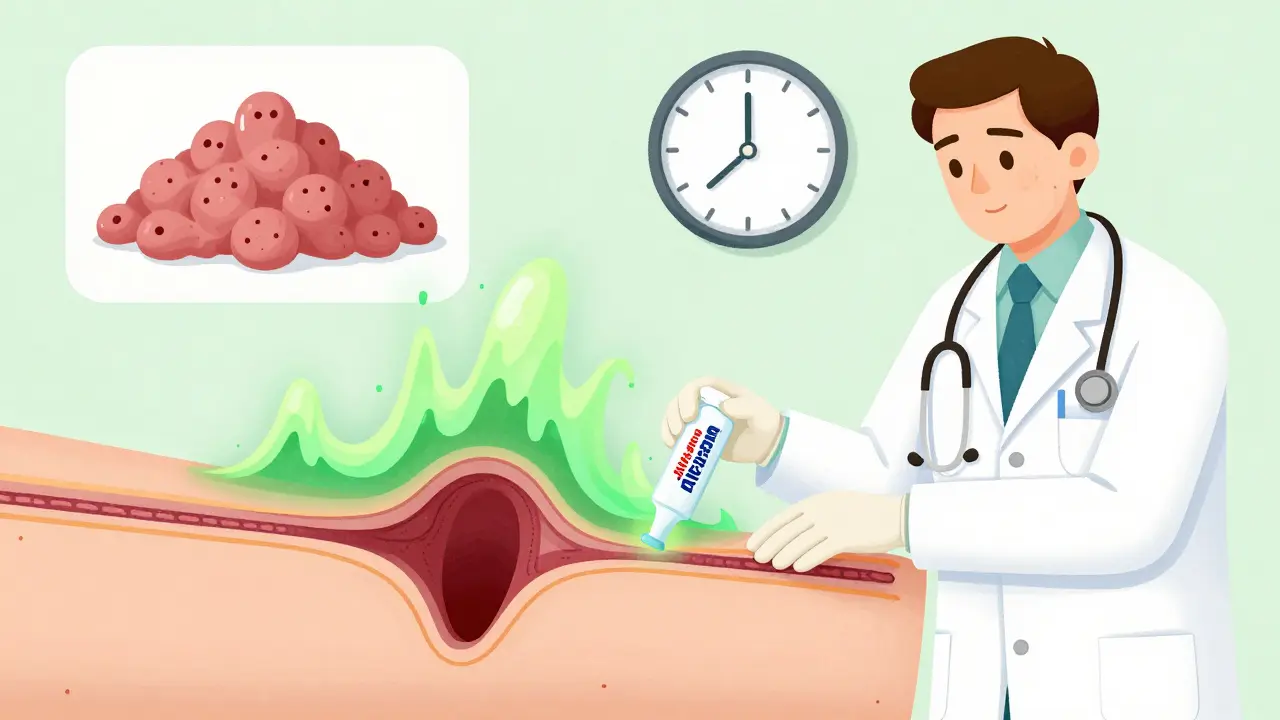
An anal fissure is a small tear in the lining of the anal canal. It’s not a cut you can see with your eyes, but you feel it - painfully. Most tears happen in the back (posterior) of the anus, about 90% of the time. The rest show up in the front (anterior). These tears aren’t deep, but they cut through sensitive tissue that’s packed with nerves. That’s why even a small split can feel like a major injury. The good news? Most anal fissures heal on their own. About 80 to 90% of acute cases (those under 6 weeks) go away without surgery. The bad news? If it sticks around longer than 8 weeks, it becomes chronic. That’s when the body starts trapping itself in a loop: pain → muscle spasm → less blood flow → slower healing → more pain. It’s a cycle that doesn’t fix itself.Why Do Anal Fissures Happen?
The #1 cause? Hard stools. Constipation. Straining. That’s it. When you push too hard, the skin around your anus stretches beyond its limit and tears. This is especially common if you’re not getting enough fiber, drinking water, or moving enough. But it’s not just constipation. Diarrhea can also cause fissures - repeated wiping and irritation can wear down the lining. Childbirth is another big trigger, especially for women. Infants get them too - about 64 out of every 1,000 babies develop a fissure in their first year. Less common causes? Crohn’s disease, anal cancer, or infections. That’s why if your fissure doesn’t heal after 8 weeks, or if you’re bleeding heavily, having weight loss, or pain that doesn’t match the typical pattern, you need to get checked. About 10% of people diagnosed with fissures actually have something else going on.What Does It Feel Like?
The pain is the first thing you notice. It’s not dull. It’s sharp, stabbing, and often described as “knife-like.” It hits right during or right after a bowel movement and can last 30 to 90 minutes. Some people say the pain radiates to their lower back, thighs, or even their buttocks. You’ll also see bright red blood on the toilet paper or in the bowl. It’s usually just a few drops - not a stream. That’s different from internal bleeding, which is darker and mixed in with stool. Chronic fissures come with extra signs: a small skin tag near the tear (called a sentinel pile) and a swollen bump inside the anus (hypertrophied papilla). These aren’t dangerous, but they’re clues that the tear has been there too long.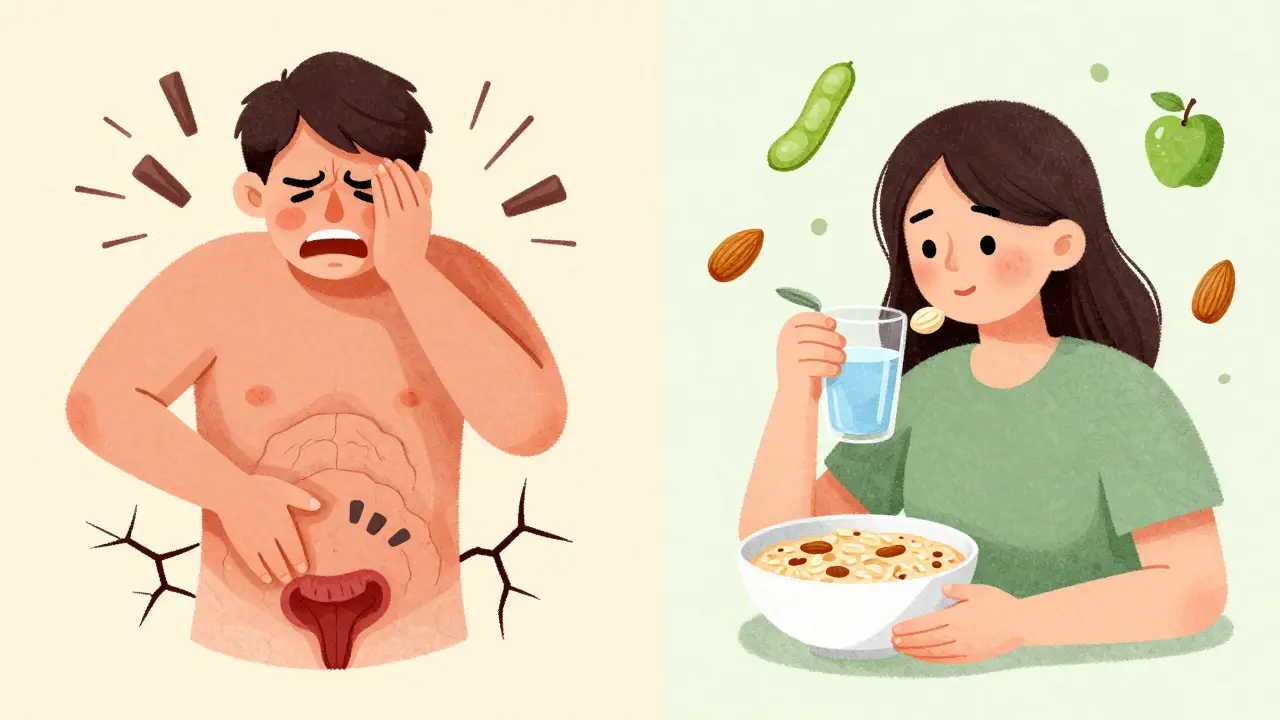
Healing Strategies That Actually Work
The first rule? Stop the cycle. You need to soften stools, reduce spasm, and boost blood flow. Here’s how to do it - step by step.1. Fiber - But Not Too Much
Aim for 25 to 30 grams of fiber a day. That’s about 2 cups of cooked beans, 1 cup of oatmeal, 2 apples with skin, and a handful of almonds. Don’t jump to 40 grams - too much fiber can make bloating and gas worse, and in 12% of people, it actually makes fissures hurt more. If you’re not used to fiber, increase it slowly. Go up by 5 grams every 3 days. Drink water with it. No water? Fiber just sits there and makes things harder.2. Hydration - Drink Like Your Life Depends on It
You need 2.5 to 3 liters of fluids daily. That’s about 10 to 12 glasses. Water is best. Coffee and tea count, but don’t rely on them. Alcohol and soda? Skip them. They dry you out.3. Sitz Baths - The Simple Miracle
Fill a shallow tub or a special basin with warm (not hot) water. Sit in it for 15 to 20 minutes, 3 to 4 times a day - especially after each bowel movement. This relaxes the sphincter, increases blood flow, and cleans the area gently. No soap. Just water. This isn’t optional. It’s one of the most effective, zero-cost treatments out there.4. Topical Creams - Pick the Right One
There are three main options:- Nitroglycerin ointment (0.2-0.4%): Helps relax the muscle. Works in 45-68% of cases. But 1 in 3 people get bad headaches. Not ideal if you’re sensitive to meds.
- Diltiazem (2%) or Nifedipine (0.3%): These calcium channel blockers are better tolerated. Healing rates hit 65-75%. Fewer headaches. Many doctors now recommend these as first-line.
- Lidocaine (5%): Not a healer - just a painkiller. Use it before bowel movements to numb the area. Doesn’t fix the tear, but makes life bearable.
5. Botox Injections - A Middle Ground
If creams don’t work, Botox can help. A doctor injects 15 to 30 units directly into the internal sphincter. It paralyzes the muscle just enough to break the spasm cycle. Healing rates: 50-80%. But in 40% of cases, the fissure comes back within a year. It’s not permanent. It’s a bridge to healing.6. Surgery - When Nothing Else Works
If you’ve tried everything for 8-12 weeks and still can’t heal, surgery is the next step. A lateral internal sphincterotomy is the gold standard. The surgeon makes a tiny cut in the sphincter muscle to reduce pressure. Success rate? 92-98%. Most people feel better in days. The catch? 14% of people develop minor incontinence - usually just a little trouble holding gas or a small amount of liquid stool. It’s rare to lose solid stool control. Most people accept this trade-off because the pain was unbearable.What Doesn’t Work - And Why
A lot of advice online is wrong. - Witch hazel wipes: They dry you out. More irritation. Skip them. - Over-the-counter hemorrhoid creams: They’re made for swollen veins, not tears. They won’t help. - Waiting it out without diet changes: If you keep eating junk food and straining, you’re just delaying the inevitable. - Pushing through the pain: Pain is your body’s alarm. Ignoring it makes the tear worse.When to See a Doctor
You don’t need to panic. But you should call a doctor if:- The pain lasts more than 2 weeks despite home care
- You’re bleeding heavily or frequently
- You have other symptoms: fever, weight loss, diarrhea lasting more than a week
- You’ve had a fissure before and it came back
- You’re over 50 and this is your first one
i just started doing sitz baths after reading this and honestly? my pain cut in half within two days. no joke. i was skeptical but now i’m obsessed. drink water, eat beans, sit in warm water. it’s dumb simple but it works.
So many people think this is just a "gross bathroom problem"-but it’s a full-body signal. Your gut is screaming for balance. Fiber isn’t a supplement-it’s a lifestyle. And hydration? That’s not optional, it’s oxygen for your colon. I’ve helped three friends through this. One cried because she hadn’t had a pain-free bowel movement in 14 months. Now she’s hiking again. You’re not broken. You’re just out of sync.
Of course you’re healing slowly-you’re probably eating gluten and drinking coffee like a normal person. No wonder your sphincter is in rebellion. If you really wanted to fix this, you’d be on a keto carnivore diet with magnesium citrate and ice baths. But no, you’d rather just "add oatmeal" like some kind of wellness influencer. Pathetic.
thank you for this. i was so ashamed to even search this. i thought i was the only one. now i feel less alone. i started the sitz bath last night and i didn’t cry. that’s a win.
Let us not forget the ontological weight of the anal fissure: it is not merely a physiological rupture, but a metaphysical rupture-a rupture in the Cartesian dualism between mind and body, wherein the body, in its most intimate vulnerability, refuses to be objectified by modern medicine’s clinical detachment. The sitz bath, then, becomes a ritual of reintegration: warm water as the primordial element, restoring the sacred unity of self and flesh. Nitroglycerin? A palliative distraction from the deeper truth: we are all, fundamentally, fragile membranes in a hostile universe.
I’m from the Philippines and we have this traditional remedy called "bawang"-garlic boiled in water and used as a wash. My lola swore by it. I tried it with the sitz bath and honestly? It helped with the burning. Not science-backed, but it felt like love in a bowl. If you’re open to it, try it. Warm water + crushed garlic. No soap. Just pure, humble care.
This is one of the most clinically accurate and compassionately written pieces on anal fissures I’ve encountered in a long time. The distinction between acute and chronic, the emphasis on sphincter pressure, and the clear delineation of evidence-based interventions are exemplary. I will be sharing this with my patients. The inclusion of the 2023 NHS data and the European Society guidelines demonstrates an admirable commitment to current best practices. Well done.
u gotta eat more fiber but like… dont go crazy. i tried 40g a day and my stomach turned into a war zone. 25g is the sweet spot. also diltiazem is way better than nitro. i got headaches like a migraine monster with nitro. diltiazem? just a little tingling. i healed in 5 weeks. no surgery. no drama.
bro i tried everything… sitz baths, diltiazem, fiber, water… nothing worked. then i started using a bidet. like, a real one. not the attachment. a full machine. and guess what? i healed in 10 days. no joke. the water pressure is gentle. no wiping. no trauma. i’m not even kidding. this changed my life. 🌊❤️
yo. i was in so much pain i cried in a grocery store parking lot because i had to hold it in. i thought i was gonna die. then i found this post. i did the sitz bath. i ate a banana. i drank a liter of water. i didn’t even use cream. and now? i’m back. i’m alive. i pooped without screaming. i’m not a hero. i’m just a guy who finally listened. thank you. 🙏
i didn’t think anyone else understood… i’ve been dealing with this for 8 months… i feel like a freak… but reading this… i’m not alone… thank you… i’ll try the diltiazem tomorrow… i’m scared but… i’m trying…
How dare you trivialize this condition with such a flippant, pseudo-scientific guide? This is not a lifestyle hack-it is a systemic failure of modern dietary habits, compounded by the commodification of wellness culture. You suggest oatmeal? How quaint. Have you considered the psychosomatic origins? The repressed trauma? The societal shame surrounding bodily functions? This article is an insult to the suffering of those who have endured chronic fissures for decades without the luxury of "fiber recommendations." I have read peer-reviewed journals. I know better.
you’re not broken. you’re just tired. your body’s been screaming and no one listened. now you know what to do. not perfectly. not fast. just consistently. one bowl of beans. one sitz bath. one glass of water. that’s all it takes. you’ve got this. i believe in you. and if you slip? start again tomorrow. no guilt. just grace.